Satyajit Ray as an artist has created some of the best works that the world has ever seen. He was a multi dimensional personality who has revolutionized the Indian art from. During his art education in Viswa Bharati University founded by
Rabindranath Tagore he was highly inspired by his masters Nandalal Bose and Benod Behari Mukherjee. These two stalwarts of Bengali art actually had a profound impact on young Ray. Later, during his initial career as a junior graphic designer, he would first envisage a thought and a picture, then go on to explore its deep meaning, and then give it a meaningful form and shape, finally corroborating it with the original image he had in mind, be it for a cover of a book or an illustration for a story or a poster of a film.
It is actually
Satyajit Ray who was a pioneering force behind the new wave in Indian commercial art form. He added aesthetic touch and innovative thoughts to it. He revolutionized the art of typography and book jacket designs. His work experience as a graphic designer left him a more creative person.
Typography by Satyajit Ray
Interest for typography within Ray did not actually initiate with metallic letters used for printing but with calligraphy done with thick brush. The lavishness of Ray`s calligraphic typography attracted the attention of lot of people in 1943. That very year he started to work as a cover designer for books published by Signet Press. He designed advertisement logo for new publications and modern Bengali poems.
He also designed advertisements for new publications to fill the very small spaces he got in the yellowish pages of the well-liked periodicals printed in newsprint. No metallic types satisfied him, so he used his own skills and creativity to draw the cover to go with the mood of the poem. For the covers he found no metallic type suitable enough to go with the moods of the poems. Satyajit Ray created numerous new Bengali typefaces which have refreshingly original yet perfectly legible form.
The typefaces designed by Ray may be classified into two different streams: architectural (replicable) and calligraphic (non-replicable).

Satyajit Ray designed and created architectural typefaces for the logos and titles that would be repeated for a given period in all the issues of periodicals, including Sandesh, the children`s magazine that he edited. On the other hand, he very often designed calligraphic letterings for the frontispieces that would be printed only once.
Ray created only four Roman fonts (Ray Bizarre, Ray Roman, Daphnis and Holiday Script), while he created many new fonts in Bengali.
Daphnis is actually partly architectural. The upper parts of the letters are architectural, while the lower parts are not. Ray Bizarre too is partly architectural for the same reason. Holiday Script looks like an accidental creation in a game played among friends during a picnic.
Ray is the first and possibly the only designer artist of typefaces in Bengal who inspired an entire community to love and appreciate the beauty of the letters and alphabets of their mother tongue. One of the reasons for the Bengali`s love of reading is their ability to appreciate the beauty the Ray typography
Illustrations by Satyajit Ray
Satyajit Ray worked as an illustrator and had his own style of designs which we have come to love and appreciate. He studied art for two years and five months at Viswa Bharati University in
Shantiniketan. There he mastered the art of handling the painting brush with extreme dexterity. He learned the detailed use of a brush and also how to use brush strokes in varied thickness for one particular composition. There were times when his brushing became harsh and coarse, full of fidgety energetic straight lines, and sometimes the lines had a lyrical flow.
He illustrated his book covers, film posters, children`s books, billboards, publicity material and even the title cards
Book Jackets by Satyajit Ray

Satyajit Ray, abandoned the clean formal designing style, and transformed the idea of book cover designing in India. He was one of the first artists from India to experiment with the design and style of brushing that was purely Indian. His easy painting strokes, broad and pointed were the hallmark of his designs of book jackets during the early phase of his career. But his education in
Shantiniketan and the inspiration he drew from
Benode Behari Mukherjee and
Nandalal Bose, his teachers, initiated him in a journey that found expression in numerous designs and styles. At every given stage he re-invented himself as an artist and designer and broke various boundaries and became a legend.
His typical style made it possible for him to create masterpiece for Signet Press (a publishing house that Ray designed the cover of the abridged
Bibhuti Bhushan Bandopadhyay novel
Pather Panchali, that went on to become the inspiration for his magnum opus).
Advertisements by Satyajit Ray
After finishing his art education in Shantiniketan for over two years he returned to
Kolkata and joined an ad company named D.J. Keymer where he worked as a junior graphic designer. He worked there for 13 years before plunging into filmmaking.
Costumes by Satyajit Ray
Satyajit Ray always maintained a red cloth bound copy (Kheror Khata), where he sketched his editing, cinematography, art direction and designs. He designed posters, slides, titles, booklets, publicity materials and everything that post production required. His talent and ingenuity found expression in meticulously designed dresses and costumes for his characters. One of the most important costumes that he designed was for his film named
Goopi Gyne Bagha Byne (The Adventures of Goopi and Bagha) and
Hirak Rajar Deshe (The Kingdom of Diamonds).
In his Goopi Bagha series he designed the costumes in great details for the character of Goopiy, Bagha, King of Shundi, and the ministers of King of Diamonds, the Chief Minister, the magician, the guards and the sycophant. He also designed the magical slippers that Goopi and Bagha used in the film.

 Satyajit Ray, son of Sukumar Ray, was a one man army who changed the very way in which people looked at Indian cinema. Satyajit Ray and genius are two sides of the same coin. There were several international films that had widely influenced Satyajit Ray. His self proclamations establish that he was greatly affected by the Bicycle Thief, which actually inspired him to make films. And closer home it was Rabindranath Tagore.
 Satyajit Ray was born on 2nd May 1921, the year his father
  After initial reluctance Satyajit Ray decided to enrol as a student of art at Vishva-Bharati University in
  Early career of Satyajit Ray has been that of creativity. He had been associated with an ad agency named D.J. Keymer as a graphic designer. He worked there for thirteen years and then made his move to films. His visit to the West in the year 1950 had a lasting impression on him, where he watched many international movies and helped him decide to make the final plunge.
 Jean Renoir had visited
  Satyajit Ray as filmmaker has made Indians proud. His films have toured several festivals and won numerous awards. His films reflect the social standing of
  Major part of Ray`s films is based on Hindu feudal vales and traditionalist mindset, and their possible clash with the contemporary westernised reformist ideas. The film Jalsaghar (1958; The Music Room) is an unusual take about a man who is compassionate and obsessed about music. Then Devi (1960; The Goddess), a film which portrays the obsession with a girl`s divine incarnation; and Kanchenjungha (1962), Ray`s first innovative screenplay and first film in colours, a delicate study of the concept of arranged marriage among rich and westernized Bengali society. Ray`s first film in Hindi Language were Shatranj ke Khilari (1977; The Chess Players), with comparatively big budget. This films probes deep into the delicate concept of western influence in India.
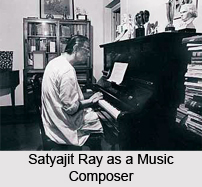 Satyajit Ray was a powerhouse of talent. No other film director, during his time, apart from Akira Kurosawa of course, has such a huge range of talent. Satyajit Ray delved deep into many territories from pure farce to high tragedy and from musical fantasies to detective stories. To describe a man of such stature is not an easy job at all. His greatness is not limited to the Apu Trilogy alone.
  He took special care of the fact that the narrative of the film and the corresponding musical score evolved simultaneously. He would often keep regular notes of musical ideas and thoughts as a when they evolved, and meticulously jotting down music either in Indian or western notation, depending on the musicians he had on board. The composing of music would give him immense satisfaction as he once wrote in an article of his that "... The pleasure of finding out that the music sounds as you had imagined it would, more than compensates for the hard work that goes into it. The final pleasure, of course, is in finding out that it not only sounds right but is also right for the scene for which it was meant".

 Satyajit Ray as a writer, has gifted the readers some of the best and immortal characters in Bengali Literature. He created popular characters for children in Bengali like
  His collection of short stories for adults was published as a collection of 12 stories. He also wrote a story collection named "Golpo 101". Ray`s love and interest for puns and puzzle is reflected in these stories. These short stories give full bridle to his awareness in the macabre, in suspense and other aspects that he cleverly avoided in film, making for an interesting psychological read. Most of his literary piece have been translated into English, and are finding a new group of readers.
 Prodosh Chandra Mitra, or Feluda as he is also known, is a fictional detective in
  While taking up cases, he is indeed very choosy and goes for the ones that are cerebral and requires the use of `Magajastra`. He is a proud owner of .32 Colt Revolver but he doesn`t use this weapon frequently. He also has through knowledge of martial art and he put that skill to use for solving couple of cases. He is good at disguises too.
 Professor Shanku is an imaginary scientist in