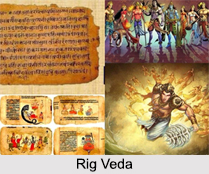
 The Rig Veda is the oldest and most important of all the works of Vedic literature. This is one of the most priceless documents on the life in ancient India. Counted among Hinduism`s four basic sacred texts called the Veda, the Rig Veda possesses 10 Mandalas or chapters, 1028 Suktas or Vedic Sanskrit hymns and 10,600 verses in totality. These are essentially invocations addressed to several Gods who are considered to bear and personify the powers of nature. There are a number of deities mentioned in the Rig Veda, the most important among them being Indra and Varuna.
Age of Rig Veda
There is a huge controversy among scholars concerning the time of composition of Rig Veda. The Rig Veda is much more archaic as compared to other Indo-Aryan texts and it was for this reason that the text attracted the attention of different western scholarship. It documents an early phase of Vedic religion and has firm cultural and linguistic similarities with early Iranian Avesta, deducing from the Proto-Indo-Iranian times, often linked with the early Andronovo culture of CA. 2000 BC. Different scholars place the work in slightly different time frames. Professor Max Muller fixes the composition of the text from 1200 B.C. to 1000 B.C., whereas, Tilak fixes it as 6000 B.C. and Professor Jacobi in 4500 B.C. However, a general belief goes that Rig Veda, the oldest of the four Vedas and the most revered one, was composed about 1500 B.C. in the Punjab (Sapta Sindhu) region and codified about 600 B.C.
Context of Rig Veda
This text is one of the oldest in Sanskrit language as well as in any other Indo-European languages. Rig Veda reflects a polytheism that is mainly concerned with the propitiation of divinities associated with the sky and the atmosphere. Most aspects of Vedic science like the practice of yoga, meditation, mantra and Ayurveda can be found in the Rig Veda and still use many terms that come from it. Thus, when the term Vedic is given to any layer of the Vedic teachings including the Bhagavad Gita, primarily, then it applies to the Rig Veda. The Rig Veda consists of concepts, phenomena and items, and fragmentary references to possible historical events, notably the struggle between the early Vedic people and their enemies.
A number of spiritual leaders gave their sayings and thoughts in the form of hymns and these hymns form a huge collection which is assimilated together in the Rig Veda. The hymns of the Rig Veda are composed in Vedic Sanskrit. Several renowned Yogis and scholars who owned a higher degree of understanding with regard to the deeper aspects of life were the composers of these hymns. A majority of the hymns in the Rig Veda are written in the praise of God. Each of the hymns possesses about ten lines on an average, in Sanskrit language. These hymns of the Rig Veda are regarded as the oldest form of Sanskrit mantras and have been continuously in use from the ancient times.
Gods in Rig Veda
The chief Gods of the Rig Veda are Indra, a heroic God who is praised for having slain his enemies. Other prominent Gods are Mitra, Lord Varuna and Ushas. Also invoked are Savitar, Lord Vishnu, Rudra, Pushan, Brihaspati, Brahmanaspati, as well as deified natural phenomena such as Dyaus Pita (the sky), Prithvi (the earth), Lord Surya (the sun), Vayu (the wind), Apas (the waters), Parjanya (the rain), Vac (the word), the rivers like the Sapta Sindhu, and the Sarasvati River. Groups of deities are the Ashvins, Maruts, Adityas and the Vishvadevas along with other other minor Gods.
 Compositions of Rig Veda
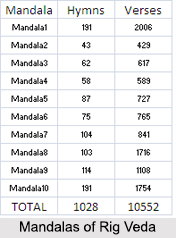
The total Rig Veda is segregated into a series containing 10 books or Mandalas of which the book number 2 and 7 are regarded the oldest and the others more recent. Each book or Mandala consists of hymns, called Sukta, which in turn consist of individual verses.
The Mandala 1 comprises of 191 hymns addressing Lord Agni, the God of fire and the name of this God is the first word of the Rig Veda. The rest of the hymns are chiefly to Indra and Agni, along with Lord Varuna, the Maruts, Rudra, Mitra, the Ashvins, Vishnu, Surya, Usas, Rbhus, Vayu, Brihaspati, to Heaven and Earth, and other Gods.
The Mandala 2 possesses 43 hymns, primarily to Indra and Agni. It is one of the family books, the oldest core of the Rig Veda and is chiefly attributed to the Rishi Grtsamada Saunohotra.
The Mandala 3 consists of 62 hymns, mainly to Agni and Indra and the Vishvedevas. The verse 3.62.10 is the Gayatri Mantra, which is of great importance in Hinduism. A majority of the hymns in this Mandala are attributed to Visvamitra Gathinah.
The Mandala 4 consists of 58 hymns, chiefly to Indra and Agni and the Usas, Brihaspati, Ashvins, Vayu etc. In this book or Mandala a number of hymns are attributed to Vamadeva Gautama.
The Mandala 5 comprises of 87 hymns, mainly to Indra and Agni, the Visvadevas also known as the Gods of the World, the Maruts, the twin-deity Mitra-Varuna and the Asvins. Out of these, there are two hymns which are each dedicated to Ushas (the dawn) and to Savitar. A majority of the hymns in this Mandala are imputed to the Atri clan.
The Mandala 6 comprises of 75 hymns, mainly to Indra and Agni and all other Gods, Ashvin, Pusan, Usas, etc. Nearly all the hymns in this Mandala of Rig Veda are ascribed to the Barhaspatya family of Angirasas.
The Mandala 7 or book possesses 104 hymns, and are primarily dedicated to Indra, Agni, the Visvadevas, Mitra-Varuna, the Maruts, the Asvins, Ushas, Varuna, Indra-Varuna, Vayu (the wind), and two other hymns each to Saraswati, ancient Goddess of Learning and Lord Vishnu, and to others. In this Mandala, a majority of the hymns are ascribed to Vasistha Maitravarun.
The Mandala 8 or book of Rig Veda consists of 103 hymns dedicated to different Gods. The Hymns 8.49 to 8.59 are apocryphal Valakhilya and the hymns 1-48 and 60-66 are ascribed to the Kanva clan, while the remaining ones are attributed to other (Angirasa) poets.
The Mandala 9 comprises of 114 hymns, entirely devoted to Soma Pavamana, the plant of the cleansing of the sacred potion of the Vedic religion.
The Mandala 10 contains 109 hymns dedicated to Agni and other Gods. It contains the Nadistuti Sukta which is in praise of rivers and is important for the reconstruction of the geography of the Vedic civilisation and the Purusha Sukta which has significance in Hindu tradition. It also possesses the Nasadiya Sukta (10.129) which deals with creation.
Phonetics in Rig Veda
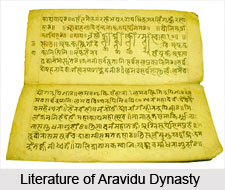
Rig Veda is built around a science of sound, which comprehends the meaning and power of each letter. All the other Vedas are based upon it and consists of a large degree of various hymns from it. Each and every letter in the hymns of the Rig Veda is pronounced in such a way that the exact meaning and power of the letter in it is clear and distinct from others. In Rig Veda the hymns are penned basing on the science of sound in order to make the pronunciation of each letter sound more powerful. It was preserved in India over centuries by oral tradition alone and was probably put in writing after the early Middle Ages. While originally several different versions of the Rig Veda were said to exist, only one remains. Its form has been structured in several different ways to guarantee its authenticity and proper preservation through time.
Thus, the Rig Veda is a storehouse of information on the lifestyle, religious, social and cultural practices of the people of the Vedic age. The suitable aspects of living a happy and healthy life by practicing meditation, yoga, etc. are mentioned in a detailed manner in the Rig Veda. In contemporary Hinduism, Rig Veda has been a reminder of the ancient cultural heritage and point of pride for Hindus, with some hymns are still in use in major rites of passage ceremonies, but the literal acceptance of most of the textual essence is long gone.