Introduction
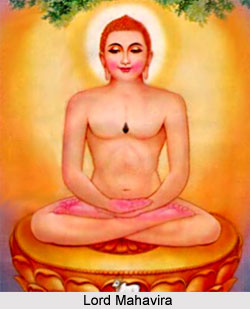
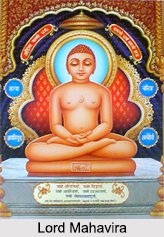 Lord Mahavira, also known as "Vardhamana", was the 24th and last Tirthankara of Jain religion. He was born in Kundagrama, i.e., Basukund of today in 599 B.C. He was a powerful thinker who had taken a keen interest in all the problems of his times and he knew answers to the questions with which he had become familiar. At the age of 30, he left his family and royal household, gave up his worldly possessions, including clothing and become a monk.
Life of Mahavira
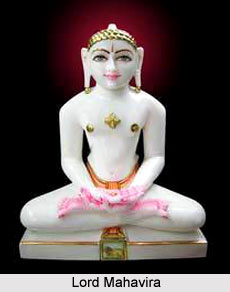 Lord Mahavira was the last Jain Tirthankara and was known as Vardhamana. He has established the tenets of Jainism. He belonged to the Jnatrikas, a Kshatriya clan of Kundapura near Vaishali, north of Patna. He realized the transitory nature of the world after undergoing all the education and training for princes of the time and became an ascetic at the age of thirty.
 Many Jain scriptures relate about the incidents about the birth of Lord Mahavira. It is believed that Mahavira was first going to be born to the Brahmin mother Devananda. However the king of Gods, Lord Indra intervened, hence there embryonic transfer took place. Thus Mahavira was born to a Kshatriya mother, Trisala. This was done because it is said that Tirthankaras should never be born in poor Brahmin families.
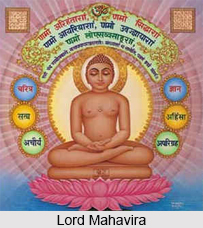 Lord Mahavira was the twenty-fourth and last Tirthankara of Jain religion. Mahavir was born in 599 B.C. as a prince in Bihar. Though Mahavira was born with all worldly comforts and luxuries, they never attracted him. He lived a simple life detached from all materialistic desires. When his parents died, he decided to be a monk.
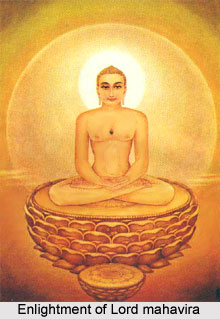
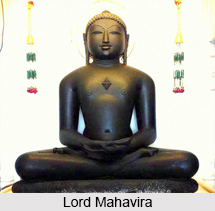 Lord Mahavira attained nirvana at the age of seventy one years and six and a half months. According to a Swetambara legend Mahavira took his seat on a diamond throne in the centre of a magnificent hall on the seventh day of his stay. The seat was specially built for him on the borders of a lake. There were many devotees who came to hear him. According to their rank they arranged themselves into twelve grades. The devotees belonged to different sect, class and order. They ranged from king to beggar. On the dark night of the seventh day of his stay the hall was illumined by the supernatural glow of the Gods who came to listen to him. That day the Lord preached the whole night. He was aware by his sukladhyayana that his end was drawing near. He thus sat with his hands clasped knees crossed. At dawn he attained nirvana on the day of Kartika Krishna. Mahavira is said to have delivered the fifty-five lectures explaining the results of Karma and also recited the thirty six unasked questions at the night of his nirvana.
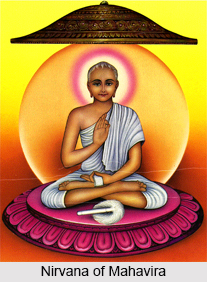 According to the Kalpasutra, the eighteen confederate kings of Kashi and Kosala and eighteen kings belonging to the Malla and Lichchavi clan gathered on the of Mahavira`s death. It is also written that these kings had observed fast and illuminated the place on the day of the new moon thinking that as the light of intelligence has gone, let there be illumination of material matters. As Mahavira attained nirvana early in the morning, the Jains worship him at that time and illuminate the earthen pots. On the night of his salvation, people celebrated the Festival of Lights, Diwali in his honor.
Teachings of Lord Mahavira
The teachings of Lord Mahavira elevate the quality of life. The living and the non-living coming into contact with each other, forge certain energies which bring about birth, death and various experiences of life that could be stopped and by a course of discipline lead to salvation. Action should be destroyed. One living in a household can do so gradually if he first avoids evil Karmas and gradually ceases from Karma. The person should observe the five rules or vows of morality, namely, ahimsa, satya, asteya, brahmacharya and aparigraha to be equipped for such a task. The whole course of conduct is finally divided into stages to achieve ultimate salvation.
Messages of Mahavira
Mahavira carried on with this ascetic life style which included fasting and deep meditation. Mahavira strengthened his knowledge and spread his message among the people. He spoke in the Audramagadhi language. Some people were inspired by his teachings to give up all possessions and become monks and nuns. Others followed Mahavira`s teachings without giving up their homes and families and work.
Mahavira`s message contains the basis of right knowledge that teaches us that each one of us is what we have made ourselves by our actions in this life and in previous lives. Every individual is a pure spirit or soul which is capable of complete knowledge and freedom. Mahavira teaches us how to start freeing ourselves from the restrictions and miseries of karma. These vows cannot be implemented completely without accepting the philosophy of non-absolutism and the theory of relativity. Monks and nuns strictly follow these while the laypeople observe them as much as possible.
Teachings of Mahavira
Mahavira has conducted six important teachings which are followed widely by the people following Jainism. The teachings promote no causing harm to anyone and how a person can connect to themselves in order to attain their self enlightenment. The six important teachings of Mahavira are discussed below:
Belief in Soul and Karma: As per Mahavira each and every element in the Universe is an amalgamation of the spiritual and material factors. The material factors are though perishable, the spiritual factor remains eternal and it keeps on evolving consistently. The soul is held in a bondage state because of karma. The soul will get released from every bondage when a person gets rid of passions. The soul attains final stage of liberation only by the disintegration of Karmic force. He preached that decay of the karma can highlight the intrinsic value of soul. When the soul matures enough, it becomes a pure soul or the Paramatma with infinite power and wisdom.
Nirvana: The main purpose of life is to attain Salvation. Mahavira had insisted on avoiding evil karmas, destroy the existing ones and prevent all sorts of fresh karmas. This can be achieved by Ahimsa (non- injury), Satya (speaking truth), Asteya (non- stealing), Aparigraha (non- possession) and Brahmacharya (non-adultery) In addition to these vows, he also insists on the principles of right faith, right knowledge and right conduct.
Non-Belief in God: Mahavira had no belief in God. He did not even believed that he created or exercised the world with personal control. As per his preaching, the world never comes to an end. It simply changes its form. The Universe is also composed of maters which changes its forms. He further believed emancipation of a person do not depend on any sort of outside authority. A person is a maker of their own destiny. People can get rid of their sorrows and miseries by leading a life of self-mortification and austerity.
Rejection of Vedas: The theory of Vedas is rejected by Jainism. They attach no importance towards sacrificial rituals of the Brahmans.
Ahimsa: Mahavira has laid too much of importance on the concept of Ahimsa. As per him, every creature, plants, animals, rock, stones etc possess life. A person should cause no harm to any of them in speech, action or deed.
Freedom to women: Mahavira favors the freedom of women and preach that they also have right to attain Nirvana. Women are allowed to be Sravikas and Sarmini in Jainism.
Mahavira was a reformer and propagator of an existing religion as his teachings were based on that of his predecessors. He followed the creed of his predecessor Tirthankara Parshvanatha. He did reorganize the philosophical tenets of Jainism to suit his age.
Iconography of Lord Mahavira
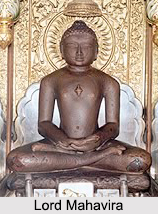 Iconography of Lord Mahavira located in Khajuraho Temples is well carved and look appealing. The temple houses the image of seated Mahavira. There are also images of Lord Mahavira with and without the images of Yakshas and Yakshinis. Apart from this there are images of lion, the vehicle of the Lord carved in the temple. The details of the images have been described below:
Seated Image of Mahavira
The image of Lord Mahavira is seated on an ornate cushion. Here the left knee of the Lord and the pilasters that support the pedestal are damaged. A small figure of lion is carved beautifully beneath the dharmacakra. It is the flanked by two worshippers with folded hands. On the right side of the pedestal an image of a two armed yaksha, Sarvanubhuti has been carved holding a purse in his left arm. On the left side a two armed yaksi, Siddhayika bearing a lotus in the left arm can be seen. With her right hand she shows the abhaya mudra. The images of the Yaksha Yakshi are surmounted by a female figure. She is seen holding a lotus in the inner hand while the outer hand rests on the thigh.
The hair of Lord Mahavira is dressed in schematic curls with a small knot. The halo behind the head comprises blossom circlet, rosette and lozenge shaped decoration arranged alternately and beaded band. Depending upon the style and architecture of the iconography the image may be dated to the 12th century A. D.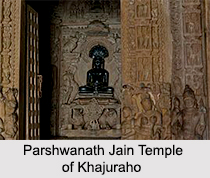
Mahavira Images without the Yaksa Yaksi Figures
There are three images of Lord Mahavira at Khajuraho that have been carved without the image of Yaksa Yaksi Figures. Two of these images have been carved in the left hand modern wall of the Santinatha Temple. This is the temple No.1. The image of Mahavira is seen sitting on a double petalled lotus placed on an ornate cushion. The image of a dharmachakra has been carved in the centre of the pedestal. A lion`s head is also visible that is regarded as the vehicle of the Jina. On either side above the flywhisk bearers a seated Jina can be seen. Another Jina is also visible below the first one.
The third image of Lord Mahavira is seen standing on a lotus pedestal in the kayotsarga mudra. The image is enshrined in the Modern Temple No. 31. An image of a lion, the Vahana of the Jina is also visible here. Apart from the head the forelegs cab also be seen. At the left top corner an image of a Jina is also carved. Two female figures have been carved on the left side one above the other.
The three images of Lord Mahavira at Khajuraho have been magnificently carved and look very appealing. However, the covering cloth, an important feature of the Jina images at Khajuraho is missing here. On the basis of style and iconography, these images are thought to belong to the 11th century A. D.
Mahavira Images with Yaksa Yaksi Figures
There are in total six images of Lord Mahavira in Khajuraho. The figures of Yaksa Yaksi look very appealing. The first image of the Lord can be seen on the southern facade of the garbhagriha of the Parshvanatha Temple. It is the oldest images at Khajuraho. The second image has been well preserved in the Open Air Museum. The third image has been installed in the Modern Temple No.2. The fourth image is sheltered in a niche of the exterior back wall of the Modern Temple No.21 while the fifth one is installed in the Open Air Museum. The sixth and the final image can be seen in the Open Air Museum. The Yakshas and Yakshis here are either two armed or four armed. They are usually seen in lalitasana pose in abhaya mudra.
Influence of Lord Mahavira in Gosala’s Life
 Lord Mahavira became an ascetic at the age of thirty. Before he became an ascetic an important event took place in his life. His meeting with Gosala Mankhaliputta, the head of the Ajivika sect was a very influential event in his life. The fifth Anga of the Jainas, known as the Bhagavati Sutra, has provided a detailed account of the life of Gosala. Many other ascetics of Ajivikism existed before Mankhaliputra Gosala and he considered himself to be the twenty-fourth Tirthankara of the current Avasarpini age. According to Tamil sources he was named as Markali. In Buddhist Sanskrit literature he is known as Maskarin Gosalal, Gosalikaputra, Gosaliputta and Moghapurusa.
Mankhali was the father of Gosala who was a poor, wandering poet, who managed to meet both ends by singing heroic songs or ballads. He also exhibited pictures related to his songs. The saint was named as Gosala as he was born in a cowshed of a rich Brahmin, Gobahula. His parents had taken shelter there as they could not find any other place for refuge during a certain rainy season.
He was born at Saravana near Sravasti and brought up in Kosala. His headquarters was situated in the Kosalan capital (Sravasti), where he was basically respected. According to Bhagavati Sutra, before Gosala met Lord Mahavira he remained engaged in the profession of a mankha, with a picture board in his hand. It is thus eminent that from the very beginning of his career he had developed an aversion towards worldly life.
During the second year of the ascetic life of Gosala met Mahavira in Nalanda were he was wandering. He took shelter in the same shed where Mahavira was staying. Gosala was aware of Mahavira`s glory and his extraordinary life style. He was very impressed by his way of life and expressed his desire to become his disciple. He was however refused by Mahavira. Later Gosala again prayed to Mahavira for taking him as his disciple but he was refused once more. Mahavira continued his wanderings and went to Kollaga, near Nalanda. Gosala went behind him but being refused was very disappointed. He then returned back to his shed and began leading an ascetic life. He gave up his clothes, vessels and also shaved off his hair and beards. He later met Mahavira at Paniyabhumi where he again prayed for his admission into his new and inspiring sect. This time his prayers made the desired effect and Mahavira accepted him. They together lived together for six years in Paniyabhumi practising asceticism. According to Bhagavati Sutra Mahavira and Gosala left Siddhattagrama for Kurmaragrama during the season of Sarada.
Doctrines of Gosala
The doctrines of Gosala were based on a main principle of Niyativada. He strongly believed that Niyati was the ultimate thing that controlled every action and phenomenon. There is actually no room for man`s free will and control. All beings (satva), life, (prana), substance (bhuta) and existence (jiva) are caused by fate. Thus according to this principle there is no room for any human effort and will power. This theory is ineffectual and was in contrast to the theories of Mahavira. Goshala`s theory of reanimation and other doctrines also did not match with Mahavira who believed in the freedom of the will. Gosala, then, served his association with Mahavira and declared himself as a Jina at Sravasti. Mahavira on the other hand had to wait for another six years for attaining the stage of perfection.
Gosala became teacher at least two years before Mahavira. However, the Bhagavati and Kalpa Sutras differ in their viewpoints of Gosala`s life. According to the former Mahavira spent six years in Paniyabhumi with Gosala, the latter gives him only one year for that place, but six years for Mithila. However, it can be concluded that in the second year of his monkhood, Mahavira parted with Gosala because of differences of opinions. Mahavira later established a new school of his own and organised a religious order almost based upon Parshvanatha`s model.
The Jain Swetambara literature believes that Mahavira was the `guru` of Gosala. Even the Jain scriptures also state that Gosala`s system was taken from the eight mahanimittas, a portion of the Purvas. These Purvas were believed to be the original sacred texts taught by Mahavira. While dying Gosala also accepted that he was the disciple of the Lord Mahavira.