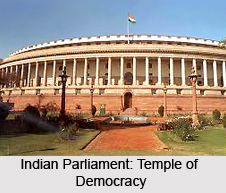
 Lok Sabha formed one of the cores of the Indian Parliament. Indian Parliament is divided into two houses namely the Lok Sabha and the Rajya Sabha. After gaining independence in 1947 it was decided to have a democratic status for future India where people could express their views through their representatives. This house is also regarded as the voice of India, as it is constituted by the representatives of the people who represent the demands of the people; the latest issues as well as the queries of the common man.
Till 2009 there have been 15 Lok Sabha elections. In the year 2014, the members of the 16th Lok Sabha were elected after the Indian General Elections. The elections were conducted in nine phases from 7 April 2014 to 12 May 2014. Bharatiya Janata Party (BJP), one of the major alliances of NDA or National Democratic Alliance, achieved a simple majority with 282 seats out 543. Narendra Modi, now the current Prime Minister of India took office on 26th of May 2014.
Composition of Lok Sabha
Constitution of India has limited the composition of Lok Sabha up to a maximum of 552 members including not more than 20 members representing the people of Union Territories and only 2 members from the Anglo-Indian community if the president finds it less represented. As of now the total size of the Lok Sabha comprises of 545 members including the Speaker as well as two more members, if any.
 Tenure of Lok Sabha
The regular tenure of Lok Sabha is for five years if not disturbed due to some emergencies as in case of Proclamation of Emergency when the tenure will be extended for one year. However, while a declaration of Emergency is in operation, this period may be extended by Parliament by law for a period not more than one year at a time and not extending, in any case, beyond a period of six months after the declaration has ceased to function.
Membership of Lok Sabha
A member of Lok Sabha is required to be a citizen of India, completing an age of 25 years, should be mentally sound, should not be a bankrupt and should not have any criminal record in his past records. Further the seats of reserved categories should be filled by the members of their own community.
The total elective membership is distributed among the States in such a way that the ratio between the number of seats allotted to each State and the population of the State is, so far as practicable, the same for all States. The number is divided among the 28 States and the 7 Union Territories. Anglo-Indians (if nominated 2 by the President under Article 331 of the Constitution).
Sessions of Lok Sabha
Lok Sabha divides its work into three sessions all through the year.
•Budget Session: February to May
•Monsoon Session: July to September
• Winter Session: November to December
Presiding Officer in Lok Sabha
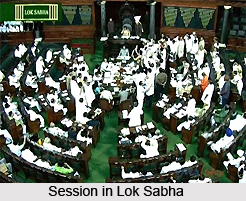
Lok Sabha elects one of its own members as its Presiding Officer and he is called the Speaker. The Deputy Speaker who is also elected by Lok Sabha assists the speaker. The behaviour of dealing in Lok Sabha is the responsibility of the Speaker.
Powers of Lok Sabha
Lok Sabha possesses some special powers which make it more powerful than Rajya Sabha. These powers include Motion of No Confidence against the existing government which can only be passed in the Lok Sabha; passing of Money Bill which is again introduced by Lok Sabha and can be deliberated to Rajya Sabha for fourteen days .If it is not rejected by Rajya Sabha or the period lapse after 14 days from the day of introduction without any action or recommendations made by the Rajya Sabha is not accepted by Lok Sabha, then it is considered passed. Also the Budget of the year is presented by the Finance Minister in the House of Commons. In case of other bills non-financial (ordinary) bills, after the bill has been passed by the House where it was originally tabled (Lok Sabha or Rajya Sabha), it is sent to the other house, where it may be kept for a maximum period of 6 months. If the other House rejects the bill or a period of 6 months elapses without any action by that House, or the House that originally tabled the bill does not accept the recommendations made by the members of the other house, it results in a deadlock.
Among the other powers, the Lok Sabha possesses certain equal powers with Rajya Sabha. This includes initiating and passing of any bill on Constitutional Amendments; equal powers in passing a motion on the impeachment of the President by two-third membership of the membership of the house. Equal powers in initiating and passing of impeachment against the judges of Supreme Court and state high courts by a majority of the membership of the House and at least two-thirds majority of the members present and voting); equal powers in initiating and passing a resolution for declaring war or national emergency or constitutional emergency in a state. In case the Lok Sabha is dissolved before the declaration of Emergency Rajya Sabha becomes the sole de facto and de jure parliament which cannot be dissolved.
After the General Election of India held in the year 2014, conducted by the Election Commission of India (16th Lok Sabha), the number of seats arranged is as follows:
| Alliance | Political Party | Seats |
| National Democratic Alliance(NDA) - 336 seats | Bharatiya Janata Party | 282 |
| All India N.R. Congress | 1 | |
| Lok Jan Shakti Party | 6 | |
| Naga Peoples Front | 1 | |
| National Peoples Party | 1 | |
| Pattali Makkal Katchi | 1 | |
| Shiromani Akali Dal | 4 | |
| Shiv Sena | 18 | |
| Telugu Desam | 16 | |
| Apna Dal | 2 | |
| Rashtriya Lok Samta Party | 3 | |
| Swabhimani Paksha | 1 | |
| United Progressive Alliance (UPA) - 59 seats | Indian National Congress | 44 |
| Nationalist Congress Party | 6 | |
| Indian Union Muslim League | 2 | |
| Jharkhand Mukti Morcha | 2 | |
| Kerala Congress (M) | 1 | |
| Rashtriya Janata Dal | 4 | |
| Regional Parties in India | Indian National Lok Dal | 2 |
| Jammu & Kashmir Peoples Democratic Party | 3 | |
| Sikkim Democratic Front | 1 | |
| Aam Aadmi Party | 4 | |
| All India United Democratic Front | 3 | |
| Telangana Rashtra Samithi | 11 | |
| All India Majlis-E-Ittehadul Muslimeen | 1 | |
| Yuvajana Sramika Rythu Congress Party | 9 | |
| All India Anna Dravida Munnetra Kazhagam | 37 | |
| All India Trinamool Congress | 34 | |
| Biju Janata Dal | 20 | |
| Janata Dal (Secular) | 2 | |
| Janata Dal (United) | 2 | |
| Samajwadi Party | 5 | |
| Communist Parties in India | Communist Party of India | 1 |
| Communist Party of India (Marxist) | 9 | |
| Revolutionary Socialist Party | 1 | |
| Independent Political Parties | Independent Party | |
| Nominated Seats | 2 | |
| Total no of seats | 545 |
Thus with the Lok Sabha, the Indian Parliament has been one of the most representative which has truly represented itself as the government of the people, by the people ,for the people. Being the main machinery of Indian administration, Lok Sabha has created a new example giving meaning democracy in a large country with diverse language, clan creed, and class like India.