


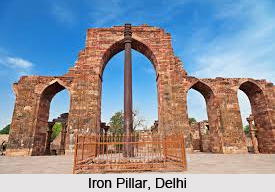
 The Iron Pillar, situated in the inner court of the Quwwat-ul-Islam Mosque, axial with the central arch of the screen, is significant as evidence that people in this region were able to weld malleable iron on so ambitious a scale as early as 4th century AD. The Iron Pillar, situated in the inner court of the Quwwat-ul-Islam Mosque, axial with the central arch of the screen, is significant as evidence that people in this region were able to weld malleable iron on so ambitious a scale as early as 4th century AD.
Origin of the Iron Pillar The pillar appears to have been erected originally as a standard to support an image of Garuda, the vehicle of Lord Vishnu, in front of a temple dedicated to the god. A deep hole on the top of the pillar indicates that an additional member, in all probability, an image of Garuda, was fitted into it to answer to its description as a standard of Vishnu. The fluted bell capital with its amalaka members is a characteristic feature of the Gupta architecture of northern India, and affords further evidence to the period of its erection. This evidence is substantiated by a Sanskrit inscription in Gupta characters of the fourth century AD engraved on the pillar. The inscription records its erection by a mighty king named Chandra, a devotee of the Lord Vishnu, as a 'lofty standard' (dhwaja stambha) of that divinity on 'the Hill of Vishnupada'. This king has now been identified as Chandragupta II (AD 375-413) of the imperial Gupta dynasty. Structure of the Iron Pillar The Iron Pillar is a remarkable archaeological artifact. The base of the pillar is not smooth, with small pieces of iron tying it to its foundations, and lead sheet covers the portion concealed below the present floor level. The total length of the pillar is 7.2 metres, of which 93 cm is buried underground. The metal of the pillar has been found to be almost pure malleable iron, which shows not even the slightest signs of rusting, and that too below the ground. The manufacture of such a massive iron pillar, which has not deteriorated much in the 1600 years of its existence, is standing testimony to the metallurgical skill of ancient Indians. Its distinct bell-shaped capital measures 306 millimeters in diameter. The monumental structure weighs over 6 tonnes. Of particular interest to archaeologists and materials scientists is the Iron Pillar's exceptional resistance to corrosion. This unique attribute has earned it recognition as a symbol of the advanced skills possessed by ancient Indian iron smiths in the extraction and processing of iron. The corrosion resistance is attributed to the formation of an even layer of crystalline iron hydrogen phosphate hydrate on the high-phosphorus-content iron surface. This protective layer effectively shields the pillar from the adverse effects of the Delhi climate, underscoring the remarkable engineering achievements of its time. Inscriptions on the Iron Pillar The Iron Pillar bears a collection of inscriptions from various periods. It is noteworthy that despite its visibility, some of these inscriptions have not undergone systematic study. The oldest inscription found on the pillar is attributed to King Chandra, who is generally identified as the Gupta emperor Chandragupta II. This inscription occupies an area measuring 2 feet 9.5 inches in length and 10.5 inches in width. Remarkably, the ancient script remains well-preserved due to the corrosion-resistant nature of the iron surface on which it is engraved. However, it is worth noting that during the engraving process, iron appears to have closed up over some of the strokes, resulting in imperfections in some letters. The inscription is composed in the Sanskrit language, employing the shardulvikridita meter. It is inscribed in the eastern variety of the Gupta script, with characters varying in size from 0.3125 inches to 0.5 inches. These characters closely resemble those found in the Allahabad Pillar inscription of Samudragupta. Nevertheless, distinctive mantras, akin to those in the Bilsad inscription of Kumaragupta I, are observed. Notably, while the characters in the Allahabad inscription feature more curved edges, those in the Delhi inscription exhibit more straight edges, a consequence of the different materials on which they were inscribed. The Allahabad inscription is on softer sandstone, while the Delhi inscription is engraved on the harder medium of iron. Furthermore, the text in the Delhi inscription deviates from the standard Sanskrit spelling in some intriguing ways. Additionally, one of the inscriptions on the pillar pertains to the Samvat 1109 era and is associated with the Tomara king Anangpal. It is postulated that Anangpal oversaw the pillar's relocation to its current location as part of the establishment of the city of Delhi. However, this theory has been the subject of scholarly debate, with differing viewpoints among experts on its historical accuracy. Original location of the Iron Pillar The Iron Pillar has a debated original location. As per popular beliefs, it was initially installed as a trophy during the construction of the Quwwat-ul-Islam mosque and the Qutb complex in the 13th century under the reign of Sultan Iltutmish. The precise origin of the pillar, whether it was originally sited on the current location or elsewhere, remains a subject of scholarly discourse. An inscription attributed to King Chandra indicates that the pillar was originally erected at Vishnupadagiri, often identified with Mathura due to its proximity to Delhi and Mathura's reputation as a significant Vaishnavite pilgrimage center. However, archaeological findings reveal that during the Gupta period, Mathura primarily thrived as a center for Buddhism, although traces of Vaishnavism may have existed. Notably, Mathura, situated in the plains, lacks true hills or elevated terrain associated with the term "giri." In light of paleographic similarities to dated inscriptions from Udayagiri, Gupta-era iconography, metallurgical analysis, and other pertinent evidence, scholars have postulated that the Iron Pillar was originally situated at Udayagiri. According to this theory, the pillar, adorned with a wheel or discus at its apex, once graced the Udayagiri Caves. This hypothesis is grounded in the inscription's reference to Vishnupada-giri, signifying the "hill with the footprint of Vi??u." A critical argument in favor of situating the iron pillar at Udayagiri is its close historical association with Chandragupta and the worship of Vishnu during the Gupta era. Furthermore, there are well-documented traditions of iron mining and craftsmanship in central India, exemplified by the iron pillar at Dhar and local toponyms like Lohapura and Lohangi Pir. It is known that the Delhi ruler Iltutmish launched an attack on Vidisha in the 13th century, providing a plausible opportunity for him to transport the pillar to Delhi as a trophy, akin to the Tughluq rulers' relocation of Asokan pillars to Delhi in the 14th century. Relocation of the Iron Pillar The relocation of the Iron Pillar from its original location to Delhi remains a matter of uncertainty, with several theories proposed by scholars to account for this historical event. One theory posits that the Tomara king Anangpal was responsible for the pillar's relocation. This supposition is grounded in a brief inscription on the pillar attributed to King Anangpal. Notably, the Pasanaha Chariu, an Apabhramsha text authored by Vibudh Shridhar in 1132 CE, alludes to a pillar of significant weight that caused the "Lord of the Snakes to tremble." This reference, when linked to the Iron Pillar, lends credence to the notion that the pillar was already situated in Delhi during Anangpal's reign. Conversely, another theory suggests that the pillar's relocation occurred during the period of Muslim rule in Delhi, possibly around 1200 CE, when Qutb al-Din Aibak initiated the construction of the Qutb complex under the patronage of Muhammad of Ghor. According to this viewpoint, it was during this era that the pillar found its way to Delhi. An alternative theory posits that it was Qutb al-Din Aibak's successor, Iltutmish, who oversaw the pillar's transportation to Delhi. This theory posits that the Iron Pillar was originally erected in Vidisha, and it was during Iltutmish's campaign when he attacked and sacked Vidisha in the 13th century that the pillar was removed and relocated to the Qutb complex. Cannonball strike on the Iron Pillar A conspicuous indentation, located approximately 4 meters above the present courtyard ground level, bears proof of a cannonball strike that left an enduring mark on the middle section of the Iron Pillar. The force of this impact resulted in horizontal fissures within the column's structure, particularly in the region diametrically opposite to the point of impact. Remarkably, despite the cannonball strike, the pillar itself remained unscathed. Notably, while historical records, inscriptions, or contemporary documents detailing this event are conspicuously absent, historians concur that the most plausible scenario entails Nadir Shah ordering the destruction of the pillar during his invasion of Delhi in 1739. It is believed that he viewed the presence of a Hindu temple monument within an Islamic mosque complex as undesirable. Alternatively, his intentions might have included dislodging the decorative upper portion of the pillar in search of concealed precious stones or other valuable items. Curiously, there exists no additional evidence of cannon fire-inflicted damage on the pillar, suggesting that no subsequent shots were fired at this remarkable structure. It is conceivable that fragments from the cannonball, possibly ricocheting, may have inflicted damage upon the nearby Quwwat-ul-Islam mosque during the same tumultuous period. This collateral damage, it is posited, might have prompted an abandonment of further assaults on the Iron Pillar. |
| |||



Home > Art & Culture > Indian Monuments > Indian Regional Monuments > Monuments of Delhi > Qutub Minar > Iron Pillar
Iron Pillar
| The Iron Pillar of Delhi, dating back to the 4th century CE, stands as a marvel of ancient Indian metallurgy. Located within the courtyard of Quwwat-ul-Islam Mosque, it is renowned for its impressive rust-free iron composition |
| ||||||||||||||||||||||||||||

