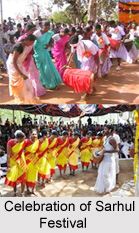
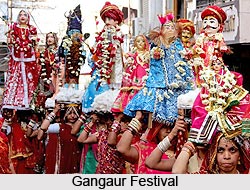
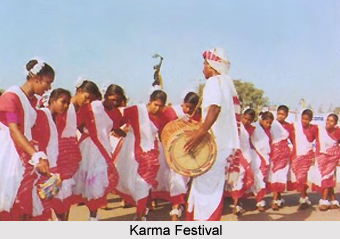
Indian customs and rituals enrich the nation with culture and customs which have been followed over centuries and continue to form and integral part of Indian tradition. Different religions and faiths, which are a part and parcel of various communities of India, make the rituals very unique and interesting. Every belief system is identified by its own practised set of rites and rituals thus making up a galaxy of rituals. Such rituals are practised by innumerable residents of India with deep respect and devotion. Starting from birth and continuing till death, Indians follow a wide range of customs and rituals which are revered.
 Hindu Customs and Rituals
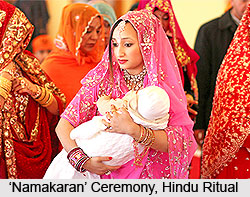
Hinduism comprises innumerable social and religious rituals and customs. They celebrate religious festivals by the standard ritual of inviting `Brahmin` priests to their houses who officially conducts the `puja` or process by which Hindu deities are worshipped. `Yajnas` are performed by the holy priests to invoke the divine blessings of Hindu gods and goddesses. A detailed series of life-cycle rituals mark the major transitions in the life of the individual. Soon after the birth of a child, the `Namkaran` ceremony is held, which is marked by the chanting of Sanskrit `Shlokas` and singing of hymns. Hindu customs assert the significance of the `Upanayana` or thread ceremony amongst Brahmins, to demarcate their distinction from the other castes or creeds of the Hindu society. The next important transition in life is marriage. For most Indians, the exact date and time of the wedding are matters decided by the parents in consultation with astrologers. Cremation is also on part of the Indian Hindu customary ceremonies. Intricate procedures are carried out to perform the `shraddhha` or funeral rites of deceased family members.
Muslim Customs and Rituals
Muslims follow multiple rituals related to birth, marriage, religious practises which involves worshipping `Allah` and funeral customs and rituals. Muslim ceremonies regarding birth are specific, and whatever is practiced usually varies with the customs and habits of different regions. However, traditionally some practices are generally followed by all. After the birth of the child, he or she is smeared with the juice of palm dates on the upper jaw. It is believed that the very first words that a new born should hear are the words of God. Accordingly, the `Azaan` is whispered into the child`s right ear whereas the `Iqamat` is spoken into the child`s left ear. `Nikaah` is the marriage ceremony followed religiously by the Muslims. It is quite brief and is confined to just two sentences. The boy has to say that he proposes to get married to a particular girl and the girl must accept this proposal three times. This event must be witnessed by at least two witnesses. A contract, known as the `Nikahnama`, is drawn up which is to be signed by the concerned people.
When a Muslim man or woman dies, people are to recite the phrase `lilaha va inna illaha raziun` meaning "We have come from God and unto him we shall return". Loud wailing and show of sadness is prohibited by Muslim law. The body is wrapped from head to toe in a white cloth called the `Kafan` and it is then taken to the burial ground, carried on the shoulders of four people. This procession is called the `Janasa`. A prayer called `dua` is recited en-route. A prayer is said by all members of the congregation following which the body is buried. After the body is lowered into the ground, the head is tilted to face the `Kaba`. Perfumed water is sprinkled on the grave and it is neatly sealed with stones, bamboo sticks or wooden boards. Handfuls of sand are thrown by the mourners over the grave and then finally it is sealed following which the prayer called `Fatiha` is said for the deceased.
The other important customs of Muslims are fasting during the holy month of `Ramadaan`, going on a religious pilgrimage which is termed as `Hajj` which means travelling to the holy city of Mecca, which is now located in Saudi Arabia and animal sacrifice should be also be performed, mentioning the name of God while doing so.
Christian Customs and Rituals
In Christianity, following the birth of a child, the child is taken to the church for the baptism ceremony. It is the most important Christian sacrament as the child is admitted into the church as a Christian only after baptism. It is done before the first birthday of the child and the child is presented with white clothes, cap and shoes.
Next is the marriage ritual of Christianity. Weddings are conducted by the priest, inside a church. The father of the bride gives her hand to the groom. Prayers are said by the priest and he blesses them and prays for a happy life for them. The girl and boy exchange rings as a symbol of their ties to each other. They are then asked if they agree to accept each other as man and wife and following this they are pronounced man and wife. The priest delivers a small sermon and a feast is given for the invitees. Small girls with flower baskets accompany the couple, to sprinkle flowers over the couple. Most of the marriage customs are influenced by local customs and practices of the different regions.
On the event of a Christian`s death, the body is laid out on a cot and a cross is placed nearby. Candles and incense sticks are lit all around. When all people have gathered prayers are held by the priest. The body is then bathed and placed in a coffin. It is kept open for the people to pay their last respects. The arms are kept folded across the chest. The priest reads verses from the Bible and gives a small lecture on the life and deeds of the deceased. The coffin is then carried to the crematorium by four people or even more on their shoulders. A small prayer is offered and the body is lowered into the pit. People throw sand on the coffin and pit is then closed. Relatives visit the coffin on the 3rd or 5th day to offer garlands and milk at the spot. Some prayers are also said.
 Sikh Customs and Rituals
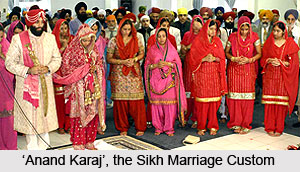
There are numerable customs and rituals of Sikhs when it comes to birth, marriage and death. Nothing much is fixed in regards to birth. Some sections of the Sikhs recite the five verses of the Morning Prayer, `Japji Sahib` into the ears of the newborn child. Sometimes, in the `Gurthi` ceremony, an intelligent and well-respected member of the family gives the newborn child a drop of honey so as to pass on his or her characteristics to the child. The ritual of the `Sushak` involves the giving of gifts by the maternal grandparents to the child`s family. These gifts usually include clothes, a spoon, glass and a bowl, money and gold ornaments for the child.
A Sikh wedding, called `Anand Karaj`, is quite similar to the Hindu wedding except that the Guru Granth Sahib is read instead of the Vedas. A number of traditional rituals are followed such as the `Nanke Chak` where bride`s maternal grandparents and uncle spend a lavish amount on the wedding and also host a meal, the `Surma Pawai` when the groom`s sister-in-law applies kohl to his eyes before he leaves for the bride`s house. The actual marriage ceremony comprises `Baraat`, `Milni`, `Lawaan`, and the `Doli` when the bride and the groom depart for the latter`s home.
The `Kirtan Solah` is read after the death of a person. People gather around the body and say the prayers and the body is then dressed and bathed with the five K`s of the Sikhs. The Sikhs cremate their dead and this has to be done before sunset. Following the cremation, the people gather at the Gurudwara where some texts from the Granth Sahib are read and `Prasad` is distributed.
 Zoroastrian Customs and Rituals
On the event of the birth of a child in a Zoroastrian family, a lamp is lit and is kept in the child`s room for forty days to keep away evil forces. Following the birth of a child in a Zoroastrian family, mother and child are not to leave the house for 40 days. `Pachori` or `Dasori` may be observed on the fifth or tenth day respectively. On the fortieth day the mother has to take a ceremonial bath with consecrated water. `Para Haoma` is the event when the first drink is given to the newborn child, which is basically consecrated Haoma juice. The formal initiation of a child into Zoroastrianism is called `Navjote` where a number of ceremonies are performed such as `Achoo Michoo`, wearing of the `Kushti` etc. Lastly the `Doa Tandorosoti Prayer` is recited by the priest for the well being of the child, the parents as well as the community.
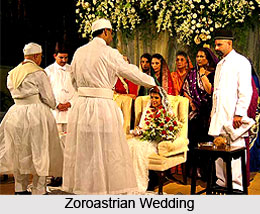
In marriage ceremonies, the groom goes to the bride`s place for the marriage ceremony. He is welcomed with `Kumkum` on his forehead and a shower of rice grains by the bride`s mother. During the ceremony, the bridegroom is made to sit at the hand of the bride with both facing the eastern direction. A person has to stand near the couple with a burning flame as a sign of respect to their God of Fire. After getting the consent of the couple they are made to sit facing each other with a curtain between them holding each other`s right hand. A cloth is wound around the chairs and its ends are tied to symbolize the marriage knot. Following this, the `Yatha Ahuvairyo` is read. Finally the marriage ceremony is over and the curtain is dropped as the couple shower each other with rice grains.
Death ceremonies of the Zoroastrians are in accordance with their strict rules on sanitation and purification. When a person is about to die, the head priests recite the `Patet` prayer, and a few drops of Haoma juice are administered o the dying person. The dead are not burned or cremated but left in the Towers of the Dead where they will be devoured by vultures. This is to ensure that the five elements created by God, are not wasted.
India is the glorious monumental example of the cultural and social diversity based on the diverse geography, newly adapted traditions and culture, ideas and national heritage. Such rituals form a fundamental part of the Indian history and will be followed with the same ardour, eagerness and zeal for centuries to come. It is these very practices which provide an inimitable sense of identity to the country and give it a mystical touch which attracts tourists form far and wide. Though the customs and rituals may vary from one region to another, essence is same and comprises the collective body of Indian customs and rituals.