 Cooking tips can be a quick solution to various problems that arise in the kitchen. These tips help one to handle the kitchen essentials as well as cook the food properly and easily. To know the basic of cooking, one should also know the art of maintaining a kitchen. For this reason the cooking tips are followed by the chefs in the kitchen.
Cooking Tips for Preparation:
•Make one cup of dal, add atleast 2-3 cups of water, depending on the type of dal.
•Soak whole pulses overnight and other dals for one hour before cooking.
•Always add hot water to the gravy to enhance the taste.
•Add 1 tbsp of hot oil to the dough for making Kachoris or Kulchas.
•Use heavy bottomed vessels to make desserts, in order to avoid burning.
•Whenever curd is to be added to the masala, it should be beaten well and added gradually.
•Never discard water in which vegetables are cooked, use it in gravies and soups.
•Always soak Poppy Seeds in hot water for 10-15 minutes before grinding it into a paste.
•While boiling milk, always add a little water at the base of the vessel to avoid the milk from sticking at the bottom.
•Add a tsp. of hot oil to homemade pastes of garlic, ginger or green chilli, along with salt to make it last longer and taste fresher.
•Store the raisins in an airtight container in the refrigerator. They will stay fresh for much longer.
•Leave a spoon in the vessel in which the milk is being boiled at low heat so that it does not get burnt at the bottom.
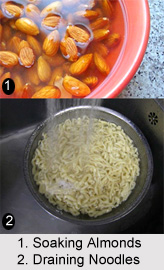
•After boiling noodles immediately put them in normal cold water to avoid them from sticking with each other.
•If one forgets to soak Chana/Rajma overnight. Just soak them in the boiling water for an hour before cooking.
•Potatoes soaked in salt water for 20 minutes will bake them more rapidly.
•To peel the skin of tomato or almonds, one can soak them for an hour in boiling water.
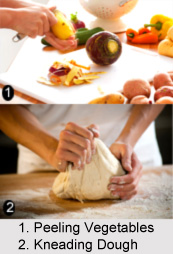
•To knead chapatis, add 1/3 cup of warm water for 1 cup of flour approximately. To make softer chapatis, add warm milk or curd while kneading.
 Cooking Tips for Cutting Vegetables:
1. When cutting raw banana, potatoes or eggplant, soak it in water to avoid discolouration. Similarly, to prevent apples, bananas or peaches from browning, add lemon juice.
2. Keep coriander leaves in a muslin cloth bag in the refrigerator. They will remain fresh for a longer time.
3. Wash vegetables before peeling or cutting to preserve the water-soluble vitamins.
4. Peel vegetables as thinly as possible to preserve the minerals and vitamins.
5. After peeling onions cut in half and soak in water for about 10 minutes before cutting to avoid burning sensation in eyes.
6. Chopping/Cutting on a marble slab will blunt the knives. So use a wooden chopping board.
7. Wrap the fruits and vegetables in newspaper before refrigerating to keep them fresh for long.
8. Freeze them first for one hour and then dip the knife into hot water before cutting the dry fruits.

Cooking Tip for Frying:
a) When frying, the oil should be in the correct temperature. If it"s too hot, the outside will get browned up too quickly before the inside gets cooked. If it"s not hot enough, the fried food will absorb too much oil before getting cooked.
b) To make puris crispier, add a little rice flour to the wheat flour while kneading.
c) Pakodas will turn out crisper if a little corn flour is added to the gram flour while preparing the batter.
d) Add some hot oil and 1/2 tsp of baking soda in batter while making pakoras.
e) While making patties or tikkis of potatoes, always boil the potatoes in advance and refrigerate it before using them. This helps the starch in the potatoes to settle down and the tikkis will not be gooey.
Cooking Tips for Preparing Gravy:
•Always use ghee instead of oil, which gives a good flavour to the gravy. If oil alone is used, it does not get separated easily from the ground mixture, as ghee separates from it.
•Fry the ground masala in reduced flame, so that it retains its colour and taste.
•Little plain sugar or caramelised sugar added to the gravy makes it tasty.
•When tomatoes are not in season, tomato ketchup or sauce can be successfully used in the gravies.
•To retain colour in the gravy always use ripe red tomatoes. Discard green portions if any.
•Good variety chillies and chilli powder also gives colour to the gravy. Try to use long variety of red chillies. Dry it under sun for few days and powder coarsely at home. Always the coarse powder gives good taste in gravies and pickles.
•While using ginger and garlic paste in curries, always use garlic at 60% ratio and ginger at 40% as ginger is very strong and may make the dish sharp and pungent.