 Hampi in Karanataka, now in ruins, was once the capital of the Vijayanagara Empire. It brought about a renaissance of art and culture, as it defended the region against the plundering armies. Much of Vijayanagara is now in ruins, as when the rulers were defeated at the hands of the invaders at the battle of Talikota in the 16th century, most of the marvellous structures and edifices were systematically destroyed.
Religious buildings are scattered about in small units in Hampi, each with its own importance and function. Perhaps one of the reasons for this change was the terrain of the area, with the plan of the city following the lay of the land. The temple architecture throughout is based on the traditional Hindu style and some of them followed traditions derived from other dynasties. Each dynasty that ruled the Vijayanagara Empire left its mark at Hampi. The Vijayanagara style of architecture relied heavily on the availability of natural resources, namely granite, which was the material used primarily by the rulers of Sangama dynasty. Other dynasties employed the softer schist rock, suitable for ornate carvings.
The temples of Hampi are famous for their large dimensions, florid ornamentation, both in painting and carving, majestic pillars, magnificent pavilions and a great wealth of religious and mythological depictions. Some of the temples of Hampi have derived inspiration from Indian scriptures namely the Ramayana and the Mahabharata.
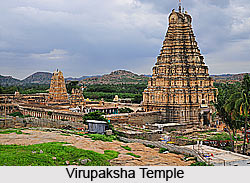
One of the most important temples of Hampi is the Virupaksha Temple. The existence of the Virupaksha temple in the twelfth century is also proved by the inscription of AD 1199, inscribed on a finely polished schist slab, now the Durga devi temple, which refers to a grant of land made to seven hundred Brahmans of Hampi and for the worship of the deities of the place such as Virupaksha, Hampa devi, Bhairava etc. As per an inscription on a slab that is found in the northern gopura of the Virupaksha temple, it has been proved that the temple continued to be of significance in the thirteenth century. The existence of the "chattra" and the Brahmans connected with the temple, points to the fact that the Virupaksha temple was already a centre not only of religious activities, but also of charitable and scholarly pursuits. It was with the establishment of the Vijayanagara kingdom and its capital at Hampi, that the Virupaksha cult gained immense popularity. The five sons of Sangama dynasty adopted Virupaksha as their kula-devata (family deity) as is clearly revealed in an epigraph, dated AD 1347, of Marappa, one of the five, in which Virupaksha is described as the family god of the sons of Sangama. This tradition was continued by the entire Sangama dynasty. The dynasty, the capital city and the kingdom were placed under the special protection of Virupaksha.
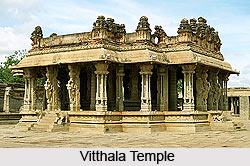 Another most important temple of Hampi, which was built in the 15th century AD, is the Vitthala temple which is located near the Tungabhadra River. This temple is meticulously elaborated with decorative details and the shrine of Vitthala - Vishnu is placed here. The architecture of this temple is vivid and artistically projected with granite. This temple houses the famous Stone Chariot which is basically a shrine that is structured in the temple chariot form. Including this, an image of Garuda, the vehicle of Lord Vishnu, is also enshrined.
Inside the Vijayavittala Temple complex, the Stone Chariot deserves getting special attention. The chariot is a miniature temple. Though some believe it is carved out of a single rock, it is not the case. It resembles the temple chariots or rathas in which the idols of the temple are taken out on a traditional procession.
A Jain temple, Kunthu Jinanatha that is built in AD 1385, is reckoned as the largest and the most imposing of the early group of temples. This temple, the contribution of Irugappa, a minister and general of Harihara II, is located in the south-western part of the "urban core", outside the "royal centre". An inscription of AD 1386 reveals the contribution of a Siva temple by a customs official near that of Narasimha. Even though this part of the "sacred centre" had begun to assume im¬portance in the religious life of the city, with a Shaiva shrine and a Vaishnava temple in close proximity to each other, the original religious area around the Virupaksha temple and Hemakuta hill still continued as a hub of religious activity, witnessing new constructions for, in AD 1398, a small temple to god Virupaksha was erected on the southern end of Hemakuta hill by two Brahmin brothers. Apart from these temples there are some other temples namely the Narasimha temple that continued to be a focus of constructional activity in the first decade of the fifteenth century. Narasimha temple is one of the temples located in Hampi, situated on the south bank of Tungabhadra River, but at a distance to the east of the cluster of Shaivite shrines in and around the Virupaksha temple and the Hemakuta group. A record within its enclosure, dated AD 1406, notes the construction of a temple for god Gopinatha. Another inscription shows that in AD 1410, the same donor constructed a mandapa for god Gopinatha and the goddess Mahalaksmi. This temple, which has a number of epigraphs referring to it, dating from AD1379 to AD 1410, appears to have received no further grants or additions after the latter date. Another temple of fifteenth century is the Ramachandra temple which is located in the heart of the "royal centre". Though there is no clear foundational inscription to help date this temple, on the basis of other epigraphical as well as monumental evidence it can be assigned to the reign of Devaraya I. The Ramachandra temple is not only an architecturally interesting structure, but was also central to the town-planning of the city.
In the area now known as Nimbapuram (east of Vitthalapura) is a Shaiva temple. An inscription near it, dated AD 1450, records that Praudhadeva-Maharaya (Devaraya II) founded a village called Somalapura, and that he erected a temple, a lamp-pillar and a sandhya-mandapa and also consecrated the god Saumya-Somesvara in the temple. To honour the Lord Krishna , Krishnadeva Raya built a new temple and a suburb after the victorious Udayagiri campaign of the king. The Krishna temple was the first major temple to be entirely constructed in the sixteenth century. Located in the area named Krishnapura, the inscriptions within the temple highlight its importance in the life of the city from its construction in AD 1515 till its abandonment in AD1565. The Krishna temple is almost exclusively in the Tamil style. However, the pattern of the "ranga"mandapa"" with its side porches harks back to an earlier tradition. The western wall of the "ranga"mandapa"" has a niche and two pilasters on either side of the entrance to the "antarala". Four pillars of the south gopura are also in the earlier tradition, though reliefs adorn the four sides of the two cubical blocks of these pillars.
As Hampi is the land of temples of great architectural styles and sculptural magnificence, there are so many temples scattered here and there. The earliest is the Mailara temple of AD 1380 which stands to the east of a massive gateway of the "urban core", in a valley to the south-east of the Malyavanta Raghunatha temple. An inscription on a rock near it not only gives the foundational date but also the information that this temple of Orateya Mailara was constructed by Baththeya Nayaka, a hunter of Edavanka, who belonged to the house of king Harihara. This small, east-facing shrine consists of a square sanctuary with comer columns; its ceiling is of rotated squares, with a medallion in the centre. Another temple is the so-called Ganigitti Jaina temple, just inside one of the fortified entrances south-east of the "royal centre". Erected in AD 1385 by Irugappa, a minister in Harihara II"s court, it was dedicated to Kunthu Jinanatha, one of the twenty-four Tirthankaras.
The greatest temple of the fifteenth century was, undoubtedly, the Ramachandra temple, a royal chapel of the reign of Devaraya I, which was probably constructed by the king himself by or before AD 1416. It is situated within a rectangular courtyard, the enclosure walls of which are adorned with extensive friezes of relief carvings. The Ramachandra temple"s architecture and decorative details embody the synthesis of the Tamil and Deccan features, with the former being more prominent. The southern elements present are the decorated plinth mouldings, the projections and recesses of the exterior wall surfaces of the temple, marked off by pilasters, niches and "kumbhapanjaras", the carvings on the wall between these elements and the brick and mortar superstructure over the sanctum.
The Parsvanatha Jain temple erected by Devaraya II in AD1426, is located in one of the major markets of the city, along an important road, within the "royal centre". The Saumya-Somesvara temple was also the contribution of Devaraya II, but unlike the Parsvanatha Jaina temple built in the Deccan style, it is constructed predominantly in the Tamil tradition. The Saumya-Somesvara temple is located on the southern bank of the Tungabhadra River, to the east of Talarighat, in the area now known as Nimbapuram. The foundational inscription, located on a boulder to the north-west of the temple, is dated AD 1450, and mentions the king`s construction of the temple and the gift of a village to it.
The Ranganatha temple is an east-facing monument, standing within an enclosed courtyard; it consists of a maha"mandapa", a ranga"mandapa" with four pillars within and two side porches, two antechambers, a garbhagrha and an enclosed circumambulatory passage. There is a superstructure of brick and mortar above the sanctum and in the south-east corner of the enclosure is a mandapa of three by four pillars, probably a later addition. The Anantasayana temple near Hospet was constructed by Krishnadevaraya in AD 1524 and this monument manifests a highly innovative scheme. Standing within a rectangular courtyard is a west-facing principal shrine and subsidiary shrine as well as a sixteen-pillar mandapa to the north-east of the principal shrine.
A temple belonging to the reign of Achyutaraya is the Pattabhirama temple, located in a new suburb named after Achyutaraya"s queen, Vardadevi. It has the largest enclosure of all the Vijayanagara temples. Within is the principal shrine, subsidiary shrine, a "vahana-mandapa", and a hundred-pillar hall. The architectural style of this temple is impressive, but less ornate, than that of other large sixteenth-century temples. The east-facing Tiruvengalanatha temple in Krishnapura lies just north of the Mudu Viranna shrine. It has a principal shrine and sub-shrine, contained with a walled enclosure, lined on its inner side by a colonnade. A unique feature of this monument is that the maha mandapa of the principal shrine forms the entrance into the shrine as well as the courtyard, two side doors in its west wall allowing access into the courtyard.
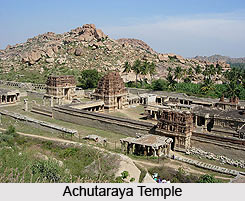
Achutaraya temple is one of the important temples in Hampi and is a large complex built by an officer of the King Achyutaraya, Salakaraju Tirumaladeva. This temple is better known as Achyutaraya temple, in whose period it was built rather than the name of the deity Tiruvengalanatha or Lord Venkateshwara.
Apart from these temples there are some other temples and religious monuments located in Hampi include the Tirumangai-alvar temple, Chandramouliswara Temple, Kodandarama Temple, Kuduregombe Mantapa, Narasimha Temple, Purandaradasa Mantapa, Rangatha Temple, Rayagopura, Rishimukh, Varaha Temple, Yantrodhara Anjaneya Temple etc. Besides the temples, there are some religious shrines and images that are themselves similar to the temples. The images like Narasimha, Ugra Narasimha, Shivalinga, Kadelakalu Ganesha, Sasivekalu Ganesha etc.
The temples of Hampi are the treasures of the land and these portray the history of earlier Hampi and Vijayanagara. These temples were given structure by skilled artisans who were patronised by the rulers of Vijayanagara Empire.