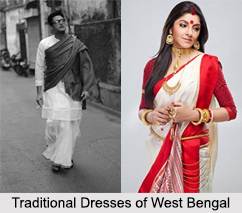
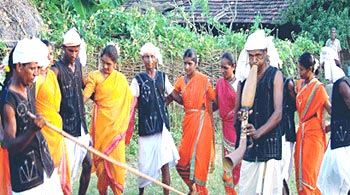
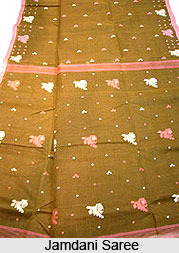
 The cotton saris of West Bengal are called Jamdani and they follow the traditional patterns. The Daccai `Jamdani` is a fabric on which the designs are raised in inimitable style. Daccai Jamdani saris distinguished from its mutant cousins by its very fine texture resembling muslin and the elaborate and ornate workmanship. The `Batik` prints originating from Javanese wax-designing, revived in Santiniketan. Floral forms circular `kalka` shapes, pyramidal and variations of geometric designs are typical. Handloom still remains the great employer in rural Bengal. Today hand-painted scrolls also silk-screened and printed are quite popular as wall hangings etc.
History of Jamdani Saree
The word "jamdani" is believed to be of Persian origin, derived from `Jam` and `Dani` i.e. flower and vase. While there is some mention of this term in the literature from the 3rd century BC and during the Gupta period, it is during the Mughal rule that the weavers of Dhaka who had been weaving this fabric for centuries, received extensive royal patronage. The finest varieties of muslin fabric were produced during this period with fabulous floral and figured motifs. This was the golden age of dhakai muslin when the skill of weaving rose to an art par excellence. With the decline of the Mughal dynasty and the subsequent British conquest of India, the trade continued to flourish for a while and enormous quantities of jamdani muslin were exported to Europe. However, by the 19th century, cheaper industrially manufactured yarn from Britain were being imported into India which eventually led to the collapse of the jamdani weaving industry in Bengal. The jamdani weaving tradition has survived into modern times, adapting to changing tastes and trends. After the partition of Bengal in 1947, many Hindu weavers from Bangladesh migrated to India and were rehabilitated in West Bengal.
Weaving technique of Jamdani Saree
Jamdani sarees are woven on the brocade loom. This is a supplementary weft technique of weaving, where the artistic motifs are produced by a non-structural weft, in addition to the standard weft that holds the warp threads together. The standard weft creates a fine, sheer fabric while the supplementary weft with thicker threads adds the intricate patterns to it. Each supplementary weft motif is added separately by hand by interlacing the weft threads into the warp with fine bamboo sticks using individual spools of thread. The result is a myriad of vibrant patterns that appear to float on a shimmering surface. What"s remarkable in this weaving technique is that the pattern is not sketched or outlined on the fabric. Instead, it is drawn on a graph paper and placed underneath the warp. The original jamdani sarees in Dhaka were woven in pure cotton. The finer the weave, the more soft, light and expensive was the resulting cotton fabric. Today, modern versions of the jamdani are also woven in a blend of cotton and silk, and sometimes, even in pure silk. More vibrant colours including gold and silver coloured yarns are used to make contemporary designs.
Different types of Jamdani sarees
There are at least six varieties of Jamdani Sarees, each deriving its name from the village in which it originated, and each with its own distinctive style. The undisputed queen of the range, however, is the fabled Jamdani, which in all its myriad local avtars continues to retain its original grandeur and sophistication. The original version is referred to as Daccai jamdani, although it is now produced in Navdeep and Dhattigram, in West Bengal. Jamdani sarees can be classified based on the type of motifs or the region where they are produced. Popular motifs include panna hajar (thousand emeralds), kalka (paisley), butidar (small flowers), fulwar (flowers arranged in straight rows), tersa (diagonal patterns), jalar (motifs evenly covering the entire saree), duria (polka spots) and charkona (rectangular motifs).
Daccai Jamdani: Daccai Jamdani is distinguished from its mutant cousins by its very fine texture resembling muslin and the elaborate and ornate workmanship. The single warp is usually ornamented with two extra weft followed by ground weft. While the original Bangladeshi sari is almost invariably on a beige background, the Indian weavers are a little more adventurous in their choice of color schemes. The gossamer thin black Jamdani with its splash of multi colored linear or floral motifs sprinkled generously all over the body and border and crowned with an exquisitely designed elaborate pallu is a feast for the eyes.
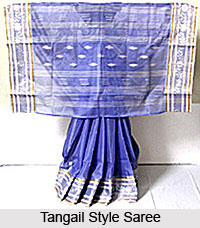 Tangail Jamdani: Woven in the Tangail district, these jamdani sarees have traditional broad borders featuring lotus, lamp and fish scale motifs. These sarees are mostly Jamdani motifs on Tangail fabric and are generally known by the confusing nomenclature of Tangail Jamdani. Although beige background is the most popular, these are available in a riot of colors. It has a fine texture, with its 100s count fabric and highly stylized motifs.
Shantipur Jamdani: Woven in Shantipur, West Bengal, these jamdani sarees are similar to Tangail jamdanis. They have a fine texture and often, elegant striped motifs decorate the saree.
Dhaniakhali Jamdani: With its origin in Dhaniakhali, West Bengal, these jamdani sarees have tighter weave compared to the Tangail and Shantipur varieties. They are marked by bold colours and dark, contrasting borders. Also it is known for its stripes and checks.
Also there are much more styles of jamdani sarees like Self-coloured style, Half-n-half style etc.
Twisted yarn is closely woven together and so the saris are more lasting. Initially the Jamdani saris were woven for the nobles of North India. Now this art is still practiced in Tanda and Varanasi in Uttar Pradesh. This inlay technique is fully indigenous. This Jamdani technique of patterning is found in the cotton centers of Venkatagiri in Andhra, Morangfi in Manipur and Kodialkarruppar in Tamilnadu.