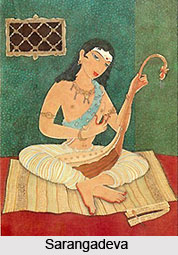
 Veena is a classical Hindu lute belonging to the family of string musical instruments. It is an ancient musical instrument which is said to have been invented by Narada, one of the seven great rishis or Saaptarishis, who was also a Veena maestro.
History of Veena
One of the ancient string instruments of India, the origin of Veena can be traced back to the ancient yazh, which is also a string instrument, similar to the Grecian harp. There are mentions of the Veena in Vedic literatures like the Rig Veda and Sama Veda. The Indian sage Bharata in his Natya Shastra describes the theory of the seven string instrument and other string instruments in 35 verses. Over the centuries, the Veena has gone through several innovations and modifications and in its current form; the instrument can be attributed to Raghunath Nayak"s 17th century rendition.
Description of Veena
Veenas are a plucked string instrument, about 4 ft long, carved and with a hollowed structure made of wood generally jack wood. Veena is considered to be an aristocrat among instruments. Good quality Veenas are carved from a single block of wood, whereas, ordinary Veenas are divided into three sections namely resonator, neck and head.
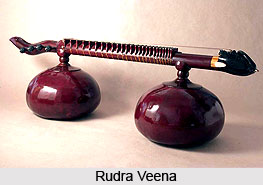 Its tapered hollow neck contains metal frets set into wax on wooden tracks. One more resonator is present on the top of the long neck of Veena. This is used as a stand to position the instrument. Usually it has seven strings, made up of steel along with a long finger board containing 19 to 21 frets or supports.
According to the number of strings, there are several variations of the Veena. The performer has to place one gourd on the shoulder and the other one on the hip. Depending on the construction and melody, Veena can be categorized into several types. Discussed elaborately below are some of the other variations of Veena:
Rudra Veena
There are several variations of the Veena and its designs have been evolved over the years. In the field of North Indian Classical Music the bin, also known as Rudra Veena, is most commonly used. It consists of a stem, about 3 ft long, that supports a bamboo fret board approximately 22 inches long and 2.5 inches wide. It has 24 metal frets, which are set to the half-steps in 2 octaves. The frets are stationary, fixed in a resinous substance. The 2 resonating gourds are large, about 14 inches in diameter. It has 4 main playing strings, which are tuned to Ma, Sa, Pa, and re. This gives the instrument a total range of over 3 octaves.
 Most of the melody, however, is produced on the first string, which is closest to the player`s body. Three additional strings, which are suspended on the sides and not over the frets, are tuned to Sa, Sa and Sa. The index and middle fingers of the right hand are used for plucking the melody strings; the little finger plays the drone. The index and middle fingers and occasionally the ring finger of the left hand reaching around from under the stem to stop the strings.
The plectrum used for the bin is like that of the sitar, but is worn sideways on the finger. Some Veena players use their fingernail rather than a plectrum for plucking. The performer sits cross-legged and holds the instrument at a slant to the left shoulder, the upper gourd resting on the shoulder and the lower gourd on the right knee.
Saraswati Veena
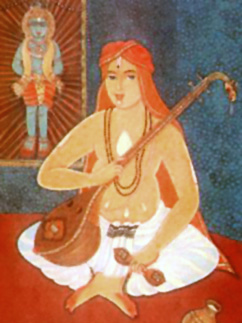
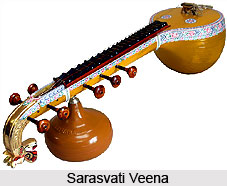
The modern Veena used in Carnatic music is quite different in construction from the northern Veena. The most noticeable difference in Saraswati Veena is the repositioning of one of the gourds of Veena, so that the stem runs into it. This Veena is therefore a lute type instrument rather than a zither, since its stem becomes a neck. Its gourd is not actually a gourd any longer; it is a hollowed-out chunk of wood, usually jackfruit that is closed in by a flat piece of wood.
At the opposite end of the stem is attached a scroll, which is usually carved into the head of a dragon. Saraswati Veena is said to be the abode of divinity as the Veena Danda represents Lord Shiva, the strings Parvati, the dragon head of Lord Vishnu, the bridge Goddess Lakshmi, the balancing gourd Lord Brahma and the connecting metal cone Goddess Saraswati.
Gottuvadhyam
This musical instrument is also known as the Gottuvadyam, Chitra Veena or Mahanataka Veena and it is a Carnatic music string instrument. It is played mainly in south India and it is usually also used as a solo instrument in Carnatic music. This instrument resembles the Saraswati Veena in its general form, but in many ways it is unique.
 The name Gottuvadhyam literally means `block instrument`. It is a complicated ancient instrument with twenty-one strings, out of which there are 6 main strings used for melody that pass over the top of the instrument, 3 drone strings and about 12 sympathetic strings that run parallel and below the main strings.
Vichitra Veena
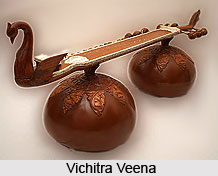
This is a plucked string instrument used in Hindustani music and it is a comparatively recent addition to the Veena family. It is similar to the Gottuvadhyam Veena, since it has no frets and is played with a slide. Vichitra Veena is made of a broad, fretless, horizontal arm or crossbar or dand around 3 ft long and 6 inches wide, with 2 large resonating gourds or tumba, which are inlaid with ivory and attached underneath at either end.
The narrow ends of the instrument are fashioned into peacock heads. This Veena has a 5 octave range. There are 4 main playing strings and 5 secondary strings called the chikaris, which are played openly with the little finger for a drone effect. Underneath them are 13 sympathetic strings tuned to the notes of the appropriate raaga.
Mohan Veena
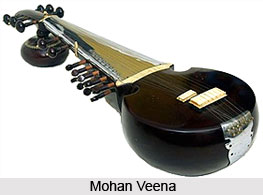
This is a stringed musical instrument used in Indian classical music and this was invented and popularized by Pandit Vishwa Mohan Bhatt. Though it comes in the category of classical instruments, it is not an ancient one, since it is actually a modified slide guitar with 20 strings: 3 melody strings, 5 drone strings strung to the peg head, and 12 sympathetic strings strung to the tuners mounted on the side of the neck. A tumba or gourd is screwed into the backside of the neck for improved sound quality and vibration. It is played by placing it on one`s lap.
Few of the other types of Veenas are the Chitra Veena, Ranjan Veena, Sagar Veena and Triveni Veena.