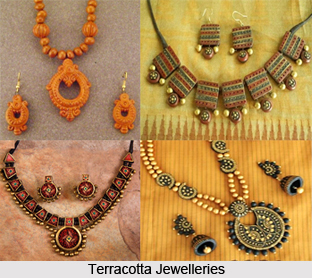
 Tribal Jewellery of Gujarat attracts the people of India and also the people of abroad. Ancient Gujarat port Broach, which was situated on the Cambay Gulf, bisected the business route to China, Greece, Portugal and Persia.
Gujarat was one of the strategic trading centers Ptolemy (which was c. 90 AD - c. 168 AD). Mughal jewellery, gold, silver, ivory, pearls, textiles, gemstones and coral all used to be traded via Broach, which in turn developed it as a Hub for stone-cutters, artisans, and carvers for almost thousand years. Till today a sizeable "diamond cutting" industry has been developed in cities like Surat, Ahmedabad, Bhavnagarand Navasari District in Gujarat, where around 800,000 workers cut n polish 80-90% of world`s overall diamonds production in small scale cutting houses.
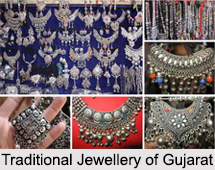
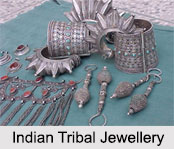
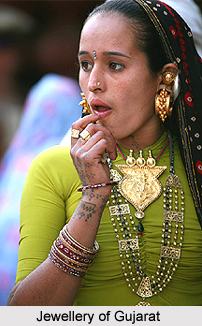
As a mark of tribal jewelleries and accessories, most of the Gujarati women very often wear key bunch on their waist. The key-ring holder is generally silver made. Other jewelleries which are famous among Gujarati women are the mangal sutra, earring, necklace, rings and bangles.
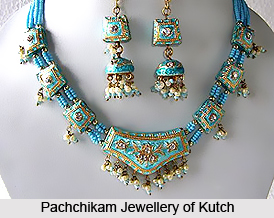
 Pachchikam, tribal jewelleries is also returned as a new age fashion statement. Centuries ago it is mostly crafted in Kutch District and Gujarat, and the style of this jewelleries is revived by today`s jewelleries designers. This artistic tribal jewellery is replacing gold ornaments and jewelleries. Pachchikam was very popular during its inception, but then turned into an out-dated fashion till its rejuvenation to its present form. The preparation of this type of jewellery covers uncutting of semi-precious stones as well as glasswork. Fabrication of this jewelleries is done in Gujarat and Kutch by few families who have got specialization in this special type of artwork, which has been inherited generation after generation. Normally each piece takes one to two months to prepare. The typical climatic constraint makes it difficult for the workers.
Among other forms of jewelleries which are traditionally made in Gujarat, agate, bead and silver jewelleries are very popular as the exquisite tribal jewelleries. Ornaments like ear rings, bangles, nose rings, necklaces etc. are made locally, whereas sold throughout the State. Silver jewelleries are made from silver-bars; normally those are locally procured and then converted into sheets and wires before making the bangles, ear rings, anklets, nose pins and many other ornaments.
The main hub of silver jewelleries work are Bhuj, Anjar and Mundra within Kutch district whereas Porbandar, Surendranagar, Ahmedabad and Jamnagar also carries a long tradition of producing quality silversmiths, who are quite capable of crafting stunning silver jewelleries. Tribal Jewelleries as a part of Gujarat`s traditional jewelleries is still crafted with great care and in styles which has continued for centuries after centuries. The age old heritage of designing tribal jewelleries with help of beads, zari, lac etc., is still relevant to meet today`s demand and these ornaments are used by tribal women of this part of the country.
Tribal Jewellery of Gujarat
Tribal Jewellery of Gujarat is very exceptional in its style; the vast collection is full of exclusive products.