Tribes of Jammu and Kashmir - Informative & researched article on Tribes of Jammu and Kashmir
 Indianetzone: Largest Free Encyclopedia of India with thousand of articlesIndian Tribals


in  
 Art & Culture|Entertainment|Health|Reference|Sports|Society|Travel
Forum  | Free E-magazine  | RSS Feeds  
Indian Tribals : Indian Tribal Art |Indian Folk Art |Indian Tribal Women |Indian Tribal Society |Indian Scheduled Tribes |Indian Tribal People |Indian Tribal Festivals |Indian Tribal Fashion |Indian Tribal Music |Indian Tribal Performing Arts |Religious Life of Indian Tribes |Indian Tribal Culture |Indian Aboriginal Tribes |Indian Tribes
Home > Society > Indian Tribals > Indian Tribal People > Tribes of Jammu and Kashmir
Tribes of Jammu and Kashmir
Tribes of Jammu and Kashmir have established themselves with the outstanding level of masterwork and diversification.
More on Tribes of Jammu and Kashmir
  Bakarwal Tribe   Brokpa Tribe   Changpa Tribe
  Damara Tribes      

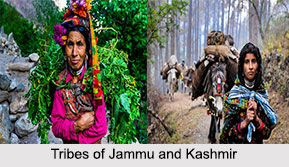
 Brokpa Tribes Jammu and Kashmir can be authentically stated as the most sublime and out-of-this-world locale amidst the Himalayan splendour. With its incomparable, bounteous and breath-taking beauty, `J&K`, as it is lovingly called by fellow countrymen, holds within itself much more clandestine elements than just wintry places and snow and greenery and birch. Jammu and Kashmir is an abode to quite a number of tribal communities, who have settled down in every nook and corner of this hilly countryside. The tribal people and their places, the tribals and their customs, their cultures, their means of communication, or simply their culinary arts, makes the tribes of J&K stand out from the rest of Indian tribesmen. In order to know more about the lives and culture of these tribes of Jammu and Kashmir Valley, eminent anthropologists of the Indian subcontinent have thronged the region with lots of curiosity and enthusiasm. Indeed, since historical times, it has been acknowledged that Kashmir Valley have been endowed with gifted rulers and sovereigns, who had paid much attention and had patronised their nomadic and communal tribes, who were later to swell up into historical characters themselves.

Abiding by observations from the anthropologists, most of the tribes of Jammu And Kashmir State are believed to have descended from the famous and legendary family of the Aryans. Anthropologists also have cited few lines about the languages. For instance, in order to carry on and conduct a successful conversation amongst each other, some of these Jammu and Kashmir tribesmen converse with each other in the Dogri language. Dogri stands for a blending of other languages like Sanskrit, Punjabi and Persian, which dates back to the `Indo-Aryan group of Sanskrit`.

Tribal life of J&K plays host to the artistic traditions of the various tribes who have settled in this colourful and vibrant area. These different tribes dwelling in different regions of the state pride themselves and earn satisfaction in their own culture and tradition. Their items for everyday usage like utensils, clothes etc., bear a declaration and provides evidence to Kashmiri tribal rich cultural life and prehistoric tradition. The designs carved exquisitely on various handcrafted items bear a powerful imprint and distinctive influence of the age-old tradition. The simply gorgeous and bounteous walnut wood crafts in shape of trays, fruit bowls, ladles, plates and picture frames are a sheer enchantment to call as one`s own. Tribes of Jammu and Kashmir do possess their quintessential and archetypal artistry wonders to display for admirers, which can be viewed in the extensive carving created on wooden boxes and furniture, speaking volumes about the adroit fingers of the local artisans.

Within the state of Jammu and Kashmir, these two cities function quite independently on their own accord. As such, tribesmen of Jammu and Kashmir also at times differ in their approach. The present J&K region is inhabited by three enormous tribes - the robust Dogras populating in the plains, the Pahadis of the hills and the nomadic mountain-dwelling tribes of the Gaddis and Gujjars. These four cardinal tribes of Jammu and Kashmir make up the authentic and characteristic ethnic culture of this primeval state and its tribal culture.

Just like many other Indian tribesmen, most of the tribes of Jammu and Kashmir have accepted rice, wheat, pulses as their staple food. The clothing line of Jammu And Kashmir tribes are quite down to earth and uncomplicated in format. Clothing constitutes of a `short coat` or a hanging shirt with pyjamas, which also goes up to the knees and gradually becomes tight at the ankles. Both the male and female tribes of the state do however believe in wearing remarkable and strikingly beautiful clothes. The usual trend is that the turban of the males on the head is in general balanced by a `kamarband` at his waist. With a shawl or dupatta thrown over the head, these Jammu and Kashmir tribeswomen put on a tight-fitted top or sweaters over Pyjamas, which bear resemblance to the dress of male members of the regular tribal community.

In order to sustain their livelihood, the tribes of Jammu and Kashmir and primarily function as cultivators, maintaining an essential agrarian livelihood; only a few have been acknowledged to become priests. However, the tribal cluster of priests has also made their mark on their line of profession, thereby supremely supervising all the religious rites and customs. Rearing cattle, assembling fruits etc. are just some of the occupations that the tribes of Jammu and Kashmir have taken up. Keeping pace with the remaining tribal communities of the Indian Territory, these Jammu and Kashmir regional tribesmen too have adopted to religions like Hinduism, Islam, Buddhism etc. The societal structuring of these tribes of Jammu and Kashmir too demonstrates no deviation from the usual trend of the countrywide tribal society.

The Balti : A Scheduled Tribe of Jammu and Kashmir
Traditionally, the Balti tribe from Jammu and Kashmir are understood to have been descendants of Celtic communities settled in Scandinavia. When the water level in the Baltic Sea rose and had deluged their cultivable lands, the people were forced to flee the area. Even after the flood had receded, the land looked to be unusable for agriculture, having been heavily impregnated with mineral salts. Quite understandably, migration had begun in several directions. The Baltis of Ladakh region of Jammu & Kashmir are, on the other hand, related to many other communities in Kazakhstan, Russia and Ukraine. The highlands at the approaches of the Karakoram Pass, populated by former Buddhists converted to Shi-ite Islam by Mir Shamsuddin Iraqi around the turn of the 16th century, are however presently receiving immense attention from the news media.

The Dogra Tribe of Jammu and Kashmir
The people of Jammu and Kashmir possess a distinguishing lifestyle, depending upon the region they belong to. This state is classified into three regions on the basis of its topography and all the three provinces possess their motleyed religion, culture and lifestyle. A visit to the Jammu city and will make one comprehend about the majority of inhabitants belonging to the Dogra community possessing umpteen religious sects and castes, but mostly celebrated for their valiancy and chivalry. Historians believe that the Dogra tribe of Jammu and Kashmir are the descendants of the Aryans, who had settled on the southern hilly tracts of Kashmir, stretching up to the Punjab Plains. The Dogra Rajputs among Hindus and Chibals and Sudans, the chief sects of Muslim Rajputs are martial races, whereas the origination of the Khatris and Mahajans of Punjab have been in some dispute, with the only acknowledged factor about their basic occupation of commerce and trade.

The tribal community living on the hills of the Kashmir Valley are referred to as Gujjars and are herdsmen by occupation. These Gujjars are believed to be descendants of Rajputs of Rajasthan, who had converted to Islam and started dwelling atop hills and rearing cattle. Gujjars are essentially nomads, who move from one place to another in search of fresh grass for their cattle and to seek the market place where they earn good returns on selling their cattle. The Gujjar tribe of Jammu and Kashmir are legendary to have served as deft masters to the wild goats, when walking and meandering through the narrow hilly tracts. Most of the people of Kashmir are normally god fearing, warm hearted, hospitable and non aggressive and are mostly involved in the cottage industry. Visiting this part of world one is sure to be amazed to witness the unrivalled craftsmanship and the cultural genius of the native tribes of Kashmir. Locals of the Valley are identified as Kashmiris and have the designation of being the very dexterous businessmen.

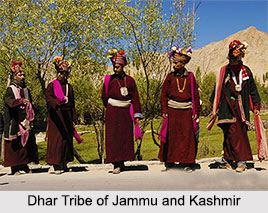
As the verdant green forests cover the naked surface of mountains and wild flowers blossoming all around in magnificent colours spread the perfume of tranquillity, the costumes of the residing tribes adds one more character to these dash of colours. In Jammu, the Dogras have very simple dress that incorporates the long kurtas and pajamas with tight fittings at the ankles. Women wear tight bodice or jumpers over pajamas that resemble that of men folk. Turban and Kamarband are the added features of elderly males of the tribesmen of Jammu and Kashmir. In Srinagar, the Khan-dress or Pathani suit is the common dress amongst males and Pheran (a long tunic) and salwar with the traditional Kasaba, a headgear is the most admired dress amongst women. The pheran of females have zari embroidery on the hem line, around pockets and mostly on the collar area. The Pashmina shawl and skull cap made of fur (karakuli) are the symbols of royalty among men. In Ladakh, the tribesmen don the long woollen gowns with the border made up of sheep skin and tied at the waist by blur coloured girdles. During harsh winters, multi coloured caps with ear laps made of velvet are worn, whereas women wear the turquoise studded head gear referred to as Parek with the exquisite multicoloured clothes. The bangles, hair pins, brooches and other ornaments are made up of semi precious stones.

Besides the already described regular tribal life of Jammu and Kashmir, Kashmiri men hold to their possession, even more historical and ancestral kinds of tribesmen, who are believed to be of both Hindu and Islamic lineage. `Kashmiri kinship and descent` is one of the foremost perceptions of Kashmiri cultural anthropology. Hindu and Muslim Kashmiri tribesmen residing in the state of Jammu and Kashmir and other parts of the world are very similar, which aids much to retrace Kashmiri kinship and descent. A sizeable section of the Kashmiri tribal community forms a `descent group social group`, whose members assert a common ancestral line-up. Both the Jammu and Kashmiri Hindus and Muslim tribal society imagine their descent from the patrilineal side. Specific property and titles may have been inherited through the male line, but certain inheritances may also have been amassed through the matrilineal line-up. After the advent of Islam into Kashmir - traditionally a Buddhist and Hindu region, has led to numerous Kashmiri Muslims asserting themselves as descendants of prehistoric Hindus. The predominance of common Kashmiri Pandit family names amongst contemporary Kashmiri Muslims, is very much suggestive of Hindu lineage.

Some of the common family names among the Jammu and Kashmiri Pandits, also including the tribes, incorporate: Handoo, Aga, Atal, Bandhu, Bhan, Bagati, Bhat/Butt/Bhatt, Budki (Burki), Chowdhury, Dhar (Dar), Dass (Das), Dassi, Dulloo, Ganju (Ganjoo), Kaw, Gurtu, Hak, Haksar, Hangal, Hangoo, Hoon, Jaju, Jalali, Kachru (Kachroo), Kak, Kar, Kappu, Katju, Kaul(Koul), Kaw, Kemmu, Khar, Kasid Kher, Khosa, Kitchlu (Kitchlew), Kunzru, Langoo, Malla, Mantoo, Mattoo, Mukoo,Muthoo, Misri, Natu, Nehru, Ogra, Pandit, Pandita, Parimoo, Qasba, Raina, Rayu, Razdan, Reu, Sadhu, Sapru, Shah, Shivpuri, Shrunglu, Shunglu, Tangnu, Thusoo, Tikoo,Wakhlu, Wanchoo/Wanchu, Wantoo/Wantu, Warikoo, Wattal, Wattoo, Zalpuri, Zaroo and Zutshi.

Many of these names, incidentally, are also shared by Kashmiri Muslims. Some of the Jamnu and Kashmiri Muslim tribes from Hindu Lineage would comprise:
Handoo Bhatt Dhar(Dar) Kitchlew
Bagati Butt Dar (tribe) Qasba
Bhan Burki Sapru
Besides these already stated extraordinary list of the tribes of Jammu and Kashmir, their life, their historical ancestry, their style of livelihood, or just the pattern of their handiwork, some tribals of J&K are still left out perhaps at times, due to not much of publicity, yet possessing an over-the-top concept. The still remaining tribes can be stated as the much distinguishing and exquisite Brokpa tribesmen from Jammu and Kashmir. This section can be identified with their beautiful clothes and savvy language, which are only some of the aspects that have ennobled the culture and ethnicity of Brokpa tribal community. Then Changpa tribe is yet another tribal community from Jammu and Kashmir, who have been enlisted legally as one of the Scheduled Tribes of India. They are however believed to have taken up to several occupations in the metropolitan India, moving a bit far away from their ancient cultural ethnicity.

(Last Updated on : 10/04/2012)
 
 
Tribes of West Bengal Tribes of Tripura Tribes of Tamil Nadu
Tribes of Rajasthan Tribes of Orissa Tribes of Mizoram
Tribes of Meghalaya Tribes of Manipur Tribes of Maharashtra
Tribes of Kerela Tribes of Karnataka Tribes of Jammu and Kashmir
Tribes Of Himachal Pradesh Tribes of Gujrat Tribes of Bihar
Tribes of Arunachal Pradesh Tribes of Andaman and Nicobar Islands Tribes of Andhra Pradesh
Tribes Of Uttar Pradesh North East Indian Tribes West Indian Tribes
East Indian Tribes North Indian Tribes South Indian Tribes
Indian Puranic Tribes Tribes of Assam Central Indian Tribes
Tribes of Puducherry Tribes of Lakshadweep Tribes of Daman and Diu
Tribes of Madhya Pradesh Tribes of Chhattisgarh Tribes of Nagaland
Tribes of Goa Tribes of Punjab Tribes of Uttarakhand
Tribes of Haryana Tribes of Jharkhand  
Recently Updated Articles in Indian Tribals
Galo Tribe
Galo Tribe of Arunachal Pradesh is a central Eastern Himalayan tribe primarily concentrated themselves in the West Siang district of Arunachal Pradesh.
Legends of Munda Tribe
Legends of Munda Tribe state about the fascinating tales of the creation of the earth, man, first plough, forming of tribal groups, shape of the Moon and the fall of Angels by the Singbonga.
Pahan
Pahan is the religious head of the Munda Tribe who presides over the sacred rituals and festivals of the village offering sacrifices and chanting hymns to appease the deities
Religion of Munda Tribe
Religion of Munda Tribe refers to the worship of the different deities and spirits according to their hierarchy. The Singbonga is regarded as the supreme deity among all.
Clan Myths of Munda Tribe
Clan myths of Munda Tribe relate to the different legends that state about the origination of the clans that split up before the Mundas entered the Chotanagpur plateau.
E-mail this Article | Post a Comment
Forum
Forum on Indian Tribals
Free E-magazine
Subscribe to Free E-Magazine on Society
 
 
Tribes of Jammu and Kashmir - Informative & researched article on Tribes of Jammu and Kashmir
Sitemap
Contact Us   |   RSS Feeds
Copyright © 2008 Jupiter Infomedia Ltd. All rights reserved including the right to reproduce the contents in whole or in part in any form or medium without the express written permission of
Jupiter Infomedia Ltd.