Introduction
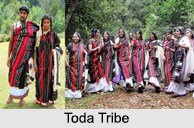 Toda Tribe is one of the original tribal communities who had resided in the rugged provinces of the Nilgiris. Karnataka is an abode of Toda tribal community who are dotted in every bend of the region. Apart from Karnataka, these Toda tribal communities can also be found in several other state of the Indian Territory. The rapid communication with the modern world brought about several changes in the lifestyle of this community. Areas where these Toda tribes make dwell are integrated to the Nilgiri Biosphere Reserve, a UNESCO famed International Biosphere Reserve.
Origin of Toda Tribe
 The origin of the Toda tribal community has got a history behind it. The Toda tribal community has established their settlements and lives cordially with other tribal communities like the Badaga, Kota and Kurumba.
The earliest record about them dates back to about 1117 AD when a ruler of Karnataka came to the Nilgiris and dedicated the highest peak in the area to the Goddess Lakshmi. They were still there in 1602 AD when a Portuguese Roman Catholic priest from Kolkata visited them. Interest in them was revived about 200 years later when the British reached the Nilgiris.
Society of Toda Tribe
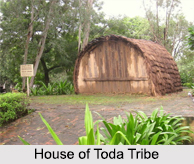
The Toda lives in settlements consisting of a mund (a duster or beehive huts), a dairy temple, which is larger than the normal Toda hut and a cattle pen which consists of a circular enclosure surrounded by a loose stone wall with a single entrance guarded by powerful stakes. Their homes are on the tops of minor rounded eminences, studded with cairns raised for burying the dead. There is only one small entrance to a Toda hut and one has to get down on all fours to crawl in. These half-barrel-shaped constructions are built of bamboos closely laid together, fastened with rattan and covered with thatch.
Todas live in a sort of classless, caste-less society where everybody is equal. They have a sacred tree, the thon, which they venerate.
A man can dispense with his wife but the compensation in buffaloes is so heavy that it acts as a deterrent. When a Toda wishes to divorce his wife, he is summoned to appear before the panchayat, who may ask him to hand over from three to eight buffaloes, according to his wealth. If a Toda marries outside his community, he is thrown out of the tribe and never taken back.
Slowly, the way of life of these people is changing. The Tamil Nadu government has started tribal residential schools for Toda children that provide free education and from here some have even gone on to college. Toda huts are fast being replaced with brick houses.
The Todas cremate their dead. In the past, according to the status of the dead man, a number of buffaloes were killed in the belief that the spirit of the buffalo would accompany the deceased to the next world, where he could live in much the same way as on earth. However, the buffalo sacrifice was stopped by government order in 1964.
When a Toda male is cremated, the fire has to be lit by wood friction by a stick taken from the "kedz tree" (`scared firestick`) but a female`s pyre can be ignited with an ordinary stick or match. When a buffalo dies, it is not cremated.
The Todas live in "reserved" forest land. Ever since the British arrived in India, they began a slow but deliberate encroachment on their grazing ground and today they have hardly any fallow land left for their use. The little that was their when the British left, is now being lost to eucalyptus plantations. Should their grazing ground disappear, it could spell the total collapse of Toda culture and tradition which would indeed be the greatest tragedy of all, for the Todas are unique.
As far as the languages are concerned, this Toda tribal community converse with each other in the language of the same name. This language has a belonging in the famous Dravidian language family with complex and intricate phonology. Very recently some of the anthropologists of Indian subcontinent acquired proud membership in the southern sub division of the renowned proto-South-Dravidian family. Under the influence of the modern civilization some of the Toda tribal community can also gain fluency in other languages of India like Kannada, Telegu, Malayalam and others.
The Toda tribes are great poets and great singers. They have only one musical instrument, a flute, without finger stops which is made of hollow bamboo, called pooheeri but now it is almost a dead instrument and only a few Todas can play it.
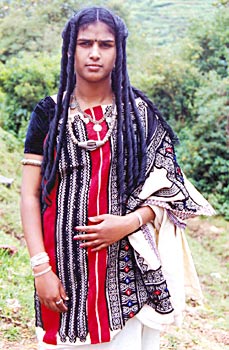
Dresses and ornaments that these Toda tribes wear adds on to the beauty and glamour to a large extent. The Toda dress comprises of a single piece of cloth.
Religion of Toda Tribe
 Religion of Toda Tribes centres on the herd of sacred buffaloes. The revered place of the buffalo in Toda society represents a remarkable feature of their life. Toda Tribes believe that God created the sacred buffalo first out of the earth of the Nilgiris, then the Todas and then the domestic buffaloes. So, to a Toda his buffalo, his native land and he himself are inseparable. A priest takes care of them and only he is allowed to graze and milk the buffalo. The sacred milk is kept in the temple where the priest churns it, makes curds, butter and ghee. With this ghee, the priest lights a lamp every morning and evening, and prays for the welfare of the tribe.
Folk Deities of Toda Tribe
 Folk deities of Toda Tribe are considered as Gods of the mountains as most of them reside on Nilgiri hills though river Gods are also included. The towtits are associated with the sacred dairies as several of them are said to have created the `principal settlements`. They are believed to have instituted the dairy operations there. Pithi is considered as the first deity of this tribe.
Goddess Teikirshy is clearly the most important deity among the Toda tribes. The division of the sacred buffaloes and dairies between the sub castes and clans is attributed to her. She is believed to be the creator and supporter of the social and ritual institutions of the Toda tribe. She is believed to be all-pervasive and omnipresent. These are the gods of the dairy-complexes
Teipakh was Teikirshy`s brother and was the river god. Another important deity is Tell who lives a similar life of that of the Todas. They tend to their buffaloes. The clans have different deities and it is regarded that most of them reside in the hills. It is believed that the deities living at a higher altitude reflect the proximity of the Todas to the deities. This implies superiority over other races in regards to divinity.
Occupation of Toda Tribe
As far as the occupations of this Toda tribal community is concerned, maximum of these Toda tribes have taken up the occupations of cattle rearing and dairy farming. Most of the members have huge herd of buffaloes. This Toda tribal community sustains their livelihood from milk products. Toda tribes have also developed expertise in silver smiting.
Temple of Toda Tribe
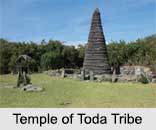
The temple is a sacred place and the priest keeps himself pure and celibate for the purpose of entering it. The charge of the dairy, therefore, ranks amongst the most respected offices. Quite a handful of temples too are built by the Toda tribal community. These are built in a circular pit covered with stones and have got very much similarity in appearance and mode of building to any of the houses of the Toda tribal community. The Todas also have a `cathedral` which has a tall conical thatched roof crowned with a large flat stone. It is surrounded by a circular wall. Only three of these now exist in the Nilgiris.
Festivals of Toda Tribe
The Todas have one important festival in the year: the Modhweth, which is held in December or January in Norsh (where the Toda claims he was created). Todas from the 20 "mundhs", their traditional settlements are scattered all over the Nilgiris trek to this place. Here they pray to their Goddess, Thekish. Coffee and puffed rice are served before the festival ends.