Introduction
 Temples of West Bengal show the rich culture and tradition of the state. Most of the temples are found here in a ruined state, partly due to the work of nature and also in some part an outcome of the work of man. Of the ruined temples in Bankura district and Burdwan district, enough remains to establish their kinship with the virile architectural movement in Orissa which produced the temples at Bhubaneswar.
A group of temples at Barakar in Burdwan is believed to have been built in the 10th and 11th centuries by the Pala kings of Bengal. These are locally known as the Begunia group on account of their fancied resemblance to the fruit of egg plant. The Siddheswara temple at Behulara in the Bankura district dates from the 10th century and is the most ornate of this group. Terracotta reliefs adorn its entire brick surface, but the lavish decoration merely emphasizes the elegance of its lines.
Along with the building movement described above, there was an indigenous style of building, approaching a kind of folk architecture, which was widely prevalent in southern Bengal. Characterised by a freshness and spontaneity, this type of structure was clearly derived from the thatched bamboo hut so common in most parts of Bengal. The curved cornice and eave, which is a special feature of these temples, are directly descended from the bamboo framework of the huts of the people, originally bent into this shape in order to throw off the frequent heavy rain.
Dakshineshwar Temple
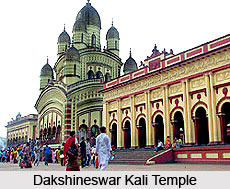
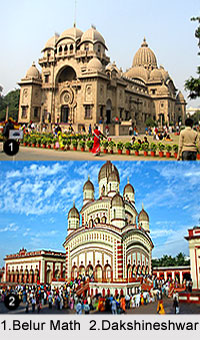
 Located on the banks of River Hooghly, Dakshineshwar Temple consists of twelve shrines which are dedicated to Lord Shiva and also a temple which houses the idols of Lord Krishna and Radha. The temple premises also possess a bathing `ghat` and another shrine dedicated to Rani Rashmoni. However, the principle deity of this temple is an avatar of Goddess Kali, known as Goddess Bhavatarini.
Kalighat Kali Temple
Kalighat Kali Templeis a renowned Hindu temple which is dedicated to Goddess Kali and is amongst the 51 `shakti peethas`. The temple is situated on the banks of Adi Ganga, which is now a small canal that leads to the Hooghly River. It is believed that the presiding deity of this temple obliterates all domestic complications of her devotees.
Tarapith Temple
Tarapith Temple is another beautiful heritage temple in West Bengal, steeped in legends and myths. Goats are regularly sacrificed by many ardent devotees of Goddess Tara after they are bathed in a sacred water tank, adjacent to the Tarapith temple. The devotees take a dip in the holy waters of this tank before they proceed to offer their prayers to the goddess since it is believed that it purifies the body.
Belur Math
Belur Math also referred to as Belur Math was founded by Swami Vivekananda, the famous disciple of the legendary Hindu saint, Ramakrishna Paramahansa. It is located on the river bank of Hooghly and is the headquarters of Ramakrishna Math and Mission. Belur Math is adorned with unique architecture which is a fusion of Islamic, Christian and Hindu motifs. The temple premises include Sri Ramakrishna Temple, Swami Vivekananda Temple, Holy Mother`s Temple which is dedicated to Sarada Devi, the wife of Ramakrishna Paramhansa and Ramakrishna Museum.
Iskcon Temple, Mayapur
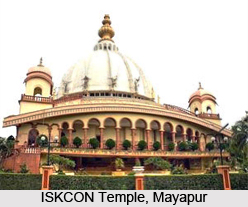 Iskcon Temple, Mayapur has been created in the memory of Lord Sri Chaitanya Mahaprabhu and is dedicated to Lord Krishna and Radha. Radha-Madhava are the principle deities while the other idols are that of eight `gopis`, Srimati Tungavidya Devi, Srimati Chitra Devi, Srimati Visakha Devi, Srimati Lalita Devi, Srimati Sudevi and several others.
Temples of Bishnupur
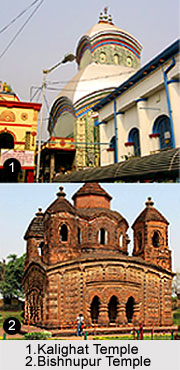 Bishnupur in the Bankura district has a group of such temples, undoubtedly built during the days of the Malla Rajas, who are known to have encouraged temple-building. The Lalgiri temple is built in laterite, has a single tower, and probably dates from 1658 A.D. The Madan Mohan temple is in brick and was erected in 1694 A.D. The Shyam Rai (1643 A.D.) and the Madan Gopal (1665 A.D.), built in brick and laterite, respectively, have five towers and are of the panchayatana type. The external decoration of these temples, particularly of those constructed in brick, consists of square panels of terracotta reliefs, the subject-matter of which is often secular and thus of considerable sociological interest.
The jor-bangla or double temple is a structural variation of the same type and resembles two thatched huts joined together and surmounted by a single tower. The Krishnaraya temple built at Bishnupur in 1726 A.D. and the Chaitanya temple at Guha-para in the Hooghly district are typical examples. A single hall or thakurbari, on one side of which is the vedi or altar, is the main feature of the interior of these buildings. Above this is an upper gallery running round the circuit of the thakurbari.
Calcutta Jain Temple or Parshvanath Temple
Calcutta Jain Temple or Parshvanath Temple is placed in Badridas Temple Street and was constructed by Shrimal Jain who was a Marwari. The temple complex consists of Mahaveer Swami Temple, Shitalnath Ji Temple, Chandraprabhu Ji Temple and Dadawadi Temple. The main deity of Parashwanath Temple is Lord Pareshnath, who was the 23rh Jain Tirthankara.
Kapil Muni Temple at Sagar Island<
This heritage temple is located at Sagar island. Idols of Ram, Sita and Bhagirath are also present in Kapil Muni Temple. Devotees and visitors bathe in the River Ganga prior to offering their prayers to the deity. This temple possesses a block of stone, which is believed to be the representation of the sage Kapil.
Temples of Terracotta in West Bengal
Temples of Terracotta in West Bengal represent one of the finest forms of Indian architecture. These temples were constructed mainly during the period when Hinduism was experiencing a revival with particularly a cult of Lord Krishna. Influences of various forms of art can be found prominently in the terracotta architecture of the temples. Styles of neighbouring regions have also combined with this architecture.
Rasmancha : Rasmancha is an ancient brick temple constructed by King Bir Hambir in 1600 CE. It is located in the Bishnupur town, Bankura district. Once, the most enchanting event of this temple was Vaishnava Ras festival during which all the Radha Krishna idols of the town were brought in the temple. This practice was continued up to the year 1932, where a sea of devotees assembled here. The temple is one of the famous terracotta temples of West Bengal which comprises of an elongated pyramidical tower surrounded by turrets resembling the shape of a hut.
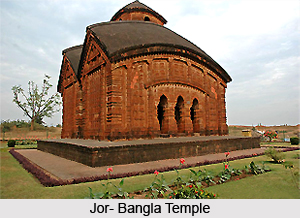 Jor-Bangla Temple : Another famous terracotta temple of West Bengal is Jor-Bangla Temple. Keshto Ray and Gouranga are the presiding deities of this temple. The temple was built by King Raghunath Singha Dev II. The temple exhibits exquisite terracotta art and classical chala style of Bengali architecture.
Pancha Ratna Temple : Pancha Ratna Temple is dedicated to Shyam Ray. The temple is adorned with beautiful terracotta carvings. Standing on a low square plinth, the temple includes an ambulatory pathway and a porch that opens to three arches. The central Sikhara of the temple is octagonal in shape whereas other four Sikharas are square. Aspects of Lord Krishna`s life are depicted on the walls of the temple. This temple was built by King Raghunath Singha.
 Madanmohan Temple : Madanmohan Temple was constructed by King Durjana Singh Deva in 1694. Madanmohan is the presiding deity of this temple. Ekaratna style of architecture decorates this temple. The temple consists of a square flat roofed building having carved cornices. Magnificent depictions of scenes from Mahabharata, Ramayana and Indian Puranas can be witnessed on the walls of the temple.
Lalji Temple : Beautiful Temples of Terracotta in West Bengal also enlist Lalji Temple. This temple was built by Bir Singha II in 1658 and is dedicated to Radha and Krishna. The temple also exhibits Ekaranta style of architecture. Ornamental stucco adorns this temple which stands on a square raised plinth.
Radhya Shyam Temple : Radhya Shyam Temple is another temple dedicated to Radha Krishna. This temple is another spectacular manifestation of terracotta carving. In 1758, this temple was built in Ekaranta style by Chaitanya Singha. The temple comprises of a dome shaped sikhara and stucco patterns with floral and geometric motifs. Scenes from Indian Puranas are also beautifully depicted on the walls of the temple.
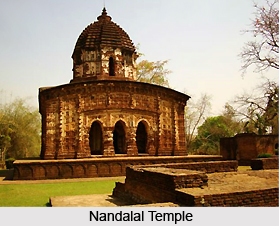
Nandalal Temple : Nandalal Temple was built in 17th century. The temple consists of a single tower which rests on a curved roof. Little decorations can be seen on the lower part of the temple.
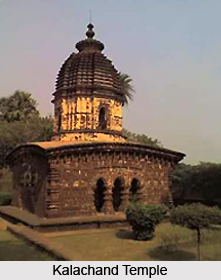 Kalachand Temple : Kalachand temple is another beautiful manifestation of terracotta architecture. The temple was built in Ekratna style by King Raghunath Singha.
Radhavinod Temple : Radhavinod Temple was constructed in 1659 by Raghunath Singha I. The temple was built in brick and has beautiful terracotta decorations.
Madangopal Temple : Another terracotta temple of West Bengal is Madangopal Temple. In the year 1665, this temple was built by Shiromani Devi, Queen of Veer Singha II. The temple is considered as a pancharatna mandir.
Mrinmayee Temple : Mrinmayee Temple was built in 997 AD by Jagat Malla. In this beautiful terracotta temple, Durga Puja is celebrated for 15 days.
Other Temples of Terracotta of West Bengal : Apart from these, other terracotta temples of West Bengal include Murulimohan Temple, Radha Govinda Temple, Radha Madhab Temple, Chhinnamasta Temple, Sanreswar temple, Malleswar temple, Krishna-Valaram Temple, Sarbamangala Temple and Radha Vinod Temple.
Variation of this art was not only confined to the architectural styles of the temples. Beautiful baked clay panels also covered the walls with different geometric and foliate motifs. Rich iconography can be observed in these temples which had evolved during the seventeenth century having religious and secular themes. The immense creativeness during that period had conferred great beauty and uniqueness to these temples.
Temples of Lakhnauti
The temples at Lakhnauti, which was the capital of the Sena rulers, were built of black basalt obtained from the neighbouring Rajmahal hill. These ornate structures were despoiled by the Muslims in 1197 A.D. and their remains were used to build a Muslim capital at Gaur. The temples of Varendra (Northern Bengal) were similar in many respects to the Mahabodhi temple at Bodh Gaya. The masons of the Vishnu temples of the 11th and 12th centuries joined the courses of their stones by means of molten metal. In what is now the Mazar of Zafar Khan Ghazi at Tribeni in the Hooghly district, two compartments have been identified as the antatrala and mandapa of a Vishnu temple of the Lakhnauti style, and therefore of the Pala-Sena period..
Other Temples of Kolkata
Important temples in the district include the Bakranath Temple at Bakreswar, Bansuli Temple at Nannur, Bargabhima Temple at Tamluk, Brindabanchandra Temple at Guptipara, Chinese Temple at Achipur, Dhirdham Temple at Darjeeling, Ekteswara Temple at Ekteswara, Jagannath Temple at Serampore, Jain Temple Ruins at Boram, Jain Temples at Deoli, Jateshwarnath Temple at Mahanad, Kalna Shiva Temples at Kalna, Kanak Durga Temple at Chikligarh, Kiriteshwari Temple at Murhsidabad, Krishnarjun Temple at Tamluk, Malleswar Temple at Chandrakona, Radha Kanta Jiu Temple at Rajbalhat, Sarva Mangala Devi Temple at Garbeta, Shivakhya Devi Temple at Amaragarh.