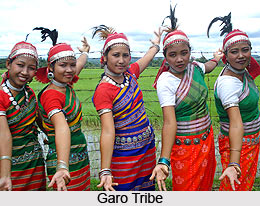
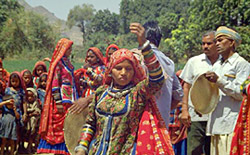
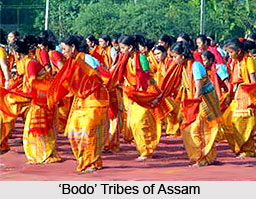
 Bodo tribe is considered as the earliest immigrants in Assam and are said to be the most culturally rich community of the north-western parts of the state. `Bodo` is derived from the term `Bod`, which means Tibet, thus signifying that majority of the Bodos arrived from Bhutan passes. The 6th Schedule of the Constitution of India has conferred the Bodo tribal community the status and prestige of a tribe. Bodo tribes are found in several places of Assam. The Bodos are concentrated in the regions like Kokrajhar and Udalguri in Assam. As per historical records, the Bodos were referred to as `Meche` or `The Mech`. The Bodo tribe prefer addressing themselves as `Bodosa` which means, the son of Bodo.
Language of Bodo Tribe
As far as the languages are concerned, Bodo tribal people speak Bodo language, which has been derived from famous Tibeto-Burmese language family. For writing, majority of these Bodo tribes of the primitive ages make use of the Roman script and Assamese script. As a recent phenomenon, this Bodo tribal community has taken up the Nagari script. There are also some eminent scholars who are of the opinion that the Bodo language</b> has developed their indigenous script, which is popularly called `Deodhai`.
Culture of Bodo Tribe
This tribal group is known for their rich and diverse culture. Cultural exuberance of the whole of the society of the Bodo tribal community incorporates elements like dancing, singing, language etc. Also if one studies the society of the Bodo tribal community, one can find several surnames like Bargayary, Basumatary, Bodosa, Boro, Brahma, Bwiswmuthiary, Dwimary, Goyary, Ishlary, Ishwary, Khaklary, Mushahary, Narzary, Owary, Sargwary, Sibigry and Wary.
Like many of the tribal communities of Indian subcontinent, these Bodo tribes have got orientation towards religion as well as spiritualism. Despite the advancement of Hinduism amongst the Bodo tribal community, the majority of Bodo Hindu follows a set of rules called `Brahma Dharma`. Also there are various religious practices and beliefs have been adapted by all the Bodo tribal people over the years. However, in the contemporary period, these Bodo tribes have undertaken the diverse practices like Bathouism, Hinduism and Christianity. To be precise, Bathouism is a special type of worship of progenitors, better known as `Obonglaoree`.
Dresses of the Bodo tribal community are quite exquisite, thereby exhilarating the beauty and glamour of females to a large extent. The conventional dress of a Bodo female is popularly called `Dokna`, which these Bodo women knit themselves. Shawls also are in fashion amongst the Bodo tribal community.
The Bodo tribal community is very fond of their conventional drink, called `Zu mai` where `Zu` means wine, `Mai` means rice. For most of the Bodo tribes, rice forms the staple diet and is usually savoured by a non vegetarian dish. Apart from these, Bodos are fond of `Oma Bedor`, `Onla` and `Narzi` and these are their main cuisines.
Fairs and festivals constitute a significant part of the culture of the Bodo people. One of the most cherished festivals of this tribal group is `Baishagu`. It is basically a springtime festival and is celebrated during mid April. These people are popularly known for their colourful folk dances.
Occupation of Bodo Tribe
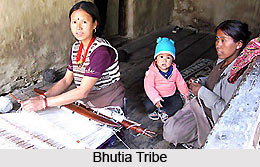
Over the years following the traditions and culture of some of the other tribal communities of the whole of the Indian subcontinent, these Bodo tribes too have taken up several occupations. In the early years, this Bodo tribal community has practiced of all types of cultivation and farming. Rice farming, tea plantation, pig and poultry farming, and silkworm rearing are quite significant amongst them. Moreover, the Bodos are excellent bamboo craftsman and the Bodo tribal community has also developed craftsmanship in creating several products from things like bamboo. Weaving is also a popular occupation of the Bodo tribes. All the exquisite products that these Bodo tribes have created over the years have been the main force of enabling the Bodo tribal community to reach to its zenith. Several Bodo families rear silkworms. Amongst the Bodo tribal females, weaving has gained fame and popularity. Since a very early age, these Bodo girls learn the art of weaving, and thus loom is an inseparable object in the courtyard of a Bodo house.
Further, some interesting points have been inferred by the anthropologists, which have carried on surveys on their lives. This Bodo tribal community speaks the language, having the same name. In the Bodo Language `Ba` means five and `thou` means deep. Bodo tribe represents one of the largest of 18 ethnic sub-groups of Kacharis group.
Administration of Bodo Tribe
During the 1930s, Gurudev Kalicharan Brahma, who was the only leader of the Bodo tribe presented a memorandum to the Simon Commission. The memorandum contained a proposal for a separate administrative set-up for the regional tribes of the state of Assam, as well as the local inhabitants. The British Raj refused to agree to their demand. Even after the Indian independence from the British Raj, such demands were not entertained by the State government.
A second phase of Bodoland Movement surfaced, in the 1960s. In 1967, a second Union Territory termed as `Udhayachal` was demanded by the Bodo leaders, through a movement. However, the State government and the Central government did not relent to the demand of creating separate political setup for local tribes and residents of Assam, since the movement was not quite strong.
Much later, during the 1980s, Bodo leaders spearheaded a third mass movement for Bodoland. Upendra Nath Brahma, a Bodo leader led a movement in the latter part of 1980s, which was aimed at establishing the individual identity of the Bodos. This man is revered as the `Father of the Bodos` or `Bodofa`.
The Bodoland Autonomous Council or BAC was established in the year 1993 by the Assam government in order to grant the Bodos their political powers. The peace alliance which was formed between the government of Assam, Bodo People`s Action Committee (BPAC) and All Bodo Student`s Union (ABSU) was unsuccessful. This had occurred since several provisions of the peace Accord had not been implemented. Finally, the Bodoland Territorial Council was granted to the Bodos on 10th February 2003.
These Bodo tribes are amongst the primitive settlers of the valley of Assam. Kokrajhar town is regarded as the hub of the Bodo tribal community. Other main concentration of the Bodo tribes includes the Brahmaputra valleys and also its adjacent areas.