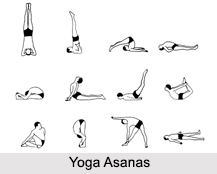
Yoga Asana, traditionally, means a `sitting condition` or `position` of the body, which contributes to the steadiness of the body and mind and a sense of well-being. Acoording to Kamadhenutantra in the word Asana, `A` stands for Atmasamadhi, `sa` for Sarvarogapratibandha and `na` for Siddhiprapti. It has also been discussed by Patanjali as a bodily pose which conforms to steadiness (sthairya) and is also equally pleasant and comfortable (sukham). On the other hand, Vachaspati Misra, an ancient Indian philosopher, interprets it as the manner of sitting or the seat whereon one sits. In a nutshell, the yoga asanas can be defined as postural patterns. One has to achieve this pattern slowly, maintain it for sometime steadily and release it again in a slow and smooth manner. Moreover, an asana is an attitude which is psycho-physiological in nature. Most of these postural patterns are based on the natural postures of various animals, birds or even the symbols like tree, lotus, bow and plough, etc.
History of Yoga Asanas
Though it was Maharishi Patanjali, who for the first time mentions yoga asanas, the history of these postural patterns goes back even earlier than the days of
Patanjali. He merely systematised all the information which had been handed down by previous generations. There are various references in the Vedas, Brahmanas, Aranyakas and the earlier
Upanishads about these practices. Besides, Lord Shiva is often seen sitting in the pose of padmasana; thus, indicating that yoga asanas were practised in ancient India as well. In fact, the ancient yogis patiently studied the varied influences of these postures on individual beings. They must have also further scrutinised their relative merits by analytical comparisons and thus formulated, after years of research, a complete course of posture training best suited to students of self-culture. Thus, the knowledge of these asanas was handed down to the disciples and finally, they were compiled by Patanjali.
Characteristics of Yoga Asanas
As far as characteristics of yoga asanas are concerned, the
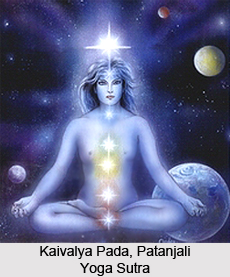
Patanjali Yoga Sutra discusses these in details. Patanjali states important aphorisms dealing with their principles, objectives, effects and also the benefits. These aphorisms provide an individual a comprehensive idea about the main attributes of the yoga asanas. Patanjali opines that yoga asanas provide stability to both the body and mind. Such stability leads an individual to the sense of well-being. To achieve this one requires relaxed conditions or effortless maintenance of asana. This, in turn, frees the mind and enables it to be attached with infinity or attain salvation (moksha).
Aims of Yoga Asanas
Yoga Asanas are psycho-physical practices to culture body and mind for further higher practices of yoga like
pranayama, pratyahara, dhyana, etc. Hence they form an integral part of the yoga curriculum. The asanas make body and mind healthy and these are trained in such a way that a necessary equilibrium is established in overall functions. One reaches the stage of asanajaya, i.e. mastering the asanas which is possible after a good deal of practice of asanas for a long time. Yoga Asanas are also expected to counteract the instability in the body. This instability or fickleness (tremor) is due to chronic disturbances in the muscular tone, which lead to the imbalance in the muscular activity. This tonic imbalance is corrected and diseases are cured by practicing yoga asanas. They tackle the root cause of the imbalance such as emotional conflicts, stresses, tensions, etc. These also overcome the imbalance in other functions of the body, e.g., endocrinal secretions. Thus, yoga asanas mould our body and mind and make them strong and healthy.
Types of Yoga Asanas
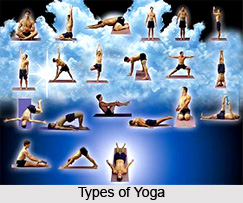
Yoga asanas can be classified by considering their anatomico-physiological features and effects, in three major groups:
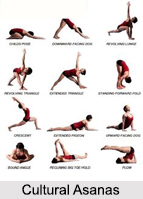
1. Cultural Asana: This group of yoga asanas is meant for reconditioning the human body and mind and to bring about stability, peace and a sense of well-being. Most of them work on the abdominal part. Even though the individual looks outwardly normal, his psycho-physiological status may not be suitable for counter-balancing the effects of higher yogic practices and therefore, it must be corrected and moulded or cultured in a very special way. Thus, these yoga asanas would remould and prepare the individual for the practice of pranayama, dhyana, etc. The postural defects, disturbed function of various systems, improper muscle tone must be corrected in order to cultivate correct mental attitude.
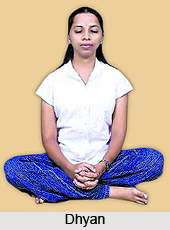
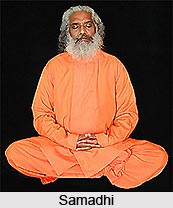
2. Meditative Asanas: These yoga asanas provide a comfortable and stable position of the body to make the mind steadier for the process of
meditation, dharana, samadhi, etc.,
Padmasana, Sidhhasana,
Swastikasana, and
Samasana are meditative asanas which are maintained for long duration.
3. Relaxative Asanas: Shavasana and Makarasana are two important relaxative asanas, which bring about relaxation of the body and mind. They eliminate the physical as well as mental tensions and work at the level of `chitta` (subtle aspect of consciousness). This process of tranquilisation further helps in Pranayama, Dhyana, etc., as it contributes in increasing one`s concentration.
Benefits of Yoga Asanas

Regular practice of yoga asana benefits the practitioner in various ways. Asana enables on to control mind; improves digestion; exercises spine; keeps nervous system in good condition and improves the working of Endocrine Glands. Yoga Asanas also boost oxygen flow throughout the body. Supply of oxygen to the body is completely dependent on the respiratory system. Lengthened deep and rhythmic breathing associated with each movement multiples the competence of respiratory system. Further, oxygen-rich blood is supplied to every tissue of the body and this in turn helps the body to be healthy. These help to strengthen the muscular system as well. The various postures ensure that every part of body, even the smallest gland, receives proper attention. The aim of yoga asanas is to achieve strength and to promote health. Lack of motion in the joints can lead to their mal-adjustments and degeneration. Stretching and contracting postures make muscles strong and healthy. It is scientifically proved that the effort given to practice yoga asanas can bring about maximum contractibility of the entire muscular system and consequently raise the tone and increase efficiency. When this simple truth is applied to internal organs, physical efficiency is gradually multiplied and the height of biological perfection is achieved.
However there are a number of factors that should be considered while practicing yoga asanas. Children up to the age of 5 years should not practice yoga asana. Between the age of 5 to 10 years, children should practice meditative poses for controlling their mind. Children between the age of 10 to 16 year are considered to be in a period for rapid growth of height and weight. Hence they should do meditative as well as cultural asana. Upto 40 years all the yoga asanas can be practised. After middle age, yoga postures that strain the muscles should not be practiced.
Practicing yoga asanas should also follow a proper procedure to attain best results. Yoga Asanas should be done in a quiet and well-ventilated place. Quiet place helps for more concentration on co-ordination between breathing and body movement. Well ventilated place provides fresh air and asana should be done with an uninterrupted and quiet mind. Hence, it is better to start with any meditative asana like sukhasana, vajrasana and so on. During asana concentration should be on the movement. Each asana should be done with complete attachment of mind. Nose and throat should be cleaned of all mucus before practicing asana so that breathing during asana remains comfortable.
The best time for practicing asana is in the morning. It should be practiced before having breakfast as at this time the energy is at the highest and therefore, the movements can be done with ease and freshness. Further, mind is calm during this time. Asana can also be done in evening before the dinner. Yoga asana should strictly not to be practiced after taking food. Using mat or woolen carpet is preferred while practicing asana as these ensures uniformity of temperature by insulation against ground contact. Before commencing yoga asanas, it is advisable to empty the bladder and the bowels, and drink a glass of water neither too hot nor too cold. Then, after fifteen minutes, one can begin with the yoga asanas. What needs emphasis is the fact that asanas need to be followed with particular enthusiasm and regularity during winter to maintain normal blood circulation and to keep the blood warm.
Yoga postural pattern play a vital role in yoga and is of greater significance with the effect of physical training on the nervous system. In
Yoga, the physical body merely serves as a medium of education for the mind, and the nervous system, thus, assumes paramount importance. All the yoga asanas or postures, thus, aim at controlling, purifying and coordinating the nervous system rather than at muscular display and strength. They aid in achieving poise and controlling the body and the mind through non-fatiguing methods.