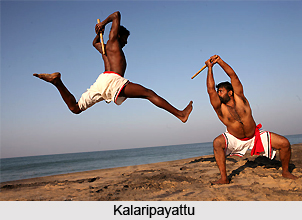
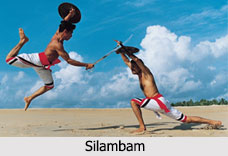
 Silambam is a weapon-based Indian martial art from Tamil Nadu. It is a popular type of fencing based on stick fighting. Silambam is the world"s first and foremost martial art that had a disciplined structure. The British who ruled for nearly 200 years completely prohibited the art. Much of the vast techniques and style in Silambam have been lost because of different development of Tamil Nadu, especially by the British. It is closely related to "Kalaripayattu" of Kerala.
Etymology of Silambam
Silambam derives its name from the Tamil word "silam" meaning "hill" and "bam" meaning "bamboo". The bamboo used in this sport is a particular type of bamboo from the Kurinji hills in present-day Kerala.
History of Silambam
Silambam apparently originated some 5,000 years ago. This ancient fighting style is mentioned in Tamil Sangam literature. Silambam was supported by the ancient Chola, Chera and Pandya kings of south India in the Sangam era. It has been widely used by Maravar pada of Travancore army. Silambam staff was one of the martial art weapons, which was in great demand among the tourists. King Veerapandiya Kattabomman relied for the most part on their expertise in Silambam in their warfare with the British Army.
Weapons of Silambam
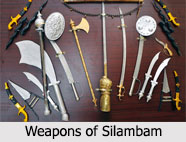
The major focus of Silambam is on the bamboo materials. The length of the bamboo depends on the height of the specialist. Preferably it should just touch the forehead about three fingers from the head. Different lengths may be used depending on the position. Separate practice is essential for the stuffs of different lengths. Following are some of the weapons used in Silambam:
Silambam: It is a material, preferably made from bamboo. The material is engrossed in water and braced by beating it on the surface of still or running water. It is frequently tipped with metal rings to stop the ends from being damaged.
Maru: It is a thrusting weapon made from deer horns.
Aruval: It is a sickle which is often paired.
Panthukol: It is a material with balls of fire or weighted chains on each end.
Savuku: It is a belt.
Vaal: It is a sword, generally curved in shape.
Kuttu katai: It is spiked knuckleduster.
Katti: It is a knife.
Kattari: It is a native push-dagger with an H-shaped handle. Some are
skilled at piercing armour. The blade may be straight or wavy.
Suruttu kaththi: It is a flexible sword.
Sedikuchi: It is a stick, often wielded as a pair.
 Training of Silambam
The first stages of Silambam training are supposed to present a foundation for fighting and to condition the body for the training itself. This includes improving better flexibility, quickness, hand-eye synchronization, kinaesthetic consciousness, balance, strength, speed, muscular stamina and cardiovascular energy. There are 16 footwork among them four are very important in Silambam training.
Styles of Silambam
The styles of Silambam differ from one another in grip, posture, foot work and length of the stick. There are about 18 different styles of Silambam practiced today. They are:
Nillai Kalakki (Practiced mainly in Malaysia and Singapore)
Karnatakan (Practiced mainly in southern Karnataka)
Kuravanji (Practiced mainly in Kerala)
Kuthu Kuravanji
Komberi Mookan
Paniyeri Mallan
Minnal Veeran
Minnal Vettu
Nagam-16
Naga Pasanam
Kalla-Pathu
Thuluk Kanam
Markanam
Kida Muttu
Kalyana Varisai
Tomman Kuthu
Paarvai Vilayaatu
Kallagam
Techniques of Silambam
Silambam favours the hammer grip with the foremost hand facing down behind the weak hand which faces up. The weak hand only touches the stick and to show its movement. The ice pick grip is used in single hand hits.
Silambam also has a mixture of locks called "poottu". Locks can be used to disable the enemy or simply capture their weapon. Techniques called "thirappu" are used to counter the locks. Silambam also has many defensive moves like blocking, parrying, enduring, turning parrying, hammering, moving out, jumping high, etc.
Contest of Silambam
Silambam is fought on an even and hard surface, but never on a dirty or slippery area. Silambam begins with salutations to God. The play field is round having a radius of 20-25 feet. The attack takes place in 4 rounds. One-minute break is granted at the end of rounds one and 3 first rounds and three minutes at the end of the second. During the contest, a fighter holds the stick in front of their body stretching the arms. From there, they can set off all attacks with only a movement of the wrist. Since the stick is held in front, the fighter does not conceal their intentions from the challenger. They attack with absolute speed. Bluffs may also be used by disguising one attack as another.
Silambam contestants do not hold out their sticks as they do in single battle against the multiple attackers. When two experts are against each other, one may challenge the other that he will hit his big toe. Hitting the big toe can create crippling effects on the fighter and this is called "solli adithal" which means "challenging and effectively hitting".
Costumes of Silambam
The contestants of Silambam wear "langots" of different colours, sleeveless vests, turbans, canvas shoes and a chest guard which is a part of the traditional clothing of Palmyra tree climbers. Wicker-work shields also form a crucial part of the gear.