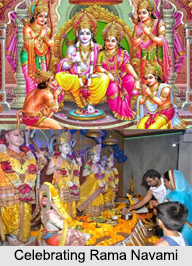
 The festival of Rama Navami falls on the 9th day of the Shukla Paksha in the Hindu calendar month of Chaitra, which is on the last day of the Chaitra Navaratri. Celebrating the birth anniversary of Lord Rama, the Hindu festival of Rama Navami is a spring time Indian festival.
Origin of Ram Navami
As the 7th incarnation of Lord Vishnu, Lord Rama is particularly important to the Vaishnavism tradition of Hinduism. The festival of Rama Navami celebrates the descent of Lord Vishnu as the avatar of Rama, who was born to King Dasharatha and Queen Kausalya in Ayodhya. The purpose of Lord Vishnu incarnating himself on Earth was to defeat the demon king Ravana, who was wrecking havoc on the people. Ravana was invincible, as he had received several boons from Lord Brahma and consequently could not be killed by any God. Thus, in the human form of Rama, Lord Vishnu defeated Ravana.
Rituals of Ram Navami
The day of the festival of Rama Navami is marked by worshipping the Lord by singing devotional songs such as bhajans and kirtans, by fasting and reading religious scriptures on Lord Rama"s life. Excerpts from the "Ramacharitamanas", praising Lord Ram, are also recited. Lord Rama`s devotees fast for 9 days with fruit and milk, whilst some fast on the 9th day only. This is one of the 5 Mahavratas observed since ancient times.
 Celebration of Rama Navami
The festival of Rama Navami is hugely popular in the Indian states of Bihar, Uttar Pradesh, Jharkhand, Telangana, Andhra Pradesh and Tamil Nadu. Cities that were mentioned in the Indian epic, Ramayana, like the city of Ayodhya in Uttar Pradesh, Rameswaram in Tamil Nadu, Bhadrachalam in Telangana and Sitamarhi in Bihar, organize major celebrations in honour of the birth anniversary of Lord Ram.
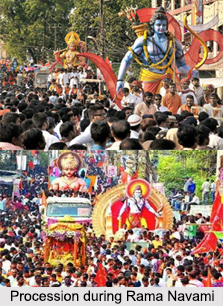
In Ayodhya, the devotees take a dip in the sacred river Sarayu and then visit the Ram temple. In several places, Ratha Yatras or the chariot processions, also known as Shobha yatras of Lord Rama, Sita, his brother Lakshmana and Lord Hanuman, are taken out. While in some places, the festival of Ram Navami is celebrated as the wedding anniversary or Kalyanotsavam of Lord Rama and Sita. And in some communities, Lord Surya is also a part of the worship and ceremonies.
The festival also promotes charitable events like organizing community meals for those in need. In Karnataka, some local organizations disperse free food and panaka, which is a concoction of jaggery and crushed muskmelon juice. Then in Bengaluru, the Sree Ramseva Mandali organizes India"s most prestigious, month-long classical music festival. This musical extravaganza is almost 80 years old and celebrates the Indian classical musicians, irrespective of their religion, from both genres, Carnatic and Hindustani. These musicians offer their musical rendition to Lord Ram and the assembled audience.
In the eastern Indian states like Odisha, Jharkhand and West Bengal, the Jagannath temples and regional Vaishnava community observe Rama Navami, and treat it as the day when preparations begin for their annual Jagannath Ratha Yatra in summer. Even today, Lord Rama serves as an inspiration to many Hindus.