 The Hindu festival of Onam is a major annual event for Malayali people in and outside the South Indian states. In the state of Kerala, the festival of Onam is the official state festival, which falls in the Malayalam calendar month of Chingam. In the South Indian states, the harvest festival of Onam is among the 3 major annual Hindu festivals like Vishu and Thiruvathira.
Legends of Onam
There are various legends surrounding the ancient Hindu festival of Onam and its history dates back to the Sangam period, when the festival used to be celebrated for a month. According to the Vaishnava mythology, it is said that after coming to power the asura king Mahabali was known for his generosity. The Gods were threatened by his growing popularity and so they went to Lord Vishnu for help, who guised himself as a poor Brahmin called the Vamana and arrived at the kingdom of the demon king. He asked Mahabali to grant him the land which he can cover within 3 feet. Being a kind hearted and charitable person, the king granted his wish and soon the Vamana started to grow in size and his first and second step covered the sky and earth. As the Brahmin was about to take the third step, the demon king stepped up and asked him to keep his last step on his head which lead him to Patala. However for the good deeds of Mahabali, Lord Vishnu granted him a boon that he can annually visit his people which led to the celebration of the Onam festival.
An alternate legend behind the festival rel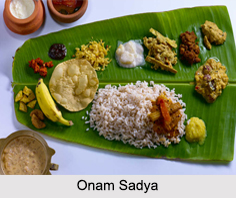 ates to the sixth incarnation of Lord Vishnu, Parshurama, whose legends are attested in texts and epigraphs dating back to the 2nd century. It is said, Parshurama was upset with the kings and warrior clan who were always at war with one another. So one day, when king Kaartavirya came into Parshurama"s hermitage and stole his calf, Parshurama called him to war, and killed the king and all his oppressive warriors. At the end, he threw the axe, and wherever it fell, the sea retreated, creating the land of Kerala and other coastal western parts of Indian subcontinent. The Onam festival, according to this legend, celebrates Parashurama`s creation of Kerala by marking those days as the New Year.
Celebration of Onam
Significant to the Hindus, the festival of Onam brings people together and eliminates all the religious disparities and propagates harmony in the society. The most impressive part of Onam celebration is the grand feast called Onam Sadya, prepared on Thiruonam. It is a 9 course meal consisting of 11 to 13 essential dishes and is served on banana leaves.
Across the state of Kerala, the festival of Onam starts off every year with a parade called Athachamayam at Thrippunithura near Kochi. The parade features elephants marching, drum beats and other music, folk art forms, floats and colourfully dressed people with masks. The history of this parade dates back to the time when the Kochi king used to head a grand military procession in full ceremonial robes from his palace to the Thrikkakara temple, meeting and greeting his people. The procession path historically has been from Trippunithura to the Vamanamoorthy Temple in Thrikkakara, Ernakulam district. The temple is dedicated to Vishnu in his Vamana avatar.
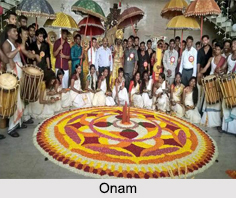
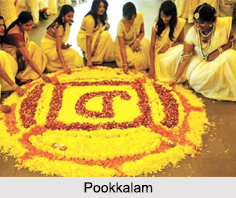 Another tradition in Onam is the arrangement of floral carpet known as Pookkalam, which is made out of the gathered blossoms with several varieties of flowers of differing tints pinched up into little pieces to design and decorate patterns on floor. These are placed particularly at entrances and temple premises like a flower mat with lamps in the middle or the edges. This traditional ritual of laying pookkalam starts on the Atham day with small flower mat, which grows in size progressively with each day of the Onam festival.
On the special day, each and every member of the family wears new clothes or `vastra`. These people wear new clothes and visit as much temples as they can and take part in lots of dance including `Thumbi Tullal`, `Thiruvathirakali`, `Pulikhali tribal dance etc. which are some of the few popular dance-forms performed in this southern Indian festival.
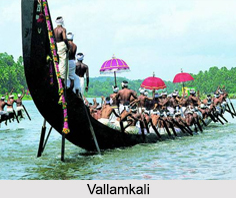 Another major attraction of the Onam festival is `Vallamkali`, which is a famous boat race. In the boat race, more than hundreds of men row the boats accompanied by the beating of cymbals and drums. A prominent thing which is noticed is that above each and every boat there is a scarlet-coloured silk umbrella and some gold coins hanging from the umbrella. The race is very popular where several boats compete with each other in order to win the race. The race is particularly featured on the Pampa River, which is considered to be sacred in Kerala.
Elaborate feasts, folk songs, elegant dances, energetic games, elephants, boats and flowers are all a part of the dynamic festival of Onam.