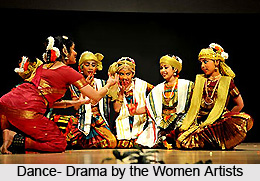
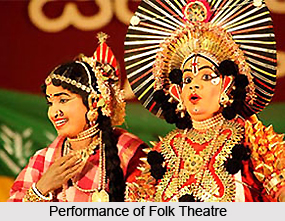
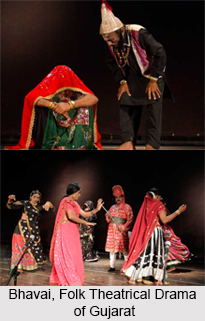
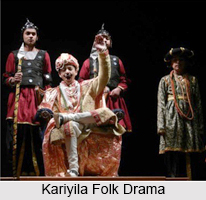
Indian drama and theatre are considered even older than the tradition of Indian dance and music and possess the infrastructural lineages from classical theatrical conventions which have had influenced modern theatre, especially the Hindi, Marathi and Bengali plays. Drama in India portrays people going through specific eventful period in their lives, blending serious with the humorous. Though there are tragic situations, there is no tragedy as such in Indian stage. A product of Indian culture which does not entertain Death as the end of everything even holds the notion that `right` and `virtue` triumph eventually. Thus Indian drama bears the testimony of a sing song happy ending! A play comes fully to life only on the stage, where it blends into numerous arts that have been developed by those of the author, director, actor, designer, production team and others. Dramatic performance involves an intricate process of rehearsal, based upon imagery inherent in the dramatic text. When drama is performed in India, a play is generally divided into acts and scenes where the intermissions are satiated by musicians unlike West where One act plays are in vogue.
Umpteen lyrical scenes lead to the description of charismatic passionate tit-bits in nature including a flow of moral observations, logical knowhow`s and depicting the principles of wisdom.
History of Indian Drama
History of Indian drama has its deep roots embedded in Indian Sanskrit drama. The origins of drama in India are lost in myths, rituals and dialogues of the Veda. Tradition also points to the Vedas as the source of the departments of drama; speech deemed to be derived from the recitation of Rig Veda, song from the singing of Samaveda, action from the Yajurveda, which concerns itself with the sacrificial performances and the sentiments from Artharvaveda. In the initial times, dramas were penned down on the basis and foundation of the epics and Indian Puranas. Indian drama sojourned during the Vedic Period, precisely with the enactment of Rig Veda. The Natyashastra (dramaturgy) by Bharata depicts everything about composition, production and enjoyment of ancient Indian drama. The great epics of Ramayana and Mahabharata and their times, imbibed with the richness infused by scholars that have taken the concept of drama in India to higher plains and only to reach the sky! Valmiki, Ved Vyas and Panini also had shed decisive light on dramaturgy and Patanjali had heartily contributed in his Mahabhashya that there existed two dramas, Kansa Vadha and Vali Vadha.
In the 15th century, Indian theatre had almost disappeared due to the foreign invasions in the country; it had been the Dark Age for artistic progression. Gradually, Loknatya climbed the ladder of popularity from 17th century, as many states developed their own forms of drama and initiated their active roles in Art Crusades. Bengal evolved the styles like Yatrakirtaniya;or Pala Gaan in Gujarat the forms comprised Bhavai, Ramlila; in Madhya Pradesh, Mach; in northern India Nautanki developed, along with Bhand, Ramlila and Raslila; in Kashmir Bhandya Thar; in Assam it was Ahiyanat and Ankinaat etc. Colonial period manifested radical change in Indian drama, setting the stage on fire with the translation of Kalidasa`s Shakuntala, by Sir William Jones in 1789. In 1850, modern theatrical activity originated in Bengal, Karnataka and Kerala also, adding feathers to the crown of Indian drama.
It is also evident that every writer, whichever background or genre, did belong to the Hindu religion. This founding religious mode later paved the way for various religious diversities in India. As such the origin of Hindu drama in India comes under crucial and decisive limelight and securitisation, when present-day and later dramatic and theatrical performances are concerned.
Performances in Indian Drama
The performances in an Indian drama unfurl with a `Vandana` or prayer and then moves on to the appreciation of the assembled spectators and finally meanders to a brief of the upcoming performance. All dramas have a Prologue mentioning the author and his work. The play is segregated into acts and scenes with musicians performing in the intervals. Most of the play is presented in prose with the diversion of poetry in four lined stanzas, used to uphold the emotional passages.
Movement of the plot is in five junctures or Sandhis, Opening, Progression, Development, Pause and Conclusions, these junctures being worked by the interaction of five stages of action namely Beginning, Effort, Hope, Certainty and Success with five elements of the story called Seed, Continuity, Major episode, Minor episode and Denouement. Moreover lyrical scenes are enacted where the beauty of nature is glorified. Generally the heroes and important characters speak in Sanskrit, the women, slaves, and minor characters use the lower class dialect. Passionate love, feelings of anger, hate and jealousy and violence, is not permissible. Though the unity of time or place is not place is not observed unity of action is highly maintained by developing one Rasa: Sringara (love) or Vira (heroism). Moreover, the acts of sleeping, scratching, eating, yawning and kissing are also regarded inappropriate and generally avoided. Supernatural and magical elements are incorporated where the essential characters are bewitched or cursed. The play concludes with a prayer as well.
The production of drama in India was infested with Stratified hierarchy; absolutely an involvement of the elite, who arranged for such festivities in honour of an enthronement, a lunar holiday, a royal marriage, or the birth of a royal successor. The actor`s profession was always looked at with deference and there was no objection to women being utilised and acting on the stage. In many ways, however, Indian drama unwrap the social philosophy upon which the caste system is based, as well as a profound religious feeling. Great importance is attached to the idea of self-sacrifice which is at par with the highest form of self-realisation.
Popular Plays of Indian Drama
The most famous plays of Indian Drama were probably written by the two greatest playwrights, Bhavabhuti and Kalidasa. The earliest extant stage piece, The Little Clay Cart, attributed to a sovereign named Sudraka, is the earliest extant stage piece of Indian drama. The play is in all probability dated sometime before 400 A.D. This is one of the few oriental dramas treating, in part at least, of middle-class lives and everyday living. Kalidasa`s Shakuntala is most popular amongst the Europeans as it was translated into English by Sir William Jones in the year 1789. The play divided in 7 acts, and the plot is inspired from the 1st book of the Mahabharata. "The Rise of the Moon of Knowledge" is a theological and figurative play divide into 6 acts, where qualities like willpower, reason, and a truant vice like recklessness of man are portrayed.
Other popular works of Indian Drama include "The Signet of the Minister", a political piece; and "The Binding of a Braid of Hair".
Contemporary Indian Drama
After Indian Independence Act 1947, Indian drama has made an attempt to segregate dramas in 2 broad segments of Professional Theatre and Non-Professional Theatre. Bengali, Marathi and Hindi plays have developed over the span of years and the demand for them has acted as a stimulant factor for their growth.
The Sangeet Natak Academy in Delhi offers support in sponsoring, research, propagation, admiration and benefaction of Indian Drama. Indian Drama has now evolved into much improved level that has found admiration and appreciation in the global stage.
Indian Drama
Indian Drama is one of the oldest forms of art that originated from the epics and Puranas and includes famous plays like Kalidasa’s `Abhigyanam Shakuntalam`.