 Being a secular nation, Christmas in India is not only celebrated among Christians, it is a cultural festival where people from other religious community or background revel in. Commemorating the birth of Jesus Christ, all throughout the world, Christmas is an annual festival that is observed on 25th December.
Etymology of Christmas
The word Christmas is derived from the words Cristes Maesse or Christ"s Mass, which roughly translates to the celebration of the Eucharist, which is a sacramental Christian rite. Throughout its history, the holiday has been known by various other names.
Christmas Celebration in India
Christmas is a public holiday in India and is celebrated with much fervour and enthusiasm. The celebratory customs associated in various countries with Christmas have a mix of pre-Christian, Christian, and secular themes and origins. The modern popular customs of the festival include exchanging gifts and Christmas cards, attending church services, putting up Christmas decorations like the Christmas tree, lights and other decor along with preparing a scrumptious special meal.
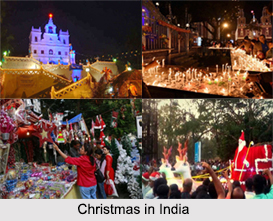
In India, the Christian community constitute about 2.4 percent of the total population and the Indian states like Arunachal Pradesh, Assam, Mizoram, Manipur, Meghalaya, Nagaland, Goa, Kerala and Tamil Nadu has the largest percentages of Christians. Christmas in India starts with the Midnight Mass, which is an important service among the Catholics. For the Christmas Eve Midnight Mass, the churches in India are decorated with poinsettia flowers and candles are lit.
Goa is one of the best places to have a traditional Christmas in India with the homes and churches decorated with flowers and the children singing Christmas carol. The old Latin quarter of Foutainhas in Panaji is an outstanding place to celebrate Christmas. The festival is quite famous in Goa and attracts tourists from all over. In other states like Bengaluru, the state already has a rich Christian legacy as there have been influences from the Europeans, British and even French. Prominent churches like the St. Patrick"s Church and the All Saints Church are decked up during Christmas and the Christian devotees throng the church grounds during the festivities.
In north western India, the tribal Christians of the Bhil tribe, an aboriginal people, go out night after night for a week at Christmas to sing their equivalent of carols the whole night through. In South India, the Christians put small clay lamps on the rooftops and walls of their houses at Christmas, just as the Hindus do during their festival called Diwali.
With contemporary times, commercialisation has brought more secular Christmas celebration to the public sphere. Days before the festival, markets have a colourful look as they are decorated with traditional Christmas trees, stars, images of Santa Claus, balloons and festoons.