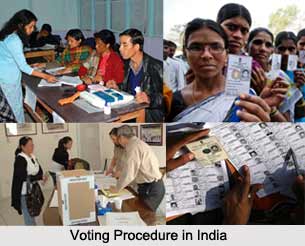
 Voting procedure in India strictly adheres to the principal of Secret Ballot. Polling in India is normally held on a number of different days in different constituencies, to enable the security forces and those monitoring the election to keep law and order and ensure that voting during the election is fair. The days for the polls are fixed by the election commission and they are well publicized before all elections. Polling stations are usually set up in public institutions, such as, schools and community halls. Each polling station is open for at least 8 hours on the day of election. The Election Commissioner has been instructed to employ the Voter Verifiable Paper Audit Trail System or VVPAT, along with the Electronic Voting Machines according to the amendment of the Conduct of Election Rules, 1961 by a notification of 14th August, 2013 issued by the Government of India.
On reaching the polling station, entry will be regulated by queues. There are separate queues for men and women voters and the physically handicapped persons. The persons who enforce the queues allow three to four voters into the polling station at a time. Physically handicapped voters and women voters with babies in arm are given precedence over the other voters in the queue.
Pre-Voting Procedure
On entering the polling station, one has to go to the First Polling Officer who is in-charge of the marked copy of the electoral roll and responsible for identification of electors. One needs to keep the identity document ready to show to the First Polling Officer. The First Polling Officer will then call out the name and serial number so that the polling agents become aware of the person`s presence and the identity is not challenged. Following this, if the person`s identity is not challenged, he/she will move to the Second Polling Officer who will mark the left forefinger with the indelible ink. Following this, the person`s serial number is recorded by the Officer in the Register of Voters. Once this is recorded, the voter has to sign in the appropriate column in the Register of Voters. If a voter cannot sign, his/her thumb impression will be obtained. The Second Polling Officer will then give you a signed voter`s slip which will record your serial number in the register of voters and your serial number in the electoral roll.
Operating the Voting Machine
Inside the voting compartment, the voter has to press the blue candidate button on the Balloting Unit against the name and symbol of the candidate of the voter`s choice. On the candidate button being pressed, the red lamp will glow against the name and symbol of that candidate. There will also be a beep sound heard to indicate that the vote has been recorded and the Busy lamp goes off in the Control Unit.
Traditional Voting Procedure
In the traditional system of voting, votes are cast by means of the ballot paper. On entering the polling station, the elector is checked against the Electoral Roll, and allocated a ballot paper. The elector votes by marking the ballot paper with a rubber stamp on or near the symbol of the candidate of his choice, inside a screened compartment in the polling station. The voter then folds the ballot paper and inserts it in a common ballot box which is kept in full view of the Presiding Officer and polling agents of the candidates. The marking system eliminates the possibility of ballot papers being surreptitiously taken out of the polling station or not being put in the ballot box. Since 1998, the Constitution of India has increasingly used the Electronic Voting Machine instead of ballot boxes.
Any elector or candidate can file an election petition if he or she thinks there has been a malpractice during the election. An election petition is not an ordinary civil suit, but treated as a contest in which the whole constituency is involved. Election petitions are tried by the High Court of the State, and if upheld can even lead to the restaging of the election in that constituency.