 Greatness of Lord Vishnu is emphasized in Narada Purana. Vaishnavism shares its aspects to many sources and religious advancement, tracing back to ages before the Vedic period. Vaishnavism in Narada Purana also illustrates various incarnations of Vishnu. According to the Narada Purana, Brahma, Vishnu and Shiva are only three manifestations of Narayana, Mahavishnu or the Supreme God. They perform the individual functions of creation, conservation and devastation of the. He occupies the spirit of every living thing. Vishnu"s position amid the deities of the Narada Purana is best understood from his relation to Shiva and Brahma. Vishnu offers his residence Kail to Shiva, to free latter"s sin of Brahmahatya. Bhagiratha was advised by Vishnu himself to propitiate Shiva, to liberate his ancestors from their evil deeds.
Thereafter Vishnu"s incarnations have been descripted. Incarnation is assuming form of man or animal and living on earth. In the Narada Purana, in connection with the Dasavatarakhya vrata, ten of them have been detailed. They are Matsya, Kurma, Varaha, Narasimha, Rama, Krishna, Bauddha and Kalki. Vishnu has been identified by various names like Sankhya – Yogesvara, Vedakarta. Among the ten incarnations of Vishnu, Narada gives detailed accounts Narasimha, Rama and Krishna. Narada describes Narasimha in different types. He also instructs the ways to worship Narasimha through mantras and tantric practices.
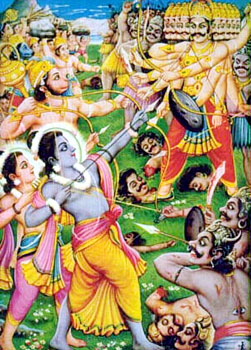
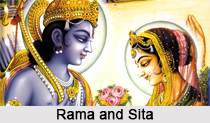
Narada considers Rama and his three brothers Bharata, Lakshmana and Shatrughna, to be a four fold incarnation of Vishnu. The worship of Rama with Sita, his brothers, and Hanuman has also had a mention here.
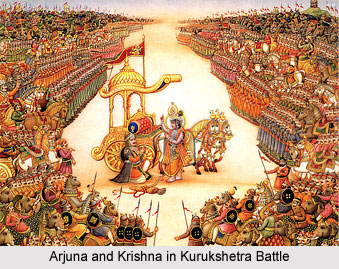
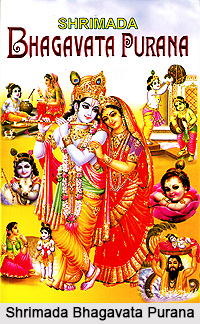
Narada relates story of Krishna`s boyhood and youth in brief. Lord Krishna figures along with Radha residing in world of cows keeping cowherds and cowherd-women in bliss. Narada considers Radha Krishna with the Supreme God and him to be Trinity"s main basis. Narada Purana shows the rise of Lord Krishna to the position of the Supreme God has been accepted by this time.
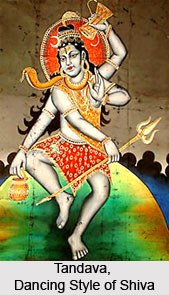
Narada states that for the purpose of creation, destruction and preservation of the world, Supreme God created Brahma from the right side of his body, Rudra from the middle and Vishnu. It is also stated that Vishnu took birth from the left side of the body of Krishna and Mahalaksmi from that of Radha. Then Krishna gave Mahalakshmi in marriage to Vishnu and set up him in Vaikuntha for world"s protection. The four-faced Brahma with is wife Savitri was born from Krishna`s navel, and he was allotted the work of creation. Additionally, Krishna divided himself into Krishna from the right half and Shiva from the left. Durga, was born out of the body of Krishna, was married to Shiva, who was engaged in world"s destruction.
According to Narada, Hanuman is son of Anjana, of Pavan, who meditates upon Rama"s feet. He is also considered as messenger of Rama and remover of Sita"s sorrows and destructor of Lanka"s buildings. He is characterised as Hari, the monkey, who is keeping his left hand on his knee, having Jnana Mudra on his heart and mind on Adhyatma, imparting knowledge to others and seated in plantain forests. He has also been portrayed as someone having a long tail wearing a loin cloth. Hanuman"s birth story has also been narrated by Narada. Here Narada also characterises him as an important deity.
Vishnu was the greatest of all gods to Narada. Vishnu worship is given the pride of place throughout the Narada Purana Narada`s devotion to Vaishnavism is so great that he has made Radha the chief presiding deity for Tantric practices, and the source of the Trinity. Another specialty is the all-embracing treatment given to Radha and Krishna. It cannot be ruled out that Narada"s immense importance laid in Vaishnavism is also a factor in leading to its growth.