 The Vaishnava Bhakti (devotional) Movement dealing with well accomplished and accepted Haridasas (devotee saints) of that time, marked an unforgettable impression on Kannada literature in mystic period, beginning from the 15th century, instigating a body of work referred to as Haridasa Sahitya ("Haridasa literature"). Immensely charmed and tempted by the Veerashaivism of the 12th century, this Vaishnava Bhakti movement affected upon the lives of millions with its potential undercurrent of devotion. The Haridasas had begun to convey the message of Vedantic philosopher Madhvacharya to the commonplace man by uncomplicated Kannada language in the form of devaranamas and kirthanas (devotional songs in extolment of god). The philosophy of Madhvacharya was circularised by reputed and distinguished disciples, letting in Naraharitirtha, Jayatirtha, Vyasatirtha, Sripadaraya, Vadirajatirtha, Purandara Dasa and Kanaka Dasa. Chaitanya Mahaprabhu, perhaps the most prominent and legendary saint from distant Bengal, is known to have a paid a visit to the region in 1510, further exciting and motivating the devotional movement.
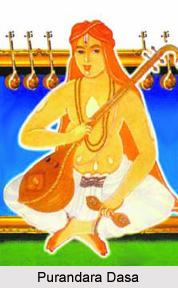
Purandara Dasa (1484-1564), a wandering bard, is assumed to have penned 475,000 songs in the Kannada and Sanskrit languages, though only approximately 1000 songs are known in present times. Framed in umpteen ragas and often coming to an end with a courteous acknowledgement to the Hindu deity Vittala, Purandara Dasa`s compositions represented the quintessence of the Upanishads and the Puranas in uncomplicated yet easy-to-read language. He also had contrived a system by which the everyday populace could learn Carnatic music and also indeed had codified the musical composition forms svaravalis, alankaras ("figure of speech") and geethams. Owing to such contributions to Kannada literature in the mystic period, Purandara Dasa had gained the honorific Karnataka Sangeeta Pitamaha ("Father of Carnatic Music").
Kanaka Dasa (known by birth as Thimmappa Nayaka, 1509-1609) of Kaginele (in present day Haveri district) was a spartan and spiritual quester by nature, who had authored important writings in Vaishnava literary genre, such as Mohanatarangini ("River of Delight"), the story of the Hindu Lord Krishna in sangatya metre; Nrisimhastava, a work covering the grandeur of god Narasimha; Nalacharita, the story of Nala, celebrated for its narration; and Hari Bhaktisara, a spontaneous authorship on devotion in shatpadi (six-line verse, first cited by Nagavarma I in Chhandombudhi of c. 984 and operational from 1165) metre. The latter compositional work, which deals with niti (morals), bhakti (devotion) and vairagya (abandonment), has presently earned pretty popularity as a paradigm book of learning for children. Kanaka Dasa, another luminary Vaishnava during the mystic period in Kannada literature had authored an unbeatable allegorical verse, titled Ramadhanya Charitre ("Story of Rama`s Chosen Grain"), which supremely beatifies ragi above rice. Apart from these classics, approximately 240 songs written by Kanaka Dasa are still available in contemporary times.
The Haridasa Movement had again come back to distinction from the 17th throughout 19th centuries, giving rise to as many as 300 poets in this genre, precisely Kannada literature in the mystic period. Well-known amongst this Vaishnava Haridasas consist of Vijaya Dasa (1682-1755), Gopala Dasa (1721-1769), Jagannatha Dasa (1728-1809), Mahipathi Dasa (1750), Helavanakatte Giriamma and others. With time, the movement`s devotional songs tremendously gave rise to a form of religious and didactic performing art of the Vaishnava people, referred to as the Harikatha ("Stories of Hari"). Likeable evolutions and maturations were also witnessed among the followers of the Veerashaiva faith, who had broadly generalised the Shivakatha ("Stories of Shiva").