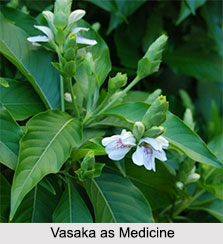
 Vasaka herb is also called Justicia Adhatoda which is a bushy shrub common in most parts of India and used in making fences.
Health Benefits of Vasaka
The leaves and roots of this plant are considered expectorant and antispasmodic and are much used in a variety of forms in cough, consumption, catarrhal fever and asthma. This medicine was considered so serviceable in phthisis that it was said no man suffering from this disease need despair as long as the vasaka plant exists.
Dose of Vasaka in Medicine
The fresh juice or decoction of the leaves in doses of one tola is given with the addition of honey and long pepper in cough. A decoction of vasaka root, chebulic myrobalan and raisins is used in the same cases. Another compound decoction much used in fever with cough, is as follows. Take vasaka root, gulancha and the root of Solanum Jacquinii (kantakari) in equal parts, 2 tolas in all and prepare a decoction in the usual way. This is given with the addition of honey. A ghrita is prepared with clarified butter, a decoction of the plant and a paste of the root taken in the usual proportions and is used in phthisis.
Vasavaleha: Take the juice of vasaka leaves 4 seers, white sugar 1 seer, long pepper 16 tolas, clarified butter 16 tolas, boil them together till reduced to the consistence of an extract. When cool add honey 1 seer and stir with a ladle till intimately mixed. Dose should be 1 to 2 tolas in phthisis, cough with pain in the sides, haemoptysis and asthma.
Vasachandanadi Taila: Take vasaka plant 12 seers and a half, water 64 seers; boil till reduced to one-fourth. Take lac 8 seers, water 64 seers; boil down to 16 seers. Take red sandal wood, gulancha, root of Clerodendron Siphonanthus (brahmayashti), the ten drugs called dasamula and Solanum Jacquinii (nidigdhika), each 2 seers and a half, water 64 seers and boil down to 16 seers. To these decoctions, add of whey and prepared sesamum oil 16 seers each and the following substances in the form of a paste, namely, red sandal wood, liquorice root, wood of Berberis Asiatica, long pepper, black pepper, ginger, turmeric, pachak root, emblic myrobalans, tejapatra leaves, wood of Cedrus Deodara, cinnamon, cardamom, seeds called renuka, pouch of civet cat, root of Withania somnifera (asvagandha), Paderia foetida (prasarini), Vanda Roxburghii (rasna), saileya (a sort of lichen), zedoary root and the fruit of Aglaia Roxburghiana (priangu), each 8 tolas and boil them together in the usual way. This oil is rubbed on the body in affections of the chest and especially in phthisis.
Related Articles
Ayurveda
Origin of Ayurveda
Ayurveda Medication
Elements of Ayurveda
Concepts of Ayurveda
Ancient Literature of Ayurveda
Sushruta Samhita