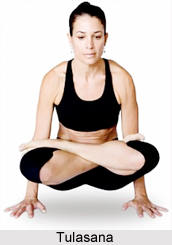
 Tulasana is also known as "Tolasana`, "Dolasana" and `Utthita Padmasana". The name Tulasana is derived from the Sanskrit word `Tula` which means balance. Hence Tulasana is a balance pose. The complete body weight hangs on shoulders or it looks as if the body is hanging on the hands and for this it is also named as "Dolasana" or "Utthita Padmasana". From Padmasana the practitioner with the hands placed either side of the hips raises the entire torso, legs and feet balancing on the arms and shoulders.
Techniques of Tulasana
•Sit down on the ground in the Padmasana pose.
•Rest the palms on the ground keeping both hands at the sides.
•Breathe in deeply and hold the breath.
•Supporting the weight of the body on the hands, lift the whole body locked in Padmasana, above the floor.
•Lift it upwards as much as possible while holding the breath.
•Hold the position as long as you can hold your breath.
•Slowly return back to the former position. Relax for few minutes and repeat it again.
Benefits of Tulasana
By practicing this asana regularly there is good circulation of blood in hands, elbows, wrists, shoulders and chest. With this the lungs and heart also become strong. It removes the disorder in the uterus of the women. And chest becomes strong and tight. The arms, hands and shoulders are strengthened. This asana is useful for back and shoulder aches.
Cautions for Tulasana
Those suffering from heart ailments, having weak wrists and shoulder should not practice this asana. The asana should not be practiced with current or recent shoulder or wrist injuries.
This article is a stub. You can enrich by adding more information to it. Send your Write Up to content@indianetzone.com