
While discussing the various Vratas Agni Purana in one of its chapters has discussed the Trayodashi Vratas in detail. Explaining the Trayodashi Vratas the first Vrata which has been mentioned in the Agni Purana is Ananga Trayodashi. This Vrata was first practised by the god of love, on the day of the thirteenth phase of the moon`s increase, in the month of Magha, by worshipping the god Hara. The Vrati should take honey on the day of the observance, worship the god Hara, and perform the essential Homa ceremony, by casting libations of clarified butter mixed with sessamum and sun-dried rice into the sacrificial fire.
Agni Purana narrates that thus by propitiating the god Yogeshvara with a Homa, on such a Tithi in the month of Pousha, as well as by worshipping the god Maheshwara in the month of Magha after having eaten no other thing than Mouktika, the penitent would ascend heaven after death. Similarly a Vrati should take water simply and worship the god Kakola on such a Tithi in the month of Phalguna, and live on camphor and worship the god Maheshvara on a similar Tithi in the month of Chaitra, whereby his fortune would take a better turn. Similarly, the penitent living on a diet of Jati fruits simply, should worship the god Maharupa, on such a Tithi in the month of Vaishaka, while on a similar occasion, he should worship the god Pradumnya in the month of Jaistha, by eating cloves simply. Likewise the observer of the vow should worship the husband of the goddess Uraa in the month of Ashada, while he should take nothing but perfumed water on a similar occasion in the month of Shravana and worship the trident-bearing god.
It has been said in the Purana that similarly the Sadyojata manifestation of Lord Mahadeva, should be worshipped in the month of Bhadra, and the penitent should propitiate his spiritual preceptor as well. Likewise; a Vrati should worship the lord of the celestials in the month of Ashvina, and drink the washings of gold on the day of its observance. The god Visheshvara should be worshipped in the month of Kartika on a similar Tithi, and the penitent should eat nothing else than the plant known as the Madanaka, duly cooked and prepared. The Lord Shiva manifestation of Shambhu, should be worshipped in the month of Agrahayana or at the close of the rainy season, covered over with the leaves of a mango tree. Clothes and other wearing apparels should be offered to the god on the occasion, and gifts of cows, beds, umbrellas, pitchers, shoes and juicy and luscious edibles, should be made to the Brahmanas.
Towards the end of this adhayaya it has been said that the Vrata, known as the Kamatroyodashi, should be practised on the day of the thirteenth phase of the moon`s increase in the month of Chaitra as follows. An image of the celestial elephant known as Ashoka should be painted with red lead, and the Vrati should worship the same at each night fall through out the year, whereby he would obtain all his wished for objects in life.
Trayodashi Vratas
Trayodashi Vratas are performed during the thirteenth phase of the increasing or waning moon. Various gods are worshipped in the Trayodashi Vratas.
Recently updated articles in Indian Puranas
Mandakini, Holy River
Mandakini River is a significant Himalayan river in Uttarakhand, renowned for its ecological, cultural, and religious importance. Originating near the...
Kausika, Son of Vasudeva
Kausika is a minor figure in Hindu mythology and is identified in the Vishnu Purana as the only son of Vasudeva and his wife Vaishali. He is recognize...
Tandu, Attendant of Lord Shiva
Tandu is revered as the divine attendant of Lord Shiva and the foremost exponent of the Tandava dance. According to the Natya Shastra, he instructed S...
Niramitra, Mahabharata
Niramitra was a son of Nakula and Kareṇumati in the Mahabharata. A descendant of the Pandavas and the Kuru dynasty, he fought on the Pandava side duri...
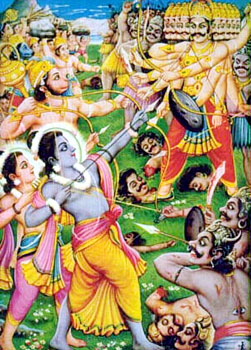
Mahodara, Ramayana
Mahodara was a prominent Rakshasa warrior, minister, and army chief who served under Rāvaṇa during the Battle of Lanka in the Ramayana. Celebrated for...
Related articles in Indian Puranas
Adhyayas in Agni Purana
Adhyayas in Agni Purana are all encompassing. The chapters have dealt with a variety of subjects related to human lives. A large number of chapters ha...
Indian Puranic Tribes
The existence of Indian Puranic tribes is often mixed with mythology and fiction that depict them as superhuman or sub.
Puranic Texts
Puranic Texts are vital according to Hindu, Jain or Buddhist religion; they describe the history of the Universe.

Puranic Shaivism
Puranic Shaivism established during the Gupta Dynasty. This puranic religion developed and expanded, and was accompanied by the development of Brahman...

Nilamata Purana
Nilamata Purana is a Kashmiri Purana that is referred by Kalhana. It is considered as one of the sources of ancient history of Kashmir.