 Themes in Punjabi novel deal with a number of issues. Beginning with the initial attempts at social reform and upliftment, the Punjabi novels went on to take up and portray a number of different and varied slices of life. Most of the themes of the Punjabi novel are in keeping with the most prevalent contemporary event and circumstance which, in turn, is reflected in the writings of the time. Some of the major themes of Punjabi literature are discussed below.
Socialist Realism in the Punjab Novel
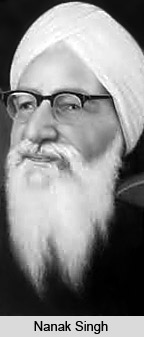
Following the works of the first ever novelist of Punjabi literature, Nanak Singh, whose works focus on the social reforms and upliftment, the Punjabi novel developed under the impact of movements of socialist realism.
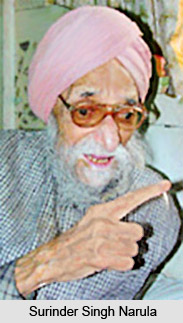
The strongest advocator of Marxist ideology during this time was Surinder Singh Narula (1919). Peo Putter (Father and Son, 1946) is his first major work of fiction and it tells the story of Amritsar city and the various important phases of its development in the first two decades of the twentieth century. In Rang Mahal (The Palace of Enjoyment, 1949), the writer, using Marxist and Freudian critique, draws the picture of a retired, corrupt bureaucrat and his equally corrupt wife, who live in a shish mahal (a glass palace) with four mentally retarded daughters. The couple is tormented with mental agonies, resulting in a prosperous house turning into a virtual hell. His novels also depict the duality of class disputes.
Narula has also written a historical novel, Nili Bar (1956), depicting the life of the people in one of the canal colonies developed by the British in West Punjab. In another novel, Lok Dushman (The Enemies of the People, 1953), he attempts to depict the conflict between the feudal lords and the peasants.
Narula, in short, is responsible for introducing intellectual realism in Punjabi fiction supported by documentation of facts. As a result, his novels turned into more or less dry accounts of social and historical facts, and the story interest in them took a back seat. Some of his novels written after independence made some attempts to liberate them from the puritanical and reformist frame given by Nanak Singh. Another feature of his works is that it shifted the domestic scene to which the Punjabi novel was confined earlier and broadened its sphere to meaningful socioeconomic perspective.
Sant Singh Sekhon with his Lahu Mitci (Blood and Soil) narrates the story of a Punjabi peasant with a background of vast agricultural and economic changes. Sekhon`s major contribution to Punjabi fiction is in the field of the short story.
Jaswant Singh Kanwal, was a committed Marxist who wrote profusely and was rather sentimental in his storytelling. However unlike Nanak, he mainly place his stories in rural settings with a romantic plot. His novel Puranmashi (The Night of Full Moon, 1954), a work of his early phase, depicts village life in an exquisite manner. Later on, he went on to become more and more political and there is increasingly seen a mixture of Marxist ideology with Indian religious philosophy.
Historical Theme in the Punjabi Novel
Another popular theme in the Punjabi novels was the elements of Sikh history, myth as well as legends. These works are based on a lot of research and many are also biographical in nature. In this category of writers was Narinderpal Singh who attempted a number of works on Sikh history. Some of his works include Walon Nikki (Thinner than Hair, 1960), which depicts the time when the Sikh Missels were fighting with one another to gain political power, Et Marg Jana (This Path to Be Followed, 1960) which deals with the rule of Maharaja Ranjit Singh etc. Other works are Ik Sarkar Bajhon, Ik Rab Ik Para Shakti, Tria Jal, Aman de Rab. Another writer who wrote along these lines was Kartar Singh Duggal. His works mainly focus on the changing Punjabi society during the era of the partition.
 Stream of Consciousness
Stream of Consciousness as a theme in Punjabi novels derives from the Western concept which was followed by James Joyce and others. Surjit Singh Sethi, a dramatist, theater artist, novelist, and short story writer, wrote a couple of novels on the lines of stream of consciousness. His experiment with this form is very bold, indeed, but in his Ik Khali Piyala (An Empty Cup) he did not achieve much success. However, in his second novel, Kal Vi Suraj Charhega (The Sun Will Rise Even Tomorrow), the story based on the Jallianwala Bagh tragedy, he is able to establish better communication with his readers. Sukhbir, another fiction writer settled in Mumbai, has written novels on the life of the metropolis and has described the elements of the alienation in this life with a good measure of success. He has also experimented with stream of consciousness with much maturity and skill. Other examples of the experimental novel are Narinderpal Singh`s Puniya ke Masya and Jagjit Brar`s Dhup Darya di Dosti (The Friendship of Sunshine and the River), in which novel techniques of building a fictional image have been tried with unequal success.
Individual in the Crisis of Values
Niranjan Tasneem, Surjit Hans, Joginder Kairon, Ram Saroop Ankhi, and a host of young writers have written novels of new sensibility. They portray a picture of the harassed individual enmeshed in the crisis of values. They express various aspects of the same theme with different techniques and varying levels of symbolic and allegorical expressions. Along with the new, some of the old novelists continued to write. Harnam Dass Sehrai, who started writing fiction in the mid-1960s, is still actively engaged in writing novels on Sikh history saturated with sentimentalism. He has published more than 40 novels eulogizing the Sikh gurus and heroes, but they lack authentic historical facts and are largely based on stories preserved in oral tradition.
Thus discussed above are the various themes that are found reflected in the novels of Punjabi literature.