
The Uniqueness of the Supreme Knowledge has been explained in the third chapter of the Kenopanishad with the help of a story. The story may apparently seem to be a fairy tale but in reality it has deeper significance and as the profound meaning of the story is understood it gives people an opportunity to understand the inner essence of life. The story has given an elaboration of the Upanishadic truth and has also discussed the nature and significance of the Self. To understand the story in its exact form it is necessary that one understands the five elements of which the entire entity is composed in terms of their grossness.
The story in the third chapter says that once the Gods had won a victory over the demons with the aid of a Supreme Power. At this the Gods became blinded with their success and took that victory as their own glory. Then the Supreme Power gave the Gods a vision. As the Gods had the vision they became curious and send Lord Agni, the God of Fire to find out about the Supreme Power. But Lord Agni failed and said that he could not find anything about the Supreme Power.
Next the heavenly denizens sent Lord Vayu to enquire about the Supreme Power but even Lord Vayu who was filled with self-ego and pride failed miserably at the presence of the Supreme Power.
Then the heavenly populace decided upon Lord Indra, the Ruler of Heavens to seek the Supreme Power. But unlike the early visitors Indra was not obscured with egoism, vanity and self conceit. Therefore as a result he was blessed by Goddess Uma. On enquiring upon the Goddess, she told Indra that the yaksha who had helped the lords to win over the demons were none other than the Eternal-Non-dual-Truth.
Hence it can be concluded that the uniqueness of the Supreme Knowledge according to the third chapter of the Kenopanishad is that unless one gives off ego, vanity, pride and self conceit from ones entity one is not in a position to realise the Supreme Being. Thus when an individual fails to realise the Supreme Being he is also incapacitated to decipher the Absolute Truth of life and in turn is deprived from the Infinite Bliss. Thus it can be well assumed that the forte of the third chapter is to find out the uniqueness of the Supreme Knowledge.
The Uniqueness Of The Supreme Knowledge
The Uniqueness of the Supreme Knowledge has been discussed by the third chapter of Kenopanishad with great efficacy.
Recently updated articles in Indian Philosophy
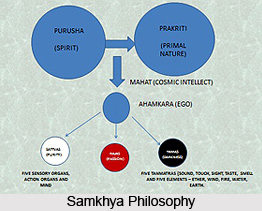
Samkhya Philosophy
Samkhya philosophy is one of India’s oldest intellectual traditions, explaining reality through the interplay of Puruṣha (pure consciousness) and Prak...
Maya, Prakriti in Hinduism
Maya or illusion is a very potent instrument of the Divine Prakriti, the Primal nature. In Hinduism one must be able to come out of Maya in order to a...

Samadhi in Hinduism
Samadhi is the result of meditation or that state of mind when there is an absence of all idea of individuality.
Samadhi in Buddhism
According to Buddhism, oen can only achieve samadhi through strict meditation and right concentration.

Abdul Rehman Jilani Dehlvi
Syed Abdul Rehman Jilani Dehlvi was a renowned Sufi saint of the Qadri Order in India.
Related articles in Indian Philosophy

Ajivika Philosophy
Ajivika philosophy is different from the mainstream religion
Indian Philosophy In The Vedic Period
Indian Philosophy in the Vedic Period was primarily based on the concepts of nature worship.
Achintya Bheda Abheda Philosophy
Achintya-Bheda-Abheda is a School of Vedanta that represents the philosophy of unimaginable one-ness and difference in relation to the power creation...
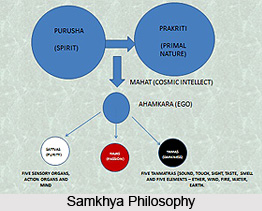
Samkhya Philosophy
Samkhya philosophy is one of India’s oldest intellectual traditions, explaining reality through the interplay of Puruṣha (pure consciousness) and Prak...
Charvaka Philosophy
The Charvaka Philosophy believes that only those things that can be perceived is the ultimate reality.