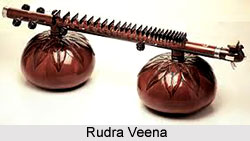
 The techniques arranged on the Veena are constrained by its ergonomics and more by the melodic austerity of the Dhrupad genre. It rules out the more supple and complex techniques used on the plucked lutes that succeeded it. An important aspect of this distinction is based on the strong bias dhrupad that has in favour of single intervallic transitions as the building blocks of melody. This portrays a more purposeful approach to melody making, compared to the Sitar and the Sarod that habitually uses a phrase consisting of two intervallic transitions as the basic unit of melody. The inventory of veena techniques is large; however, four basic techniques may be mentioned here.
The left hand performs the melody on the Veena using two categories of techniques - (a) fretwork, which involves the movement of the fingers between the frets, and (b) string deflection, which involves the pulling of the string with one or more fingers static on a single fret.
Techniques of Fretwork
The Rudra Veena in addition to the simple melodic execution by movement of the fingers between frets also uses two types of fretwork technique: Ghasita which is also called sunta and Khataka.
Ghasita: It accomplishes a phrase, usually flat-out and unidirectional. It executes it by dragging the left hand finger over the fret-board under the impact of a single stroke. This is accompanied by a light left-hand pressure over the string, so that the resultant glide transports an aural impression of a fretless instrument. The ghasita is used mostly for medium to long-span intervallic transitions.
Khataka: It is also self-explanatory. It is used for short-span intervallic transitions. It is usually used in descending melodic motion. Khataka is executed under a single stroke. The right-hand stroke is stimulated with the left-hand finger resting on one fret. With it the follow-through in jerky motion executes the intervallic transition along the frets, employing the residual power of the stroke, along with that of the jerky motion of the left-hand finger.
Techniques of Deflection
There are two types of principal deflection techniques (a) minda and (b) gamaka.
Minda: It is a simple execution of a phrase by pulling the string from a single fret and executing a phrase under the impact of a single stroke. Three-svara mindas were common in Veena music.
Gamaka: It creates a pulsating or quivering effect; a magnified vibrato by repeatedly playing a svara from a fret at a lower pitch. The gamaka is generally used for distances of upto two, and occasionally three svaras.