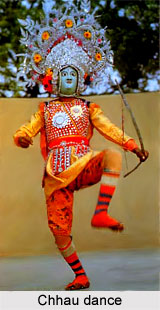
 Technique of Chhau dance reveals that it has less movement in the upper part of the body and more movements in the lower part and on the footsteps. The facial expressions on the masks are steady and literally dead and only by means of the footsteps they are animated. Chhau dance has developed a classical character with its own codification and systematization. It has developed a character of its own due to some of its own special features like the masks.
Expression through body or Angikabhinaya in exclusion of that of the face or Mukhabhinaya is the only means of conveying the ideas. During the dance there is no dialogue, music in the background. The heroic sentiments of the warriors and many other finer sentiments of life are expressed. The devotional sentiment plays the most important role. The techniques have developed out of different ideas of heroism.
Chal is the movement of the characters. It is divided into two main divisions-Deva Chal and the Rakshasha Chal or the gait of the gods and demons respectively.
The physical movements of the individual dancers:
* Trembling of the crown: The whole body of the dancer remains stiff and erect. The top of the crown of the mask trembles from a slow to a violent motion giving expression of the feeling of anger. This is performed generally by the demon characters. The masks are made to give scope to reflect light from the tiny particles of decorations. Overall beauty is enhanced.
* Trembling of the shoulder. This is a feature of Chhau dance of Bagmundi area. The top of the crown and the lower part of the body remain stiff and motionless while the two shoulders tremble vigorously. This is a heroic movement giving expression of anger and practised both by the gods and the demons.
* Leaps, jumps and spins: The dancers either individually or simultaneously with others jump high or spin in the air with the greatest ability and the dancers land and pat on their knees only to rise again immediately to continue the practice several times. They move forward and backward on their knees immediately after landing on the ground in a threatening attitude against the enemies. This movement is that of the hero and practised both by the gods and the demons.
* Trembling of the chest: The head and the lower part of the body of the dancer remain motionless. His chests tremble vigorously. It is a warrior`s movement and is practised both by the gods and demons while charging the enemies in a face to face battle.