
The tatpratisedhanham ekatattva abhyasah yogic sutra states that absolute surrendering and yielding to the Almighty is impossible for an ordinary individual, except the highly evolved souls that have graced the earth very few occasions. One needs to be cleansed from every worldly attribute that prevents a person to attain such a state. He or she must be totally uninhibited towards the Lord and give up their everything, expecting nothing in return.
Tatpratisedhanham for their prevention
Eka one, single
Tattva a real state, reality, truth, essential nature, the very
essence, a principle, a doctrine
abhyasah practice
Adherence to single-minded effort prevents these impediments.
To remove the thirteen obstructions and thwart their reappearance, several specific methods have been distinguished.
Though most observers have concluded that ekatattva is loyalty and surrender to God, it is beyond an average person`s comprehension that surrendering to God is the cure for all maladies. If surrendering to God was possible for everyone, and could by itself eliminate all deterrents, Patanjali need not have dilated on all the other means of reaching the divine state. Only a few stupendous personalities like Ramana Maharsi, Sri Ramakrishna Paramahamsa, Mahatma Gandhi, Jada Bharata and the great acaryas of the past could submit wholeheartedly to God, as they were angels in human form, exceedingly evolved souls, whose subliminal impressions from previous lives facilitated them to assume their final human form in order to clear up the residues.
But absolute surrender to God is beyond the abilities of most ordinary men and women, who are still entangled in pleasure and pain, joy and sorrow, success and failure. Meditation undoubtedly helps to minimise the mental agitations of such people. But in order to conquer all the obstacles to Self-Realisation, all the eight stages of yoga must be followed.
Only when body, mind and intelligence are fully sanctified is it possible to submit whole-heartedly to God, without awaiting any return. This is a surrender of the highest order, beyond the capacity of the average individual.
Tatpratisedhanham ekatattva abhyasah
This is the thirty-second yogic sutra that is contained in the Patanjali Yoga Sutras.
Recently updated articles in Yoga
Khanda Manda Yoga
Khanda Manda Yoga is a difficult form of yoga where the Yogi cuts off his own arms and legs with a sharp cleaver, that is axe-like knife, and throws t...
Kaivalya Pada
Kaivalya Pada, the fourth chapter of Patanjali Yoga Sutra denotes an absolute, indivisible state of existence of the Yogi. The Kaivalya Pada is someti...
Vibhuti Pada
Vibhuti is the Sanskrit term for “power” or “manifestation.” In this third chapter, Patanjali introduces the final three limbs of Aṣṭanga Yoga, collec...
Sadhana Pada
Sadhana Pada in Patanjali Yoga Sutra denotes the idea of practicing yoga that leads to spiritual illumination. Sadhana, the Sanskrit term for “practic...
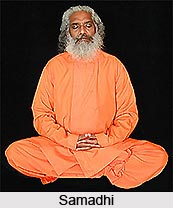
Samadhi Pada
Samadhi Pada is the first chapter of Patanjali Yoga Sutra. In this chapter, the author explains the essence of yoga, the nature of samadhi, and the me...
Related articles in Yoga
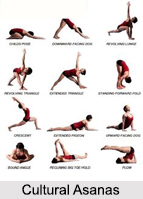
Cultural Asanas
Cultural Asanas refer to the daily physical exercise postures that train the body and mind in Yoga Practice.
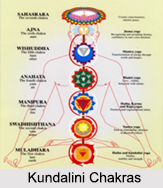
Kundalini Chakras
Kundalini Chakras are psychic energy centres or vortices, which connect between our psychic and physical energy systems.
Patanjali Yoga Sutras
Patanjali’s Yoga Sutras presents a foundational guide to the philosophy and practice of yoga. Through concise aphorisms, it outlines the nature of the...
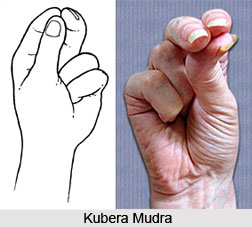
Kubera Mudra
Kubera Mudra, a form of Hatha Yoga, leads to the elevation of mental peace and physical relief by proper practice and cleanses frontal sinuses.