
The tasyapi nirodhe sarvanirodhdt nirbijah samadhih yogic sutra speaks of the attained state that took a tough time to achieve. When one is imbued with further knowledge, the new light of wisdom also bows out. A sadkaka, who has come to such a final state of the first pada, needs to further understand the states of existence. Every illusion, every inhibition, every old and new impression, every personal choice, every shackle of worldly sense are dissolved in the mind. However, in order to reach absolute samadhi, be one with citta, one needs to push beyond the limits of the present existence.
Tasyapi that too
Nirodhe by shutting, closing, restraining, destroying, by cessation
Sarva all
Nirodhat checking, suppressing, destroying
Nirodhat seedless
Saadhih profound meditation
When that new light of wisdom is also relinquished, seedless samadhi dawns.
The sadhaka must learn to hold back even this new impression of truth-bearing light. When both old and new impressions are dissolved, a state of seedless enlightenment arises, in which all illusions and delusions cease. This is nirbija samadhi - the state of absolute identity with the seer.
Even this distinctive knowledge of insight (1.50) has to be checked, curbed and moderated. Then, as a flame goes out when the wood is burnt out, or as rivers cease to have their individual existence on uniting with the sea, all volitions and impressions of the unconscious, subconscious, conscious and super-conscious mind cease to exist. All these rivers of consciousness unify with the ocean of the seer.
Nirbija samadhi is the conquering of the citta where the root mind is one with the seer. As all invading thoughts are brought to an end by practice and detachment, the soul is freed from the pinions of earthly vehicles - the body, senses, mind, intelligence and consciousness. The seer is in the amanaskatva state.
When citta is dependent on an object, idea or symbol, the state is called sabija samadhi. In nirbija samadhi, citta dissolves and no deposit of impressions remain. All residual impressions, the thinking faculty and the feelings of `T` are extinguished without trace and become universal. The soul alone manifests and rages without form, in immaculate clarity.
Here ends the exposition on samadhi, the first pada of Patanjali`s Yoga Sutras.
Tasyapi nirodhe sarvanirodhdt nirbijah samadhih
This is the fifty-first yogic sutra that is contained in the Patanjali Yoga Sutras.
Recently updated articles in Yoga
Khanda Manda Yoga
Khanda Manda Yoga is a difficult form of yoga where the Yogi cuts off his own arms and legs with a sharp cleaver, that is axe-like knife, and throws t...
Kaivalya Pada
Kaivalya Pada, the fourth chapter of Patanjali Yoga Sutra denotes an absolute, indivisible state of existence of the Yogi. The Kaivalya Pada is someti...
Vibhuti Pada
Vibhuti is the Sanskrit term for “power” or “manifestation.” In this third chapter, Patanjali introduces the final three limbs of Aṣṭanga Yoga, collec...

Sadhana Pada
Sadhana Pada in Patanjali Yoga Sutra denotes the idea of practicing yoga that leads to spiritual illumination. Sadhana, the Sanskrit term for “practic...
Samadhi Pada
Samadhi Pada is the first chapter of Patanjali Yoga Sutra. In this chapter, the author explains the essence of yoga, the nature of samadhi, and the me...
Related articles in Yoga
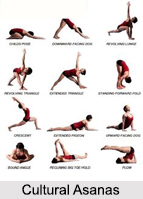
Cultural Asanas
Cultural Asanas refer to the daily physical exercise postures that train the body and mind in Yoga Practice.
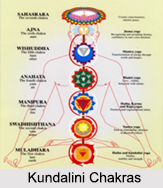
Kundalini Chakras
Kundalini Chakras are psychic energy centres or vortices, which connect between our psychic and physical energy systems.
Patanjali Yoga Sutras
Patanjali’s Yoga Sutras presents a foundational guide to the philosophy and practice of yoga. Through concise aphorisms, it outlines the nature of the...
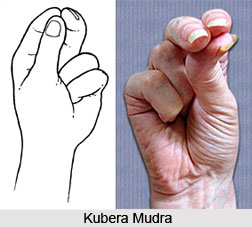
Kubera Mudra
Kubera Mudra, a form of Hatha Yoga, leads to the elevation of mental peace and physical relief by proper practice and cleanses frontal sinuses.