
Tala in Hindustani Classical Music comprises one of the most fundamental concepts. The term `Tala` basically is a Sanskrit word which means meter. The word refers to the metric system as a whole and to individual meters as well. A number of Talas are used in North Indian Classical music. While some are used only for instrumental performances, others are used for vocal performances as well. Some talas are used for both instrumental as well as vocal performances. One of the most widely used talas is the tintal. A single cycle may be a sufficiently long unit to accommodate a complete musical idea. However, two or more cycles are often combined into a phrase. In the song "Payaliya jhankar," the first section of the song (sthai) has two phrases of 16 counts each. (In the notation, each phrase is marked by a slur.) The phrases begin on khali (count 9) and end on the next count 8. In the second section of the song (antara), the phrase structure is the same. The phrase structure may, however, be quite different from this; it is flexible.
Although in Indian melodies, two or more tala cycles can be combined into a musical phrase, the metric base remains the same in the recurring cycles. If a section of a Hindustani melody begins on any count other than the first count of a cycle, it is necessary to complete that first incomplete cycle. The sthai of "Payaliya jhankar" begins on count 9 and ends on count 8, as does the antara. In Hindustani music, that final count 8 could not be a cadence point for the melody as a whole, however. Count 1 of the next cycle of the tala must be the count of finality. One accomplishes this by repeating the portion of the initial line of the melody that leads up to and includes count 1. The performer can go beyond count 1 to finish a text phrase, but that count 1 marks the "official" end of the melodic-rhythmic phrase. Thus, the beginning of the song is used as an ending; the first count of a tala cycle serves both as a beginning and as an ending. This is an important characteristic of musical structure in Hindustani classical music.
The speed at which a composition is performed in Indian Classical Music is specified in relative terms. Earlier, it was measured in terms of the heartbeat but even that was relative. The relative speeds in the Hindustani system are conceptualized in levels- slow, medium and fast. A variation of the established speed is achieved in Hindustani music by two main methods. One way is to accelerate the tala counts. For example, at the beginning of a slow performance, a cycle of 16 counts may take 32 seconds to complete. As the performance progresses and the speed increases, that cycle may take only 20 seconds. The means of achieving this acceleration varies. It has been found that in some performances of khayal (a vocal genre), the acceleration takes place very subtly and gradually throughout the melodic phrases sung by the soloist. In other performances, the vocalist increases the speed only at the beginning of a tala cycle; other vocalists apparently direct the accompanying drummer to increase the rate of his beats while the soloist pauses for a cycle or two to rest. The second method of varying the established speed does not actually change the speed of the counts. Rather, it changes the rhythmic density.
Tala in Hindustani Classical Music
Tala in Hindustani classical music is the Sanskrit term for the word meter. Tintal is one of the most widely used talas in North Indian classical music.
Recently updated articles in Music in India
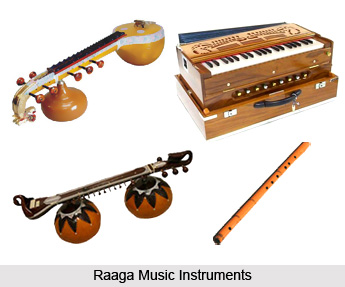
Classification of Raagas in Carnatic Music
Classification of Raagas in Carnatic music is based on scale type, devised as a system for raagas that existed as well as those that were in the proce...
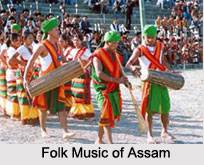
Folk Music of Assam
Folk Music of Assam reflects the outdoor and indoor life of the folk people and it does not follow any strict rule of composition and performance. Fol...
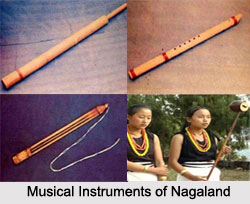
Musical Instruments of Nagaland
Musical Instruments of Nagaland reflect its rich tribal heritage and deep cultural roots. Crafted from natural materials like bamboo, wood, and animal...

Rasa, Hindustani Music
Rasa is an important part of Hindustani Music. Here the creative experience of the artist i.e. musician and the aesthetic response of the connoisseurs...
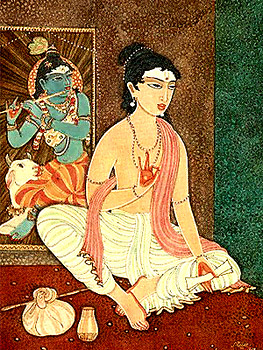
Kshetrajna, Telugu Poet and Composer
Kshetrajna (1600 - 1680) was a creative Telugu poet and composer of Carnatic music. He composed several padams and keertanas.
Related articles in Music in India
Kriti Carnatic Music
Kriti refers to one of the most widely used genres of Carnatic music. It originated from the kirtanas of the bhaktas, i.e., musicians who expressed th...
Indian Folk Music
Indian Folk Music is full of rustic charm. The appeal of Indian folk music lies in the simplicity of its style and lyrics. Most of the folk songs are...
Haryanvi Music
Haryanvi music is the folk music of the state of Haryana and is sung in western Uttar Pradesh along with the neighbouring districts of Rajasthan and P...
Carnatic Music
Carnatic music, also known as `Karnataka Sangitam`, is one of the two styles of Indian classical music.