
The twenty-sixth yoga sutra speaks about the manner in which the consciousness is strongly attracted towards the soul or the seer, owing to the strong gravitional pull of the `exalted intelligence`. Consciousness, it seems, heavily relies upon this intelligence. When this `exalted intelligence` goes aflame, consciousness is likewise illuminated. It becomes liberated and radiates divinity. And due to this mechanism, consciousness is drawn towards its source - the undividable seer. Although, before reaching such a state, consciousness has to pass through several stages of worldly pleasures. And finally, when both (intelligence and consciousness) are released from biasness, they gravitate towards the seer.
tada then
vivekanimnam flow of exalted intelligence in consciousness
kaivalya indivisible state of existence, emancipation
prag towards
bharam gravitation, influence, importance
cittam consciousness
Then consciousness is drawn strongly towards the seer or the soul due to the gravitational force of the exalted intelligence.
When the exalted intelligence is ablaze, consciousness is illumined; it becomes free and tinged with the divine (citta suddhi). Due to this divine light, citta, with its exalted intelligence, is attracted as if by a magnet towards its source - the indivisible seer who is alone, free and full.
Before reaching the state of exalted intelligence, consciousness is attracted more towards the pleasures of the world. When intelligence is free from doubts and prejudices, it gravitates towards the absolute seer.
As a farmer builds dykes between his fields to regulate the flow of water, similarly, exalted intelligence builds a dyke for the consciousness, so that it does not move again towards the world, but turns and flows towards union with the divine seer. This is kaivalya, an existence filled with freedom and beatitude. Such a yogi becomes a king amongst men.
Tada vivekanimnam kaivalya pragbharant cittam
This is the twenty-sixth yogic sutra, which is incorporated in the fourth phase of the Patanjali Yoga Sutras.
Recently updated articles in Yoga
Khanda Manda Yoga
Khanda Manda Yoga is a difficult form of yoga where the Yogi cuts off his own arms and legs with a sharp cleaver, that is axe-like knife, and throws t...
Kaivalya Pada
Kaivalya Pada, the fourth chapter of Patanjali Yoga Sutra denotes an absolute, indivisible state of existence of the Yogi. The Kaivalya Pada is someti...
Vibhuti Pada
Vibhuti is the Sanskrit term for “power” or “manifestation.” In this third chapter, Patanjali introduces the final three limbs of Aṣṭanga Yoga, collec...

Sadhana Pada
Sadhana Pada in Patanjali Yoga Sutra denotes the idea of practicing yoga that leads to spiritual illumination. Sadhana, the Sanskrit term for “practic...
Samadhi Pada
Samadhi Pada is the first chapter of Patanjali Yoga Sutra. In this chapter, the author explains the essence of yoga, the nature of samadhi, and the me...
Related articles in Yoga
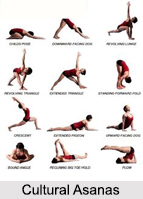
Cultural Asanas
Cultural Asanas refer to the daily physical exercise postures that train the body and mind in Yoga Practice.
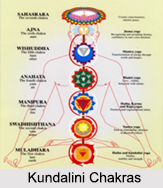
Kundalini Chakras
Kundalini Chakras are psychic energy centres or vortices, which connect between our psychic and physical energy systems.
Patanjali Yoga Sutras
Patanjali’s Yoga Sutras presents a foundational guide to the philosophy and practice of yoga. Through concise aphorisms, it outlines the nature of the...
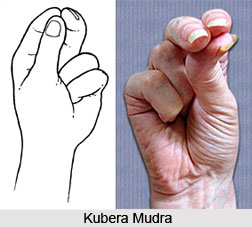
Kubera Mudra
Kubera Mudra, a form of Hatha Yoga, leads to the elevation of mental peace and physical relief by proper practice and cleanses frontal sinuses.