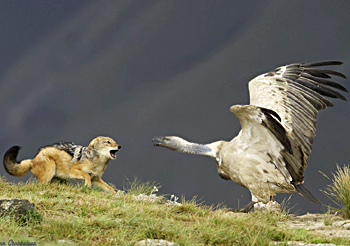
 Story of Vulture, Jackal and the Dead Child is one among many narratives in the Mahabharata which has a moralising end in view. It seeks to impart ethical knowledge to the people regarding how human beings are to behave towards death. In fact the question of man`s behaviour towards death has been again and again treated in innumerable maxims, and also in many a consolatory story by Indian thinkers. One of the most beautiful of these stories is that of the Vulture and Jackal and the Dead Child, the contents of which are briefly discussed below.
The only little son of a Brahmin had died. Lamenting and weeping, the relatives carried the corpse of the little child out to the place of burial. In their grief they could not bear to part from their dead beloved child. Attracted by the sounds of lamentation, a vulture comes flying to the place, and explains to them how futile all the lamentations for the dead are. The vulture goes on to say that no mortal returns to life when he has once succumbed to Kala. Therefore they should return home without delay.
Consoled to some extent, the mourners begin the homeward journey. Then a jackal comes towards them and reproaches them with want of love, because they leave their own child so quickly. Sadly they turn back again. Here the vulture awaits them and reproves them for their weakness. One should not mourn for the dead, but for one`s own self. This one should above all cleanse from sin, not weep for the dead; for all the weal and woe of man depends only on the Karma. "The wise man and the fool, the rich man and the poor man, they all come into the power of Kala, with their good and bad deeds. What do you want with your mourning? Why do you complain of death?" and so on.
Again the mourners turn homewards and again the jackal exhorts them not to give up their love towards their offspring; one should make efforts against fate, for it may perhaps after all still be possible to restore the child to life. Whereupon the vulture remarks, "A thousand years old am I, but I have never seen a dead person come to life again. Those who do not care for their mother and father, their relatives and friends so long as they are alive, commit a crime against morality. But of what benefit is your weeping to one who does not see with his eyes, who does not move and is absolutely dead? "Again and again does the vulture urge the mourners to return home, whilst the jackal tells them to return to the burial place. This is repeated several rimes. Vulture and jackal thereby pursue their own ends, for they are both hungry, and greedy for the corpse. At last Lord Shiva, urged by his wife Uma, has pity on the poor relatives and lets the child become alive.
This then is the story of the jackal, vulture and the dead child which seeks to educate man about the nature of death.