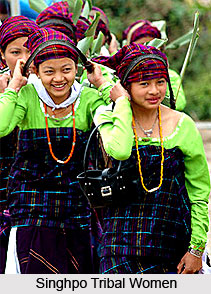
 Society of Singhpo Tribe is similar to the other tribes of Arunachal Pradesh. The Singphos follow the religion of Buddhism. However people are largely devoted to the traditional belief patterns also. They believe in spirits called Nats, which control their routine activities. Some are benevolent while some are malevolent. The Singphos have village priests who are known as Dumsawa. Great reverence is also paid to the Buddhist monks along with the Dirmsaioas. Clan exogamy is religious followed. Cross-cousin marriage is however parallel-cousin marriage is prohibited. The system of senior levirate is also followed where a younger brother can marry the widow of his elder brother. However the elder brother cannot marry the widow of his younger brother. The negotiated marriage among the Singphos is more common compared to other forms of marriages. Bride-price is the factor in the Singhpo marriage.
On the arrival of the bride in groom`s house after marriage she has to undergo a test at the gate known as Gam Bang Salai which is constructed at the entrance of the groom`s house. As the bride enters the Gam Bang Salai a domestic fowl is placed over her head. If the fowl flies and enters back to the house then it is believed that the bride will be a good house-wife. No elaborate marriage rituals are performed except in negotiated forms of marriage.
When the first child would be delivered then a cock is sacrificed to ensure a safe delivery. The name giving ceremony is also performed where a pig is also performed. Divorce rates are very low. The Singphos are advanced in agriculture. They cultivate on permanent plots which are ploughed by either the buffaloes or oxes. They also grow paddy, wheat, mustard, potato, vegetables and so on. Rice is their staple diet which is taken along with sweet potatoes and arum.
The Singphos are patriarchal and patrilocal. The father is the family head and ancestry is traced though male line. The central political authority is exercised by the clan chief who is also the territorial chief. The chief holds legal and administrative powers. He is assisted by the council of elders. The Gaon Bum is the government representative of the council.
The village dormitory is known as Pinlanta which is non-existent at present. Burial is the usual process but cremation is also followed. Decisions regarding that are taken by the priests after consulting the omens.
Dance and music are activities that form an integral part of festivals and rituals. They perform dances like Manglup dance, Kakhang, Woigap and Mamthu dance.