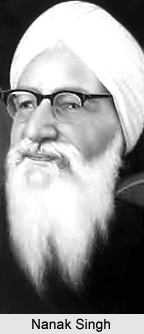
 Socialist Realism in Punjabi novels was one of the prominent themes which came up after the proper emergence of the novel under Nanak Singh. In keeping with the changing social and political environment of the times, Punjabi novels which emerged after the works of Nanak Singh reflected a strong tendency towards Socialist Realism unlike Singh`s works which aimed at reforming society.
The impact of the movements of Socialist Realism was seen in the works of the novelists who emerged after Nanak Singh. Surinder Singh Narula (1919) is the most consistent exponent of Marxist ideology in his fiction. His first novel, Peo Putter (Father and Son, 1946), accepted as a major work of fiction, narrates the story of the city of Amritsar and its significant phases of development in the first two decades of the twentieth century, bringing into focus successive religious and political movements in the Punjab. In Rang Mahal (The Palace of Enjoyment, 1949), the writer, using Marxist and Freudian critique, draws the picture of a retired, corrupt bureaucrat and his equally corrupt wife, who live in a shish mahal (a glass palace) with four mentally retarded daughters. The couple is tormented with mental agonies, resulting in a prosperous house turning into a virtual hell. His novels also depict the duality of class disputes.
Narula has also written a historical novel, Nili Bar (1956), depicting the life of the people in one of the canal colonies developed by the British in West Punjab. It reproduces with sympathy and sensitivity the life of the tribes inhabiting the areas between Chenab River and Jhelum River and foreshadows the sufferings and exploitation they were likely to undergo from the local aristocracy with the help of the rulers. In another novel, Lok Dushman (The Enemies of the People, 1953), he attempts to depict the conflict between the feudal lords and the peasants. Narula, in short, is responsible for introducing intellectual realism in Punjabi fiction supported by documentation of facts. As a result, his novels turned into more or less dry accounts of social and historical facts, and the story interest in them took a back seat. Some of his novels written after independence made some attempts to liberate them from the puritanical and reformist frame given by Nanak Singh. Another feature of his works is that it shifted the domestic scene to which the Punjabi novel was confined earlier and broadened its sphere to meaningful socioeconomic perspective.
Sant Singh Sekhon with his Lahu Mitci (Blood and Soil) narrates the story of a Punjabi peasant with a background of vast agricultural and economic changes. Sekhon`s major contribution to Punjabi fiction is in the field of the short story. In fact, he inaugurated the era of experiment in the field of the Punjabi short story. He brought a whirl of fertilizing ideas, pleading for a new society, new humanism, and a "new hero." He is responsible for introducing into the short story the pattern, technique, and realistic methods of Chekhov and Katherine Mansfield.
Jaswant Singh Kanwal, who wrote profusely, like Nanak Singh, is very sentimental in his storytelling and is a committed Marxist. He is, however, puritanical in his approach while depicting love themes and also preaches revolution for fulfillment of the total human personality. Whereas Nanak Singh depicted mostly the urban life of Punjab, Kanwal moved the scenario to rural settings in which his heroes and heroines are involved in romance. He attempts to invest a charm in the rural life of Punjab. His novel Puranmashi (The Night of Full Moon, 1954), a work of his early phase, depicts village life in an exquisite manner by combining the elements of romance, mystery, and beauty. In his later novels, he becomes more and more political, and in most of his novels he superimposes abstract polemical discussion on Marxist ideology and mixes the same with Indian religious philosophy. Only in Civil Lines (1956) does he sustain fictional interest and give a realistic picture of the modern culture. He also wrote some short stories.
The theme of Socialist Realism was thus most prominently seen in the works of the writers discussed above.