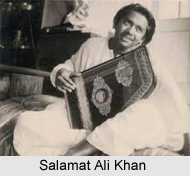
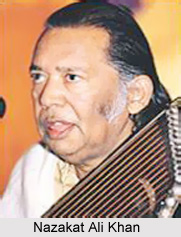
 Sham Chaurasia Gharana is a gharana in Hindustani classical music, known for the singing of vocal duets, most notably represented in modern times by the brothers Salamat Ali Khan and Nazakat Ali Khan.
Centre of Sham Chaurasia Gharana
Sham Chaurasia gharana is centred at a village of the same name in the Hoshiarpur district of Punjab; variant spellings include Shamchurasi.
History of Sham Chaurasia Gharana
Sham Chaurasia Gharana is believed to have been founded in the 16th century by Mian Chand Khan and Mian Suraj Khan who were contemporaries of Mian Tansen at the court of Mughal emperor Akbar. Successive generations of musicians in the gharana specialised in the dhrupad form of singing and evolved a tradition of duet vocal jugalbandi performances.
Composers of Sham Chaurasia Gharana
 Mian Karim Bukhsh Majzoob, Ustad Ahmed Ali Khan, Ustad Niaz Hussain Shami, and Ustad Vilayat Ali Khan were some of the illustrious members of the Sham Chaurasi Gharana.
Naming of Sham Chaurasia Gharana
The township of Sham Chaurasia was named after a cluster of 84 villages which constituted land revenue in the time of Maharaja Ranjit Singh. According to one legend, the founders were given a parcel of land here as a grant to them by Akbar. Around the turn of the century, the gharana was represented by Ustad Vilayat Ali Khan, who was noted for his dhrupad singing. His sons, Nazakat and Salamat, were to become particularly well known for their duet singing.
Nazakat and Salamat Ali Khan
Some of the most memorable classical music of modern times have been sung by the brothers Ustad Nazakat Ali Khan and Salamat Ali Khan. Salamat showed an early genius for music, and apparently they performed on radio in 1942, when Salamat was only eight years old. When the performance started, it seemed like a feast of musical notes had descended upon us in the audience. Every member of the audience was amazed and in complete awe of the duo. It was almost unbelievable that boys of that age could give such a fine performance. After the partition, the family moved to Lahore and emerged as one of the leading performers of Classical music in Pakistan.