 Seven Sacred Places around the Mahabodhi Temple Complex in Bodh Gaya are the places where Lord Buddha spent a week each for meditating after enlightenment.
The Seven Sacred spots associated with Buddha"s Enlightenment are also enclosed within the principal temple area. They signify areas on which tradition holds the Buddha further meditated upon the wisdom he had attained. They are connected by pathways and the whole complex is laid out with landscaped lawns and flowering trees. The Seven Sacred Places are as follows:
Seven Sacred Places around the Mahabodhi Temple Complex in Bodh Gaya are the places where Lord Buddha spent a week each for meditating after enlightenment.
The Seven Sacred spots associated with Buddha"s Enlightenment are also enclosed within the principal temple area. They signify areas on which tradition holds the Buddha further meditated upon the wisdom he had attained. They are connected by pathways and the whole complex is laid out with landscaped lawns and flowering trees. The Seven Sacred Places are as follows:
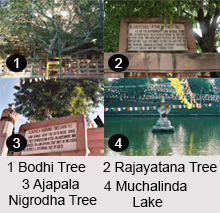
1. Maha Bodhi Tree: The Maha Bodhi tree, the fifth generation plant of the original banyan tree under which Lord Buddha attained enlightenment in 528 BCE after nine years of ascetic life, is one of the most revered sacred places for the Buddhists. The history tells that Sanghamitra, daughter of the Indian emperor, Ashoka, carried a sapling of the original Bodhi tree to Sri Lanka, whose sapling was again brought to Bodh Gaya and planted after the original tree died. Situated behind the Maha Bodhi temple, the Bodhi tree (80 feet high) is more than 116 years old and a centre of pilgrim for the Buddhists all over the world.
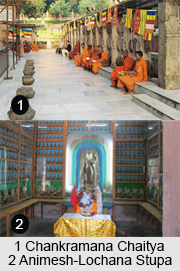
2. Animesh-Lochana Stupa: Animesh Lochana Chaitya Shrine is believed to be the place where the Buddha had spent the 2nd week of his meditation for enlightenment, looking at the Bodhi Tree without batting an eye lid. Located within the Mahabodhi Temple complex, this small and calm temple is often used by visitors for deep meditation. A prayer hall was built upon the spot. Buddhist monks hold early morning sessions to teach about spirituality at this place every day.
3. Chankramana Chaitya: The Chankramana Chaitya or the Jewel walk is a raised platform where the Budha walked up and down in meditation during the 3rd week following enlightenment. Chankramana is the place where there were lotus plants that bloomed at the touch of the feet of Lord Buddha. The path is lined with 19 lotuses and located on the north side of the Mahabodhi Temple.
 4. Ratnagarh Chaitya: Northwest of the temple, this small prayer hall marks the spot where Lord Buddha spent the 4th week in meditation, receiving the vision of his future mission. Ratnagarh is the spot where the five colours that came out of Buddha"s body. These are also commonly visited.
5. Ajapala Nigrodha Tree: Ajapala Nigrodha Tree is one of objects purified during the meditation and enlightenment of Lord Buddha. It is believed to be planted by a shepherd boy for the protection of the Lord, who spent his 5th week of meditation under this tree. The tree lies in the Mahabodhi Temple complex along with the eastern gate. As per the legend, Lord Buddha replied queries of learned Brahmins regarding religion and general conduct during his enlightenment.
6. Muchalinda Lake: The Muchalinda Lake is located to the right of the Mahabodhi Temple. Legend has it that Lord Buddha spent his 6th week of meditation here. He endured a violent storm during this time and is said to have been protected from it by the lake"s serpent king. A statue of the Buddha meditating on a snake coil and protected by the hood of Muchalinda, the Snake King is placed at the center of the lake. Also known as the "Lotus Pond", it is surrounded by lush greenery and has a very calm atmosphere around it.
7. Rajayatana Tree: Buddha spent his 7th week under this tree. It is said he gained his first two disciples here; merchants who had come and offered him his first meal following his seven weeks of meditation. This tree is close to the temple, on its southeast side.
Bodhi Sarovar- It is a pond situated to the west of the Bodhi Temple. It is believed that Buddha took a bath in this pond before going for meditation.