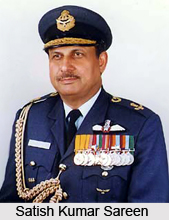
 Air Chief Marshal Satish Kumar Sareen, PVSM AVSM VM ADC CAS was born on 1st March 1939 in Rawalpindi (now in Pakistan). At the time of partition his family shifted to Delhi. In 1954, Sareen joined the Indian Air Force. Sareen did his graduation from Joint Services Wing in Dehradun, which is presently known as National Defence Academy; and also completed his flying training. Satish Kumar Sareen received the Himmat-Singhji trophy for standing first among the fighter stream pilots. After that Satish Kumar Sareen was appointed to No.20 Squadron for flying Vampire Fighters. During Goa operation in 1961, Sareen flew many sorties against Portuguese attack as part of No.4 Squadron. After that he attended the Pilot Attack Instructor (PAI) course and subsequently served as instructor of PAI Program. In 1965 war against Pakistan, Satish Kumar Sareen flew several Ouragans at Guwahati as part of No.29 Scorpios Squadron. After the war he was appointed to the No.27 Flaming Arrows Squadron.
After completing the Defence Services Staff College course in 1970, Satish Kumar Sareen led the Eastern Air Command as the Chief Operations Officer at Tripura. During the 1971 War for his courageous leadership he was awarded the Vayu Sena Medal. After the war Satish Kumar Sareen was appointed as Ops 1 Officer at Eastern Air Command HQ. As Senior Flight Commander, he flew MiG-21 in Adampur, as part of No.1 Squadron. After that he was sent to Al-Kut military airbase in Iraq, as an instructor of Iraqi Air Force. In 1977, Sareen returned to India and joined No.15 Wing as a Chief Operation Officer. After that he commanded the No.24 Squadron flying the MiG-21bis.In 1981 Satish Kumar Sareen was promoted to the rank of Group Captain and led an Air Defence Signals Unit in the Eastern Sector.
Satish Kumar Sareen held many positions such as, Air Defence Commander of WAC and SWAC, Air Attach to UK. After returning back to India, he commanded the Srinagar Air Force Station in the Jammu and Kashmir Valley. In 1990, Sareen was awarded the Ati Visist Seva Medal in 1990 for his good performances and subsequently promoted to the rank of Air Vice Marshal. As AOC-in-C he served South Western Air Command and Western Air Command. In 1995, Satish Kumar Sareen was awarded the Param Visist Seva Medal. After that Satish Kumar Sareen served as Vice Chief of Air Staff responsible for all IAF defensive and offensive and intelligence activities at Air Head Quarter. In December 1995 he assumed the charge of Chief of the Air Staff as Air Chief Marshal.
Air Chief Marshal Satish Kumar Sareen became the Chief of Air Staff of India on 31st December 1995 and retired on 31st December 1998, after completing 41 years of distinguished service to the nation.