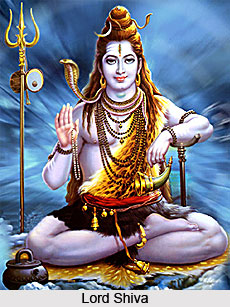
 According to the adhyayas in Agni Purana, the process of Sanskar Diksha means the rite of purifying initiation. In order to perform Sanskar Diksha Lord Shiva situated both in the heart and in the sacrificial fire should be invoked and the union of the two divine manifestations should be propitiated with tarpana performed by uttering the Hrid and the Atma mantra. Five oblations should be cast into the fire for invoking the presence of the god, and the new-born babe of fire should be touched with a flower consecrated with the mantra of weapon. It is believed that the starry effulgent point of consciousness have been mentally located therein. Having located the mantra Hum in the fire by practising the Rechaka form of Kumbhaka, the preceptor should draw it forth by means of the Sanharini mudra and merge the same in his own heart by taking in the breath wine with a Puraka form of Kumbhaka.
The Fire-God narrates that in the smokeless sacrificial fire fully ablaze, the oblation should be offered with the mantra which run as `Om Hum obeisance to the soul`, for the fulfilment of the object for which the Homa ceremony performed in a dull fire emitting smoke, fails to bring in any success. On the other hand it has been mentioned in the Purana that a pleasing fire that rises circling upwards and emits a sweet smell, is to be preferred in performing the Homa ceremony, as well as the fire which touches the ground and sends out sparks in contrary directions. The sacrificial fire should be so lighted as to possess the above characteristics, and the iniquities of the disciple should be destroyed by performing the Homa therein, which is known as the sin-eating Homa; or in the alternative the failings of the disciples might be burnt with the energy of the Mantra sacred to the Lord Shiva.
The Purana in its description of Sanskar Diksha says that hundred oblations by uttering the five principal mantra of the god, and an oblation with the same mantra followed by the term Vousat, should be cast into the fire for depriving the disciple of the attributes of the twice born caste, and for purifying and making him permeated, as it were, with the divine essence of Shiva, and by the way of performing unto him the rites of Garbhadhan, Simantonuyan and Namakaran.
The rite of Garbhadhan signifies the elevation and conversion of the soul of the disciple, by breaking through the bonds of the flesh through his own exertion, towards and into the son ship of the god Rudra; while the rite of Punsavana should be interpreted as a manifestation of the soul-attributes in the initiated, unaffected by the workings of Maya or illusion. The spontaneous dawning of the soul-attributes in the initiated, unaffected by the workings is due to the works of Maya or illusion. The spontaneous dawning of the true knowledge on the mind of the disciple, clouded by the darkness of illusion until such spontaneous lamination should be known as the rite of Simantabandhan in the instance under discussion; while the development and evolving out of the principle of absolute bliss within the disciple should be designated as the act of taking birth in this form of spiritual initiation-the wakening of consciousness in a human child, like the other acts having had its prototype in the wakening of the notion of personal identity with the supreme blissful one, in the soul of the initiated, which has become equal to the Supreme Being in spiritual perfection.
Lord Agni says it is the duty of the preceptor to carry into the lotus of his heart his own soul, manifest as an effulgent spark of fire, by exhibiting the mudra known as the Sanhar mudra; and utter the mantra, principally sacred to the god, by practising the Kumbhaka Yoga, and by bringing about an union of the god Shiva and his own soul in his heart. On the other hand the preceptor, who is well versed in the procedure of sacrificial ceremonies, should carry the principal mantra with the occult stream of his pure consciousness. Then he should duly propitiate Shiva and the fire-god; and cause the disciple to reverentially bow down unto them. The preceptor advises the disciple not to speak ill of the Shastras, to worship Lord Shiva, the preceptor and the Fire-God. The vows should be given unto those who are by self discipline, quite capable of keeping them; while portions only of the vows should be given to women, boys and old men, or to persons who are invalid or addicted to the pleasures of the world, according to their respective capacities. The preceptor should then consecrate in a vessel the alms bowl, waist cloth and other articles essential to the due fulfilment of the vow, with the Sanhita mantras coupled with the term Swaha in the end and preceded by the Ishana or the Hrid mantra.
In conclusion the Fire God narrates that with the help of Sanskar Diksha the inner man of the disciple takes a new spiritual birth and is to be looked upon as a spiritual infant though competent and entitled to perform the Homa ceremony unto the fire god and to receive the knowledge inculcated by the Agamas.