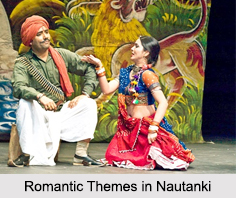
 Romantic Themes in Nautanki are mainly inspired from mythological or historical texts. In Indian culture, the tradition of romance has strong roots in the lore of village society. In North India, performances popularized a number of oral tales, each focusing on a pair of pining lovers. The concept of love in these folk traditions is distinct from the courtly notion of erotic sentiment of Sanskrit Verse and the devotional love of religious poetry. Indigenous and secular, it manifests itself in the dramas of the Nautanki theatre beginning in the middle of the 19th century and continuing to the present.
Concept of Love in Nautanki
The Nautanki dramatic literature may offer evidence of the complex ways in which society responds to the emotional lives of its members. The tension that arises between a pair of lovers and their families is one that is amply depicted in these plays, indicating a strong push and pull between individual interests and the group loyalties focused on units of caste, clan, and community. The love experience frequently seems to oppose and undermine the hierarchical order, yet in other situations the social body incorporates it into a more harmonious whole. Once more the Nautanki play, through its concrete embodiment of character and incident, explores the moral dilemmas around a difficult issue that touches each spectator. In this process, it ultimately affirms the capacity for loving as an indispensable part of being human.
Staging of Romantic Themes in Nautanki
The instantaneous origin of true love is often represented in folk romance by such beginnings as an early meeting, the appearance of the loved one in a dream or sight of the painted picture of the beloved, or even the mention of the beloved"s beauty and fame. The second characteristic is the complete constancy of the lovers and their devotion unto death. Their love for each other never wavers; they are completely loyal. They spend their entire lives in quest of union, abandoning all other concerns. No obstacle is too great, no misfortune too daunting. Third, the love depicted here is a mutual love. Fourth and paramount, the tale narrates of thwarted and obstructed love. Although the lovers finally spend a brief time together, society intercedes time and again to separate them. True union comes only after death, their total dedication to each other having removed them, as it were, from this world into another.
To this romantic ideal the drama counter poses the many obstacles encountered by the lovers as they strive for the fruition of their love.