
Romaka Siddhanta, as the name suggests, is one such Siddhanta which came to India after it was discovered by the astronomers of Rome. The Romaka Siddhanta introduces a luni- solar cycle which has 2850 years with 1050 intercalary months and 16547 omitted lunar days. This divides the calculation within two sections of synodic months as well as civil days 3which are further calculated as in this period there shall be a total number of 2850 x 12+ 1050 synodic months which is equal to 35, 250 synodic months. The second section shall calculate the number of civil days which is calculated as 35,250 x 30 - 16,547 which is equal to 1040,953 civil days. This calculation is further compared with the calculations of Hippercus and Ptolemy who estimated the anomalistic months to be equal to 3031 /110 which is equal to 27.554 days which reduces the moon`s motion of revolution as 13 3` 53" 58111 55IV 51V 45V1 which is closer to the calculation of Ptolemy`s assessment which is represented as 13 3` 53" 56`" 291V 38V 38VI in sexagesimal units.
Romaka siddhanta has been a vital Siddhanta to calculate the mean of the Sun and the moon which differed with small equation with that of Ptolemy. Romaka Siddhanta has been more successful in calculating the equation of the Sun and the moon where the difference between the longitude of the mean sun and the longitude of the apogee is stated as 75 degree which is different from that of Ptolemy who calculated it as 65 degree30 inches. The following equation of the centre of the sun and the moon comes after every 15 degrees. Romaka Siddhanta has been one of the most vital source of Indian Astronomy which has been able to distinctively mark the latitudes as well as longitudes of the Son as we`ll as the moon and mark out the other details regarding the solar system.
Romaka Siddhanta which is the second Siddhanta of Astronomical Siddhantas in Ancient Indian Astronomy contains some doubts regarding its author where it has sometimes been associated with Srisena which some recognise it as the original work Brahmagupta. With a careful study it has been revealed as the original work has been much influenced by the innovations of Varahamihira- one of prominent Hindu Astronomer which has been the only astronomical work which is based on tropical studies and which has been considered as one of the Five Astronomical Cannons of Fifth century.
The Romaka Siddhanta is thus the second most important astronomical methodology which is based on ancient Indian mathametics. Influenced with the Roman mathematics this has proved to be more accurate in locating the position of the Sun and the Moon with their longitudes and latitudes.
Romaka Siddhanta
Romaka Siddhanta had been mainly derived from the Roman Astronomy as one of the important Siddhantas of ancient Indian Astronomy. Romaka Siddhanta mainly concerns Yuga, ahargana, intercalation of the lunar months which highlight the elements of Astronomy and the tropical year.
Recently updated articles in Astrology in India
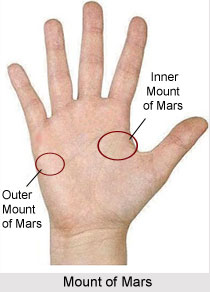
Mount of Mars
In palmistry, the Mount of Mars represents courage, determination, physical strength, resilience, and the ability to face challenges. Its development...
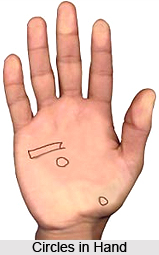
Circles in Hand
In palmistry, circle signs on the hand are considered rare markings with varying interpretations depending on their location. They may indicate fortun...

Lines of Brothers and Sisters
Lines of Brothers and Sisters in Palmistry are the subsidiary or the assisting lines found on the palm of an individual. Deep and wide lines indicate...

Lines of Friends
Lines of Friends are the subsidiary lines found on the palm. Perpendicular lines on the finger of Saturn indicate artist friends and the horizontal li...

Life Line in Palmistry
Life Line in Palmistry is believed to reveal an individual’s vitality, physical energy, and overall approach to life. Curving around the base of the t...
Related articles in Astrology in India
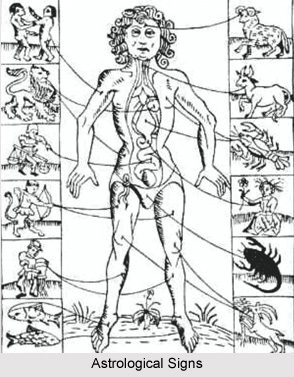
Astrology in Epic Period
Astrology in Epic Period include 400 B.C. to 400 A. D. The details about the Astrology in Epic period can be derived from the ancient texts of Mahabha...
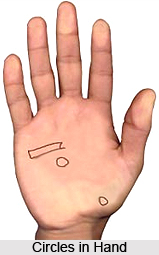
Circles in Hand
In palmistry, circle signs on the hand are considered rare markings with varying interpretations depending on their location. They may indicate fortun...

Stars in Hand
Stars in Hand hold special significance in the study of human nature as per palmistry. Palmistry states that the study of stars in hand varies as per...

Cross Signs - Palmistry
Cross Signs are found on the palm of an individual. Palmists considered the crosses, an important part while making a methodical study of the palm of...