 Representative forms of paintings are spontaneously made and are based on memory. The difference between symbolic representation and realism may occur in one of the two ways. The artist may make an effort to produce the form of the object that has to be represented in forceful outline and lower all considerations of detail. Artist may even discard all details and cover the form with more or less fanciful decoration without losing the realistic effect and the distribution of surfaces and of masses. He may make an effort to give a realistic representation of details with little regard to the form as a whole.
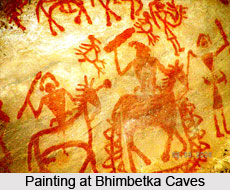
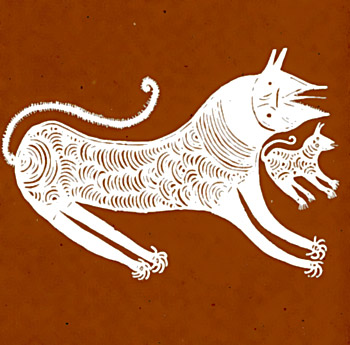
From the representational point of view few of the animal paintings are amazing. An elephant drawn with charcoal on a wall in, a bull painted in red ochre on the wall and a pea-hen in ultramarine on the wall can be sited as examples. These are drawn singly on the wall in different colours and by different artists. They have some common characteristics. Forceful outline of the body has been drawn first; legs, tail and head were added and the body has been covered partly with colourful lines and dots. In animals as well as the birds, the legs are filled with colour that shows the weight. Horns, ears, hump; tail, trunk and neck are filled with colours in some cases. The body of an elephant is shown without colour to depict more volume. An elephant has been depicted with the details of eyes, ears, tusk and trunk in a representational manner. The body of the elephant is balanced with the weight on the back and four legs.
There are a number of examples in which the Indian tribals have painted what they saw and what they could see yet knew it to be there such as the skeleton, lungs, bones. Although there is some exaggeration in the drawing of pea-hen it has representational quality. Apart from animal forms tribals have replicated the nature too. Depiction of nature is done through their memory. Nature has been drawn in a representational way. For example a plant in a flower pot is depicted on the front wall of a house between a door and a window. The drawing of flower with three petals is a universal way of depicting flower in tribal art. The two leaves are in a rhythm, and the outline of flower pot at the lower portion is balancing the heavy flowers in the upper portion.