
Rationality in Classical India philosophy is considered as a vital concept. It would be wrong to state that this concept is marginal or absent from the wide array of the traditions of Indian classical philosophy. The concept of cultural notion is stated to be rational. It is embedded, articulated and manifested in culturally specific ways. The role of a concept of rationality within a culture is a highly stratified one, its criteria and principles operating first of all in the life-world of the community concerned, then in the higher-order decisions of the scientists, law-givers and artists, finally in the theoretical discourse of the philosophers. New paradigms of what it is to act and believe rationally come into being as old concepts are criticised, revised and rejected. Forms of rationality are inter-culturally available even if they are not always inter-culturally observed.
In analysing the rationality in Indian classical philosophical literature, scholars adopt an approach that is neither comparative nor historical. According to them, Philosophy is not history, even if both disciplines are relevant to the study of classical India. History studies ideas in their context - it situates an author in an intellectual milieu. Philosophy, on the other hand, tries to free an idea from its context - it separates the idea from what is narrow-minded and contingent in its formulation. The historian of Indian philosophy is sensitive to the character of a philosophical thesis, though does not indulge in wanton borrowing from other philosophical literatures. Like for instance, Kautilya`s conception of rationality is goal-oriented and instrumental. The interest is in the reasoned way to achieve some goal, whatever that goal may be.
Reason is the instrument of all philosophers, but conceptions of the nature and function of reason vary along with varying ideas about the work for which reason is properly employed. Scholars of philosophical concept reveal that a diachronic study of conceptions about what constitutes an adequate resolution to a moral dilemma illuminates both shifts in the notion of reason itself, and also the mechanics of internal criticism, theory revision and paradigm rejection. Reason can be used or abused. A cautionary episode in the Mahabharata illustrates the point. Bhishma tells Yudhisthir that there is nothing more worth having than wisdom. Wisdom, he declares, is the greatest good, the refuge of all living things, the ultimate acquisition, and is considered by the virtuous to be heaven itself.
Rationality in Classical Indian Philosophy
Rationality in Classical Indian Philosophy is defined as instrumental. In major classical Indian philosophies such as Nyaya, Vedanta, and Samkhya, rationality is studied in theoretical manner and used practically used so that the thinking agent can lose the individual ego eventually.
Recently updated articles in Indian Philosophy
Samkhya Philosophy
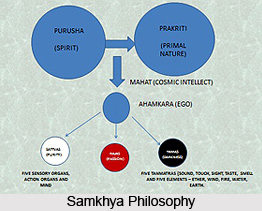
Samkhya philosophy is one of India’s oldest intellectual traditions, explaining reality through the interplay of Puruṣha (pure consciousness) and Prak...

Maya, Prakriti in Hinduism
Maya or illusion is a very potent instrument of the Divine Prakriti, the Primal nature. In Hinduism one must be able to come out of Maya in order to a...

Samadhi in Hinduism
Samadhi is the result of meditation or that state of mind when there is an absence of all idea of individuality.

Samadhi in Buddhism
According to Buddhism, oen can only achieve samadhi through strict meditation and right concentration.

Abdul Rehman Jilani Dehlvi
Syed Abdul Rehman Jilani Dehlvi was a renowned Sufi saint of the Qadri Order in India.
Related articles in Indian Philosophy

Ajivika Philosophy
Ajivika philosophy is different from the mainstream religion

Indian Philosophy In The Vedic Period
Indian Philosophy in the Vedic Period was primarily based on the concepts of nature worship.
Achintya Bheda Abheda Philosophy
Achintya-Bheda-Abheda is a School of Vedanta that represents the philosophy of unimaginable one-ness and difference in relation to the power creation...
Samkhya Philosophy
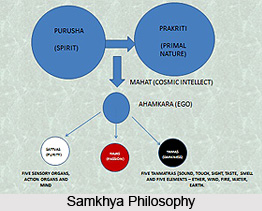
Samkhya philosophy is one of India’s oldest intellectual traditions, explaining reality through the interplay of Puruṣha (pure consciousness) and Prak...
Charvaka Philosophy
The Charvaka Philosophy believes that only those things that can be perceived is the ultimate reality.