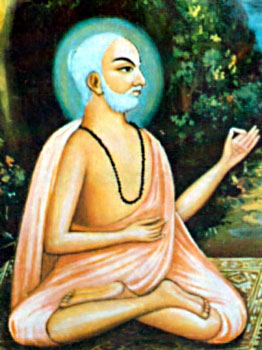
 Ramcharanji (1719-1798) was born in a Bijavargi Vaisya family in village Soda near Malpura in Jaipur. He took initiation from Kriparam of Dantada, the disciple of Santdasji Gudad Panthi. Ramcharanji gave up the `Gudad` apparel in 1758 and in 1760 came to Bhilwara where he had founded the Ram Snehi Sampradaya in the same year. The Sampradaya flourished at Shahpura, which is the main seat of this tradition. He had twelve main disciples, of whom Nawal Ram, Ramjan, Bhagwandas, Rampratap were great poets. Some of the disciples established Ramdwaras at various places, such as Bikaner, Udaipur, Rota and Jodhpur. The traditions of many of them still continue.
Ramcharanji`s Vani was first collected by Nawal Ramji and the remaining and newly composed poems by Ramjanji. Quantitatively the Vani is equal to over thirty six thousand anustup slokas and is equally important qualitatively. The Vani later published under the name Anbhai Vani, is on gyan, vairagya, yog, bhakti, good conduct, precepts, his experiences and other topics. His emphasis is on Ram smaran and Bhakti. The poems are the spontaneous outpouring of his heart and are very effective. They are simple, natural and lucid. The language is popular Rajasthani with a slight mixture of Braj and Khadi Boll here and there. The Vani of Ramcharanji is of encyclopaedic nature with regard to religious poetry and sadhana.
Ramjanji Laddha had initiated in 1767, was the second Acharya to occupy the Gaddi in 1798. His Vani in padas and other popular metres such as doha, jhulana, chappay, kundaliya etc. is quite large. He had also composed 19 granths. His poems were about the Nirgun bhakti the main note being Ram smaran and bhakti. The diction is clear and captivating. Basically the language is easy Rajasthani.
Bhagwandas Karwa of Pipad took initiation in 1766 at Bhilwara from. Ramcharanji. He travelled far and wide and propagated the Ram Bhakti. He holds a very high and respected place in the Sampradaya. He had twenty one prominent disciples. The traditions of some of them still continue. His `Vani` equal to about 4000 slokas, is expressed through popular metres (doha, caupai, arril, kavitt, kundaliya rekhta etc.). It depicts in easy Rajasthani various aspects of life particularly spiritual life, with the preaching of Ram smaran and bhakti.
Nawal Ram Mantri of Bhilwara, one of the three prominent householder-disciples of Ramcaranji, took initiation with his family some time after 1760. It was he who first collected the Vani of his guru. He died in 1785 at Bhilwara. The collection of his own poems is known as Nawal Sagar. The poems are about Ram bhakti, precepts and preaching, his experiences and dedication. The language which had been used is popular lucid Rajasthani. Sarvang Sar, is another important work of Nawal Ram Mantri, is a compilation of poems of about 85 poets, irrespective of their caste, faith, ideology or sadhana.
Rampratap was also a member of the Ram Snehi Sampradaya. In his poems the language is simple Rajasthani mixed with a little Braj. The note of vairagya and Ram bhakti is prominent in his poems.
Dulhai Ram, who was made Acharya in 1810, composed Vaal known to equal fourteen thousand slokas The Vani consists of sakhi, chandrayan, jhulana kavitt savaiya kundaliya etc. on various themes named angas, and padas. He has dealt with traditional topics in a simple wav with a running note of Ram bhakti.
Murali Ram was much influenced by Nawal Ram He took initiation in 1768 from Ramcaranji and had composed a large number of stray verses and had written nine small books on miscellaneous topics concerning the Nirgun bhakti. Intensity of feeling and lucidity of expression are the main qualities of his works.
The poems of Jagannath Soni depicted the characteristics behaviour and deeds of various types of women. The poems are popular in Rajasthani. Sarupa Bai composed devotional padas which reveal the purity of her heart. The language is easy Rajasthani. Besides him, Sangramdas was a disciple of Murali Ramji. His kundaliyas are on bhakti, niti, precepts, in a straightforward and artless way, using popular similes and sayings. The language is a refined form of popular Rajasthani.
Mukt Ram, a disciple of Bhagwandas, made his stay at Bikaner after extensive wanderings. He was known for his sadhana and bhakti. His Vani deals with gyan, bhakti, precepts and allied topics. The expression is forceful and effective and in easy Rajasthani. Some other notable poets of Ram Snehi tradition were Devadas, Suratram, Ram Vallabh, Pohkardas and Manorath Ram.