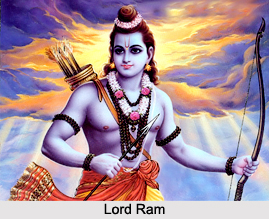
 The Hindu legends state that Raghu was the king of the Ikshvaku dynasty and the sovereign of Ayodhya. He was the great grandfather of Lord Rama. Raghu was the son of Dilipa who was a very virtuous king.
The word Raghu means light moving or moving light. Raghu had the ability to drive his chariot very fast. His achievements were celebrated and later his dynasty came to be known as the Raghuvamsha or the Raghukula Dynasty.
The history of Raghu`s dynasty is described by Kalidasa in his text Raghuvamsha. Raghu was the great grandfather of Lord Rama. The soldier Raghu leads a military expedition to Transoxiana. He defeats and conquers local peoples along the way and he reaches the Vankshu. In this place, Raghu`s army combats with the Hephthalites, or White Huns, whom the Indians called Hunas and Mlecchas or barbarians. The Hephthalites were defeated.
Raghu was also renowned for his donations and assistance. It is said that no one returns from his palace empty-handed. Raghu and his army, who were resting near Oxus encountered the Kambojas. The Kambojas surrendered to Raghu and endowed him gifts and treasures. The Kambojas resided in the neighbouring areas of the Pamirs. In the Raghuvamsha, Kalidasa describes the abundance of walnut trees in the Oxus region.
Raghu`s father Dilipa was a very pious king, and performed more than hundred Yajnas or sacrificial rituals. Indra, king of the Gods prevented Dilipa from equaling his record. Indra created many obstacles in the path of the successful completion of the hundredth sacrifice. Raghu was able to succeed over the forces of Indra himself, and the sacrifice was completed successfully.
Raghu was the great-grandfather of Lord Rama. Raghu was a heroic personality and was known for his gallantry. The Raghuvamsha relates his wonderful achievements and varied conquests, and concludes with the following legend. A Brahman named Koutsya, a disciple of the great Rishi Varatanta, having completed his course of studies, and asked his guru what acknowledgement or Gurudakshina he should make to show his gratitude. Rishi Varatanta was satisfied with the service of his follower. On return the Guru asked for fourteen crores of rupees. For this enormous sum Koutsya applied to Maharaja Raghu. Maharaja Raghu had emptied his treasury by the performance of the sacrifice or Yajna, determined to conquer Kubera as the state was the god of riches. After conquering Kubera, the wealth was then given to the sage Varatanta. In return the sage blessed the king with the promise of a good son, and in due course the illustrious Aja was born.