 "Neeranjanavidhau variphaladigrahanepi cha
sandhyayamardhyadane cha mantrapushpe cha yujyate. " -- Viniyoga Shloka
"Neeranjanavidhau variphaladigrahanepi cha
sandhyayamardhyadane cha mantrapushpe cha yujyate. " -- Viniyoga Shloka
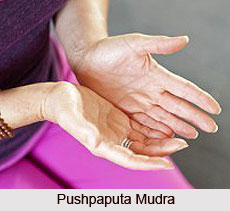
Pushpaputa Mudra means handful of flowers offered to God in reverence. Pushpa means flowers and this Mudra is about openness and acceptance. The gesture itself resembles that emotion. According to the Viniyoga shloka, Pushpaputa is used to indicate waving of lights to Gods. In order to show tribute to Gods, acceptance of water or any fruit is done through Pushpaputa. An act of giving is also indicated by using this Hasta or hand. It is believed that whatever is bad cannot affect us if we strive for a pure heart. This is a law of the cosmos. We can only attract what also has an equivalent within us. Pushpaputa Mudra assists for mental-emotional hygiene. Negative feelings arising in the mind can be transformed by the practise of Pushpaputa Mudra.
Pushpaputa Mudra is done when both the palms are joined together at the little finger and slightly hollow at the centre of the Palms. The inner palm is faced up. Place the hands like empty bowls on the thighs. Let the fingers rest next to each other in a relaxed way, with the thumbs against the outer edge of the index finger. It is said that by Pushpaputa Mudra one can enrich the world, and only with an open mind and open soul one can receive what cosmic consciousness gives us.
Benefit of Pushpaputa Mudra
•Raises feeling of compassion
•Gives rise to generosity
•Initiates the feeling of giving