
The Madhyamika school of Nagarjuna interprets Pratitya Samutpada in regard to relativity of all conditioned things. Events occur sequentially however there are no causal relations or forces over and above what happens. Whatever is considered as cause and effect cannot be joined by a real relation as cause and effect occur at different times. Dependent origination rejects the view that there are types of individual entities with inborn and specific causal powers: However it also denies that things happen randomly, which would make nonsense of moral responsibility.
Anything recognised as a unit has come into existence depending on several conditions. Buddhists though deny that there are any singular persisting entities that produce others. Reality consists of cooperating moments in fields of energies that are held together by a charm. Individual people are streams of physical and mental factors. The theory of conditioned origination is an attempt to account for the experience of organisation and repeatability. It is applicable to the physical and psychological realms and guarantees that actions will produce consequences apt to their moral quality.
It is a constructed principle that governs the formations and interactions of the basic mental and physical elements of existence. Buddhists deny that there is any persisting being such as the soul that would link thoughts and actions with their results in this and future lives and which would experience the consequences of ethically significant actions. There is no God who could do moral policing. Mutually dependent origination is expressed sometimes as a twelve fold chain: basic ignorance, karmic dispositions, which condition mental events, which condition the psycho-physical body, which conditions the sensory receptors, which condition sense-object interactions, which condition feelings, which condition `thirst` or desire, which conditions craving, which conditions repeated existences, which condition births, which condition old age and death and all woes.
This article is a stub. You can enrich by adding more information to it. Send your Write Up to content@indianetzone.com
Pratitya Samutpada
Pratitya Samutpada means interdependent origination. It is a Buddhist theory that sees casualty as one thing always following another.
Recently updated articles in Indian Philosophy
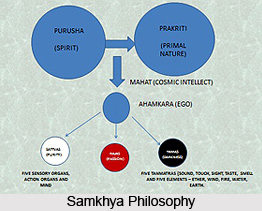
Samkhya Philosophy
Samkhya philosophy is one of India’s oldest intellectual traditions, explaining reality through the interplay of Puruṣha (pure consciousness) and Prak...
Maya, Prakriti in Hinduism
Maya or illusion is a very potent instrument of the Divine Prakriti, the Primal nature. In Hinduism one must be able to come out of Maya in order to a...

Samadhi in Hinduism
Samadhi is the result of meditation or that state of mind when there is an absence of all idea of individuality.
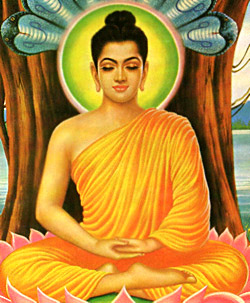
Samadhi in Buddhism
According to Buddhism, oen can only achieve samadhi through strict meditation and right concentration.

Abdul Rehman Jilani Dehlvi
Syed Abdul Rehman Jilani Dehlvi was a renowned Sufi saint of the Qadri Order in India.
Related articles in Indian Philosophy

Ajivika Philosophy
Ajivika philosophy is different from the mainstream religion

Indian Philosophy In The Vedic Period
Indian Philosophy in the Vedic Period was primarily based on the concepts of nature worship.
Achintya Bheda Abheda Philosophy
Achintya-Bheda-Abheda is a School of Vedanta that represents the philosophy of unimaginable one-ness and difference in relation to the power creation...
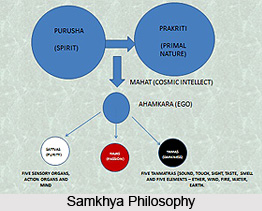
Samkhya Philosophy
Samkhya philosophy is one of India’s oldest intellectual traditions, explaining reality through the interplay of Puruṣha (pure consciousness) and Prak...
Charvaka Philosophy
The Charvaka Philosophy believes that only those things that can be perceived is the ultimate reality.